
By Ashleigh Stewart and Charles Rusnell
Global News
Published August 24, 2026
10 min read

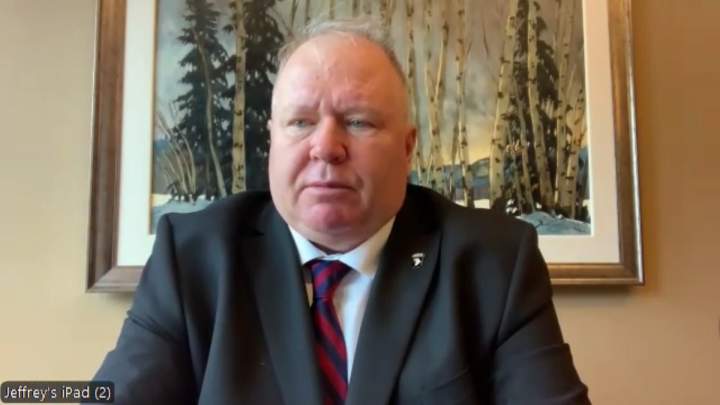
For years, Alberta separatist leader Jeffrey Rath controlled two First Nations’ settlement trusts and drained millions from them, allegedly without consent.
Now court orders, asset freezes and an investigative receiver are closing in, forcing him to account for tens of millions of dollars in disputed trust money.
Rath — who denies any wrongdoing — has emerged as the separatist movement’s leading spokesman and legal architect, co-founding the Alberta Prosperity Project and acting as its legal counsel. He has also spent decades representing First Nations in treaty claims.
The Tallcree and Sturgeon Lake Cree Nations have launched overlapping and escalating legal actions. Both allege that after they sued Rath over his contingency charges, his firm retroactively charged millions of dollars in trust fees without informing them and withheld financial records that would have revealed the withdrawals.
In 2017, Rath’s professional corporation, RathPC, collected $11.5 million under a contingency fee agreement with Tallcree after the band settled a $57.6-million claim with the federal government. A judge later ruled the payment unreasonable and ordered the firm to repay $8.5 million. The following year, Sturgeon Lake paid RathPC $28.6 million under another contingency fee agreement, which a judge later declared invalid.
As part of those settlements, Rath’s professional corporation also became the trustee of funds to be distributed to beneficiaries under 18. Those trusts are now at the centre of Rath’s legal difficulties.
To determine where the millions of dollars of disputed First Nations money may have gone, Global News reviewed thousands of pages of court documents and financial records, conducted corporate, personal property and land title searches, and interviewed forensic accounting and mortgage law experts.
The investigation uncovered a complicated set of financial arrangements: a security registration, or lien, over all of Rath’s current and future assets by a Delaware company; a $10-million collateral mortgage registered in his wife’s name on property they jointly owned; and the purchase and sale of millions of dollars worth of precious metals.
Rath declined several interview requests from Global News, stating, “I’m responding through court proceedings at an appropriate time. I will not comment on personal financial matters that are not properly part of the public record or any other matter that is currently before the courts.”
While judges have ruled there was strong prima facie, or initial, evidence of breach of fiduciary trust by Rath in the Tallcree case, none of the allegations in either of the First Nations’ civil actions have been conclusively proven in court.
Of the two First Nations, Tallcree was the first to challenge Rath’s stewardship of its trust and later shared evidence with Sturgeon Lake.
Tallcree challenged millions’ worth of Rath’s legal and administrative fees, but its central allegation is that Rath misappropriated the $8.5-million contingency fee refund meant for the beneficiaries of its trust.
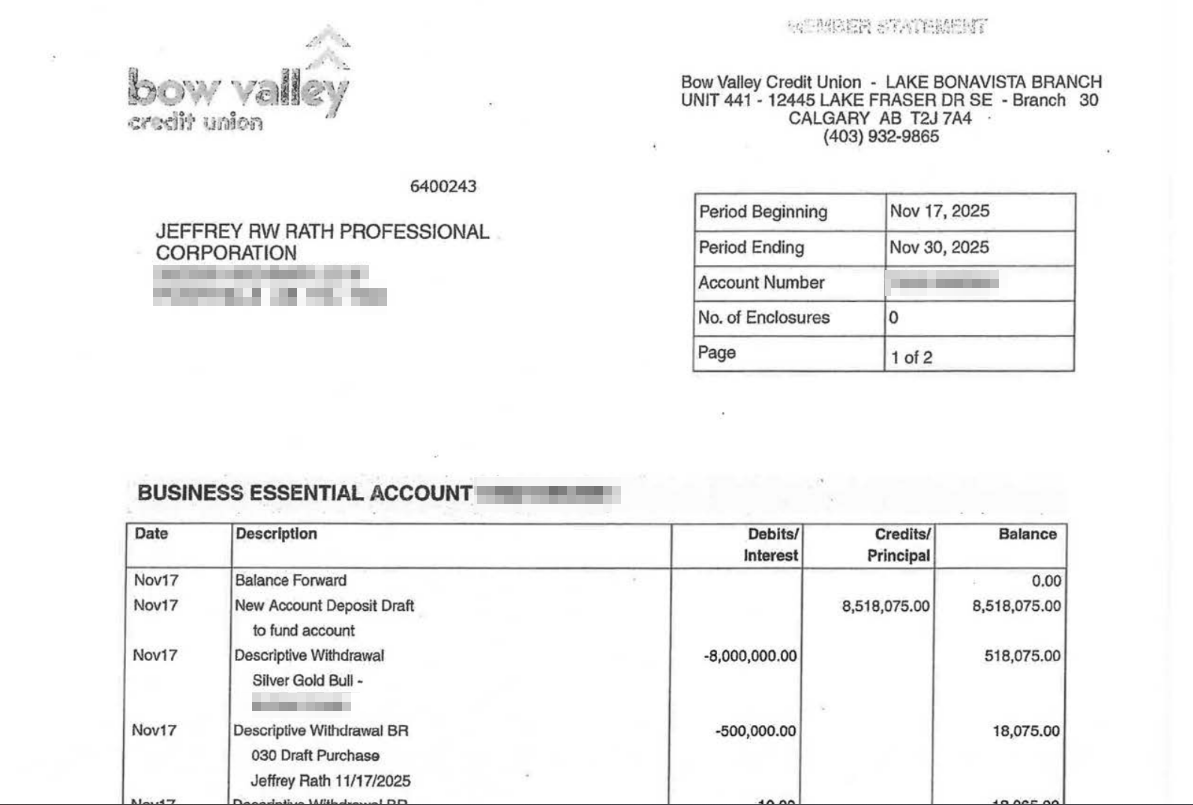
On Nov. 17, 2025, 12 days after a court order required Rath to refund the Tallcree trust, court-filed banking records show Rath instead deposited it into a Bow Valley Credit Union account for his professional corporation, opened that same day.
Rath immediately bought $8 million of bullion from a Calgary company called Silver Gold Bull Inc. and purchased a $500,000 bank draft bearing his name.
Court records show that Rath, in an email, had suggested he was entitled to the trust money, despite earlier King’s Bench and Court of Appeal decisions.
“I find that the response of Mr. Rath was a flimsy and brazen response to the request about where the money went,” Court of King’s Bench Justice Michael Marion wrote in a July 10 ruling.
“It is his position, it seems, that he is entitled to it, notwithstanding the extensive litigation about that issue, which did not go in his favour.”
Last month, Tallcree obtained an interim Mareva, or freezing, order to cover its disputed assets. The move prevents Rath, his professional corporation, and his law firm, Rath & Company, from moving or dissipating assets before the cases in question are decided. Rath did not oppose the interim order pending a future hearing on the order’s merit.
The court also appointed an investigative receiver to trace the disputed funds.
In a separate hearing last week, another judge granted Sturgeon Lake’s application for an interim freezing order on Rath’s assets while the band seeks to have him removed as trustee.
“The large withdrawals made from the trust by Rath and/or RathPC have significantly cannibalized the assets of the trust,” Sturgeon Lake Chief Sheldon Sunshine said in an affidavit.
Bow Valley’s board includes several members associated with causes Rath has publicly championed, including separatism, anti-vaccine activism and support for the so-called “Freedom Convoy” in Ottawa.
The credit union’s president has publicly stated that it markets itself to Albertans who mistrust Canada’s federally regulated banks. Bow Valley keeps gold and silver in off-site vaults as a hedge against inflation, government mismanagement and a potential failure of the entire fiscal system.
In January 2024, Alberta’s credit union regulator told Bow Valley to stop undermining confidence in the federal banking system and warned that its precious metal purchases are not covered by provincial deposit guarantee legislation.
“I have not seen any lawyers that have precious metals on behalf of their client,” said Jerome Malysh, an anti-money laundering expert and former RCMP financial crimes investigator.
“What is the point of it here? You are there to hold trust funds and to preserve the asset. You are not there as an investment advisor to make money for your client. You are there to preserve your asset … so that is curious.”
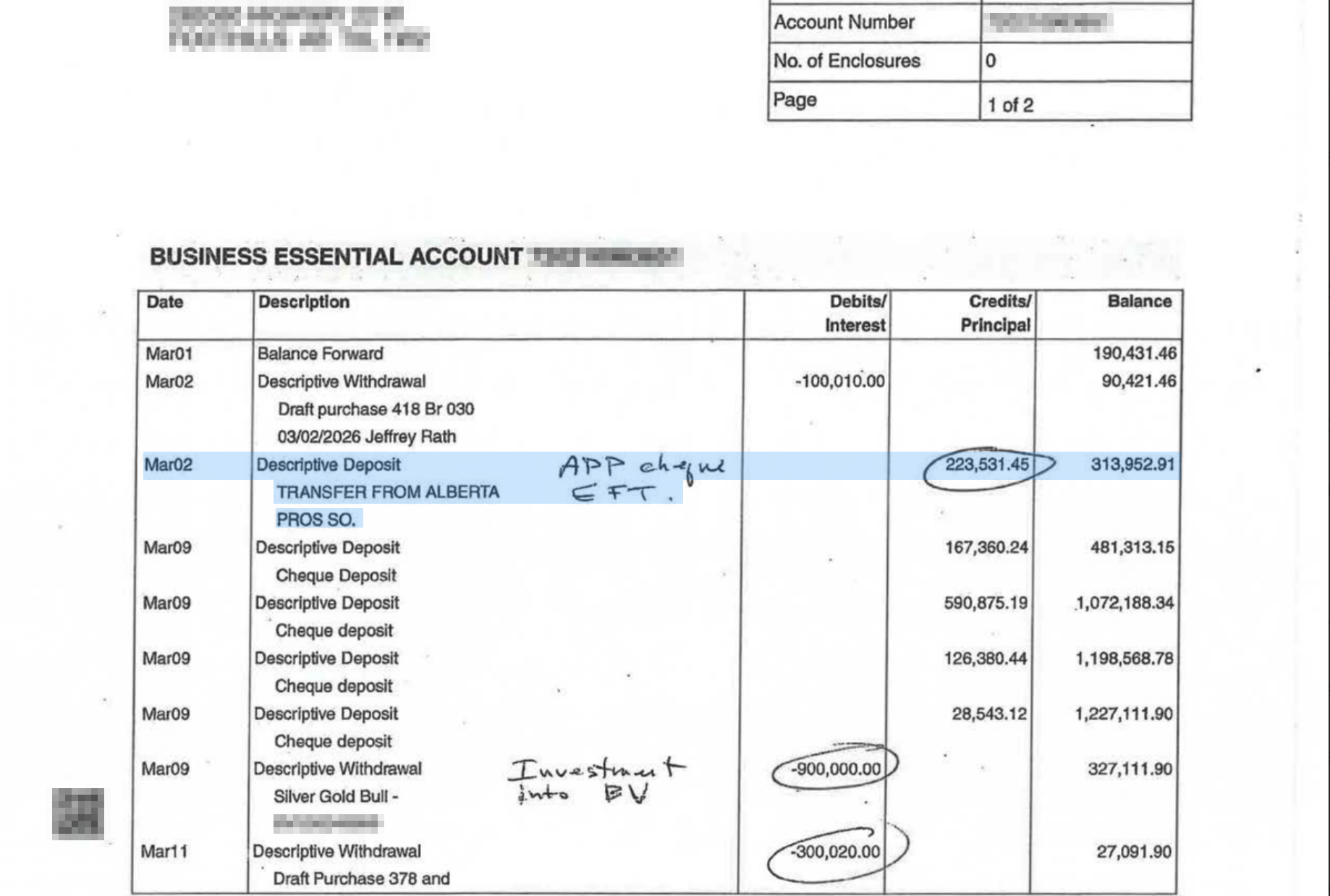
Rath’s financial records show that after the initial purchase of $8 million in November 2025, he made two further bullion transactions totalling $3.4 million in February and March 2026.
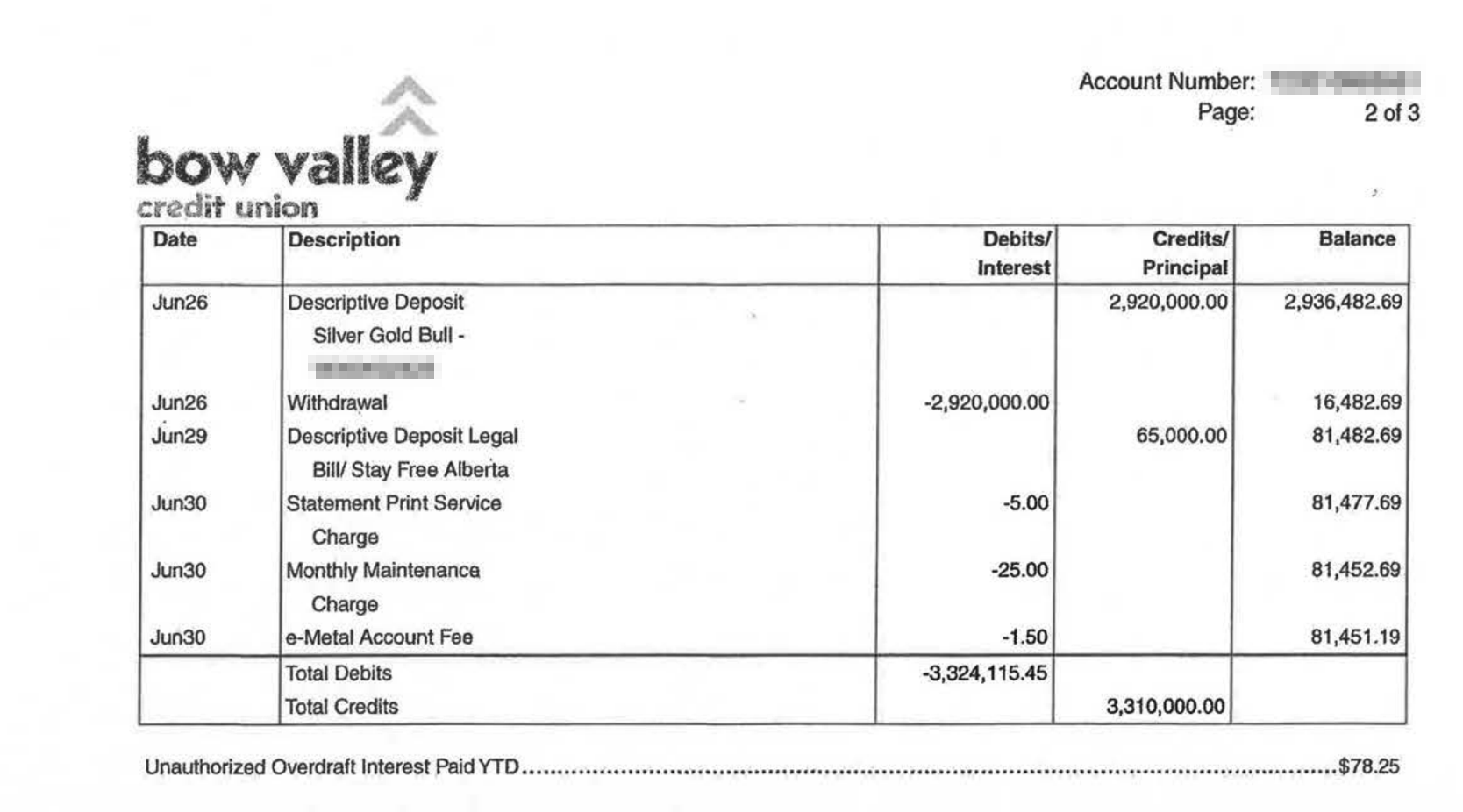
In the first half of the same year, his account recorded 11 Silver Gold Bull deposits worth $4.8 million. Many of those deposits were followed by same-day drafts or withdrawals — including a $2.9-million deposit and withdrawal on the same day.
Banking records also show millions in transfers between his professional accounts and a numbered company he controlled.
“There are various transactions with that same precious metals provider, as Mr. Rath liquidates his position and deposits amounts into the account, and money appears to flow in and out in a way that is, frankly, difficult to trace,” Tallcree counsel Jessica Kras told an Aug. 5 court hearing.
“And intermingled with those transactions … there are several cheques and wire transfers made out of this account.”
Malysh said there should be a “bona fide economic purpose” for all interrelated or related-party transactions.
Bow Valley banking records reviewed by Global News show that funds also shifted from Alberta separatist-linked organizations to Rath’s credit union account.
In March 2026, Rath received $223,531.45 from the “Alberta Pros So,” a name that resembles the Alberta Prosperity Society. The society is the registered non-profit arm of the Alberta Prosperity Project (or APP), which Rath co-founded.
Another $65,000 marked “Legal Bill/Stay Free Alberta” was transferred to Rath’s account in June. Rath is Stay Free Alberta’s lawyer. Stay Free Alberta sponsored a petition to trigger a referendum on Alberta’s secession from Canada.
APP and Stay Free Alberta did not respond to questions from Global News.
Citing privacy rules, Bow Valley CEO Brett Oland declined to answer questions about Rath’s account and bullion purchases, but said the credit union meets the highest standards for tracking and reporting transactions.
Oland stated that Canada’s banking system is at risk of failing because the dollar is not backed by gold or silver.
“The fiat currency system and the value of the Canadian dollar are collapsing before our eyes.”
Silver Gold Bull managing partner Nikolas Morianos also declined to answer specific questions, citing legal and privacy obligations, but said the company “complies with applicable Canadian laws and regulatory requirements governing its business” and has “cooperated with lawful requests” related to the Rath case.
Global News discovered two significant claims against Rath’s personal and professional assets.
In June 2020, a company called Vance SPV LLC registered a broad lien in Alberta against all of Rath’s and his firm’s present and future assets.
Global traced Vance’s origins to Delaware, where it was incorporated exactly one month earlier.
The state is a popular place to start a company because it offers privacy. It does not require businesses to disclose their directors, shareholders and executives. Anyone can launch a company in Delaware simply by clicking a button that says “Start a Delaware company now!” on a website.
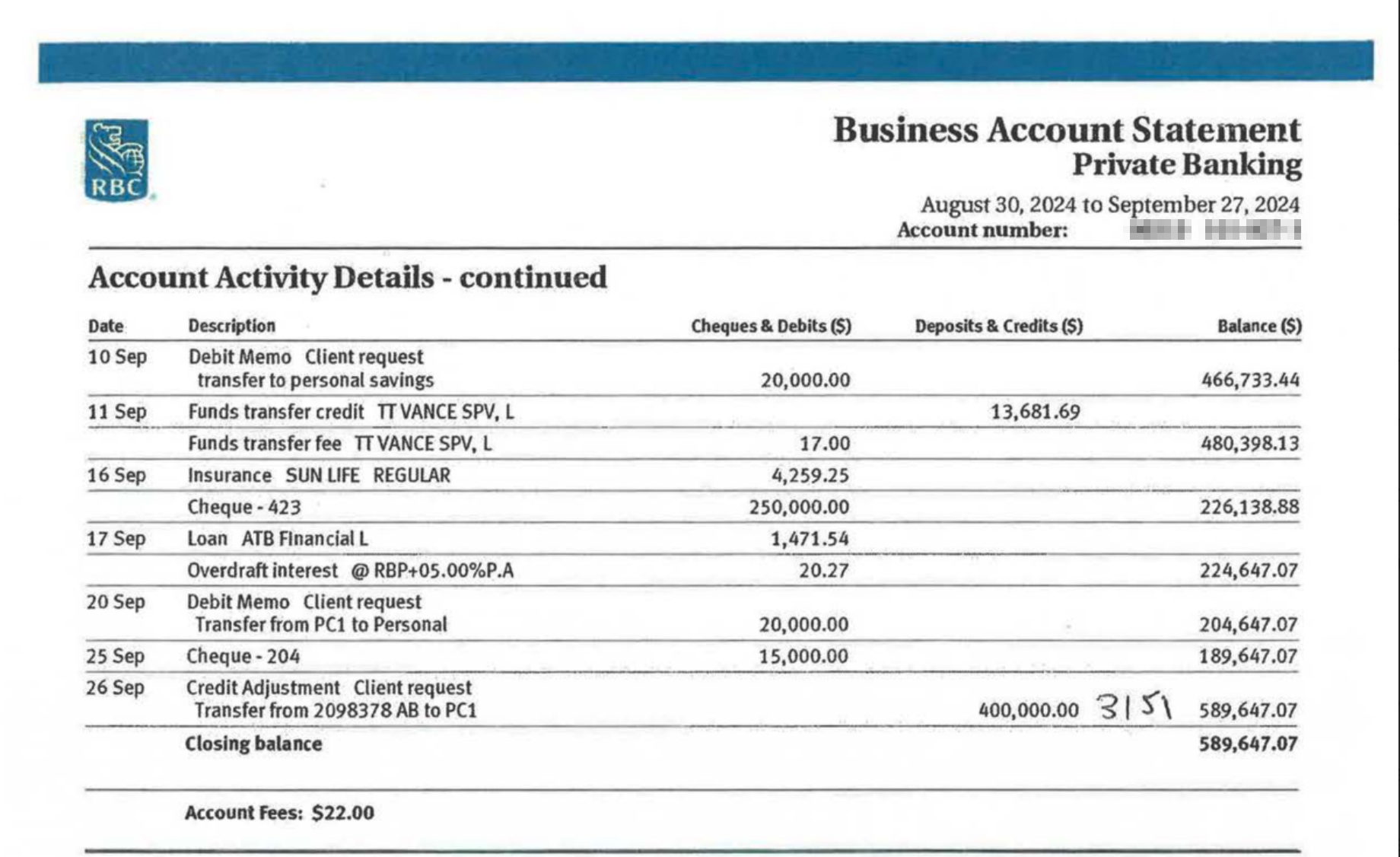
Financial records show that in September 2024, Vance paid Rath PC $13,682.
Malysh said there are legitimate reasons a secured party might transfer money to a debtor, such as an additional advance or another transaction. He added that a security agreement is a consensual arrangement, which can be used to secure financing now or in the future.
Global was unable to determine who owned Vance or the purpose of the security agreement.
In November 2021, Rath and his wife registered a $10 million collateral mortgage in favour of his wife over their property near Priddis, about half an hour’s drive southwest of Calgary. A collateral mortgage allows a property to be used as security for a loan.
Global News asked two mortgage law experts to review the mortgage. Each explained that a collateral mortgage can serve a legitimate purpose, such as providing a line of credit. However, it could also be used to thwart creditors by granting a mortgage to a spouse when there is no legitimate debt on the property, putting it out of creditors’ reach.
Rath did not respond to questions about Vance or the collateral mortgage.
The timing of the June 2020 Vance lien and November 2021 mortgage registrations coincides with the period when both Nations say Rath’s financial reporting became less transparent. Tallcree alleges Rath stopped providing trust statements in 2020, and Sturgeon Lake says its last full audit covered 2021.
After a court forced the disclosure of up-to-date trust statements, Tallcree learned that Rath had taken more than $6 million from their trust, including more than $4 million in retroactive administration fees dating to 2017.
Sturgeon Lake alleges that RathPC paid itself $11.46 million in retroactive administrative fees. He is alleged to have taken nearly $575,000 from the trust to pay his own legal fees in the dispute over his contingency fee charges. Subsequent financial statements revealed further charges, bringing the total challenged withdrawals to about $12.8 million.
Rath argues that the trust agreement entitled his firm to charge the fees. In the Sturgeon Lake case, Rath told auditors he had reviewed administrative fees charged by similar trusts and his charges were “well within the range” of those fees.
Rath previously told Global News that the court action’s “only relevant issue” is that Sturgeon Lake’s trust permitted settlement and administration fees. That “was done and fully documented, disclosed, reported on and reviewed by the auditors,” he said.
In the face of the vast legal onslaught, Rath has signalled his intent to appeal almost every major ruling against him.
The lawyer is seeking to overturn his removal as Tallcree trustee and the temporary freeze on his assets, arguing that the expedited hearings were unfair and relied on unsupported or prejudicial material.
Despite the Law Society of Alberta hiring a lawyer to monitor the Tallcree and Sturgeon cases for a possible future investigation, he ignored its code of conduct — which advises lawyers against “intemperate” criticism of judges — and used a July 16 post on X to attack, by name, a judge who had ruled against him, while defiantly proclaiming the righteousness of his actions.
“Over the course of his career, Jeffrey Rath has created billions of dollars in wealth and economic opportunities for the communities that he served,” he wrote.
“THANK YOU TO ALL OF MY FRIENDS AND FELLOW ALBERTANS WHO HAVE EXPRESSED THEIR SUPPORT.
“This matter remains in active litigation every allegation of impropriety is disputed.”





CLEAR EVIDENCE OF ALBERTA AS A SEPERATE ENTITY. DANEILLE SMITH MUST BE LICKING RATH’S BOOTS.
THE MAN IS A DOWNRIGHT CROOK. HE KNOWS IT. HIS FRIENDS AND ASSOCIATES, KNOW IT AND THE UCP, IN ITS ENTIEITY, KNOW IT.
DOUBTFUL THOUGH IT IS, IF THE REFERENDUM GOESTHE WAY DANIELL SMITH HOPES, ALBERTAN’S ARE GOING TO BE SHAFTED INTO PERGATORY
Rath is just another loudmouthed right wing grifter. These treasonous snakes are in bed with the most corrupt administration in American history, and they are selling out Albertans to it.
China meddling in our elections? The Kamikaze incident was 100% UCP.
This guy is bad news. He was also part of an anti-vaccine town hall, which Eric Bouchard, a UCP MLA, happened to be hosting. These people cannot be trusted.
Why the dig at the Freedom Convoy. It is not ‘so-called” It was called the Freedom convoy.
Thank you Global News for finally doing an investigative article! Keep it up, especially with the Premier and the UCP personal side deals with corporations, the convoy, anti-cancers, healthcare, coal deals, data deals, Tucker Carlson, ETC
Proud Canadian where was this attention when we had concerns of China meddling into our election, or Liberal MPs with ties to China? It took the media months to start taking the concerns seriosuly.
This is just how our side of political spectrum does business. F Trudo.
A situation where coyote dressed as a duck guarding the henhouse.
Brent Gibson fails to admit the RCMP found hundreds of rounds of ammunition besides rifles and other lethal at a time when big game hunting was not legal . Would one suppose anther form of game was considered legal. There is a right to peaceful demonstrations not to protest by threat or similar means. Some separatist loving people were there at some point. Far as I am concerned they are of a republican based MAGA group that should just pack up and move to their dream of living with USA standards in one of the 59 states of America.
When a person can see too many Grey areas used to show a lack of accountability it usually shows that the person is likely a fraudster with a lower than average ethical standard that the law society expects from its members. With so many questionable transactions that are difficult to trace it leads a person to wonder if there is a connection made to the Cayman Islands banking system.
Anon,
Let’s remember that he broke laws and he hurt people financially. He is one of the people misrepresenting what it will be like to be governed if we seperate. Snake oil is snake oil. Let’s not try to cover up by slamming the media who are doing their jobs by keeping the public well informed of what is happening regarding this movement and its leaders just like they are supposed to be doing. Just because you don’t like it, too bad, truth is truth…
Gibson, are you for real. When is it okay to disrupt the lives of other Canadians through honking, diesel fumes, occupying public roads and areas when you can write openly at any time to any politician. To call it anything but what it was is a disservice to Canadians who were frankly embarrased by these people and for people in Medicine Hat it has become a stain on our city that Tamara Lynch even lives here. That was a mild version of idiots on display.
And this is just the tip of the iceberg of people who want to take control of our province of Alberta and run it. Vote not to seperate please to prevent people with this background from taking charge of our province.
Yup, just the type of character to be in charge of separatism! We don’t need his corruption.
*** FOREVER CANADA ***
Never allow a Lawyer, whether it’s for a House Sale, Accident, etc. etc. etc. to hold Your Money in any Trust Account, unless it’s under Your Name.
“Alberta separatist leader Jeffrey Rath”
What kind of fools would support someone who steals from a trust fund?
Oops, we were all blockaded for much longer during shelter in place when all other G7 countries had stopped that practice. The isolation lasted longer here than elsewhere. The protest was about that. It was not violent until Trudeau made it violent.
Robert: doesn’t sound like you were there for the convoy. It sounds like you got your lies straight from Tamara’s Facebook. It wasn’t your house that was blockaded by siege engines that were honking their horns 24/7 in front of seniors’ apartments. Did you know sleep deprivation is a form of psychological torture?
…it should be concerning to the separatists that rath is being exposed….but I suspect they just see him as one of their own doing business as they do. Whereas they should be looking at who is financially benefiting form these cults…ALWAYS FOLLOW THE MONEY.
Quit refering to the peaceful protest in Ottawa as ” the so called freefom convoy”. They were the only people who stood up for our constitutional rights. They were so well behaved the feds had to manufacture a crisis.
Shall everyone refer to Global news as ” the so called government bought and paid for propaganda machine?”
Oh gosh, that’s what you are.
Liquidate all his assets , Lock him up and throw away the keys
Global continues with its subliminal messaging of “old white conservatives must be bad”.