


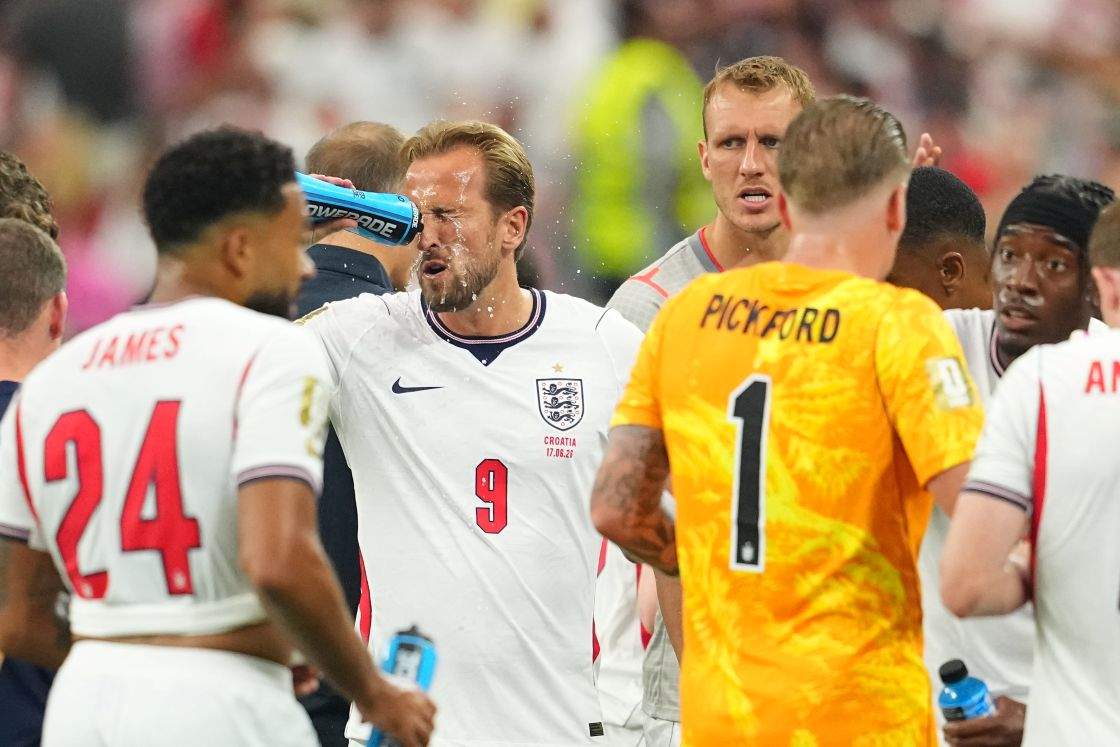
The World Cup looks different this year not only because it’s being played across three countries, but thanks to a new addition sparking a heated debate: hydration breaks.

FIFA introduced the three-minute pauses in each 45-minute half, effectively creating four unofficial quarters.
Soccer’s governing body says the measure is necessary to protect players from heat and humidity, with climate change creating more extreme conditions for athletes.
But some coaches and players are questioning whether the move is really about player safety or profits.
“I think it’s probably making some more money for FIFA, a hydration break turned into a commercial break,” said Canadian defender Alistair Johnston at a news conference Tuesday in Vancouver.

The stoppages have allowed some of the world’s most recognizable brands to squeeze in more advertising, making Canada, Mexico and the United States’ first World Cup feel distinctly more commercial.
That shift has triggered complaints from players, coaches and fans, along with boos from the stands. Some critics see the hydration breaks as another cash grab in a tournament already facing backlash for sky-high ticket prices.

Get weekly health news
“I think they’re probably right to be cynical,” said Toby Mündel, a kinesiology professor at Brock University.
“It’s better that FIFA has done something than absolutely nothing,” Mündel added. “Although they’ve done something, you also have to question why.”

FIFA faced growing pressure to make the tournament safer for athletes, who are often playing during some of the hottest months of the year.
“Most sports are getting faster, stronger and so when you have hot conditions during a soccer game, what it means is that it pushes a player’s physical and mental abilities to the limit,” said Mündel, who is also Canada Research Chair in Extreme Human Environments.
But skeptics point out that much of the tournament is being played in domed, air-conditioned venues such as BC Place, while some outdoor matches have taken place in relatively mild conditions. Ghana and Panama faced off in Toronto this week with temperatures hovering around 19 C.
Ghana coach Carlos Queiroz has called for a review of the policy.


“To have a hydration break in that context is completely unwarranted, in my opinion,” Daniel Keir, a kinesiology professor at Western University, told Global News.
FIFA says it’s rolling out hydration breaks universally to ensure consistency across matches. But the change has frustrated soccer purists for another reason: interrupting flow.
“It breaks up the game. It can change momentum and gives teams the opportunity to adjust tactics,” Keir said.
“The coaches can gather all the players, provide instructions, can move people around like pieces on a chessboard.”

Mündel says it’s hard to say whether it’s been an advantage or disadvantage for World Cup competitors, adding it depends on the game.
The Brock University professor says there are ways other than hydration breaks to reduce heat-related risks, like scheduling matches earlier in the morning or later in the evening, outside the hottest parts of the day.
But that could also be a hard sell.
“That has logistical and financial implications because of television audiences,” he said.


Obviously. There is no reason to think any other motive could exist.
They’re probably more exciting than the game.
yeeeeeeeeeeeees…..
GEEZ , NO KIDDING ! YOU PEOPLE ARE SHARP !!!
There is something strange about the new three-minute hydration breaks at the 2026 World Cup.
On paper, they sound noble. Footballers are playing in June and July across the United States, Mexico and Canada, sometimes under brutal heat. No serious person should mock the idea of protecting players from dangerous temperatures. We have already seen athletes and coaches complain about extreme conditions in recent competitions. If a player is dizzy, overheated or physically at risk, stopping the match is not only reasonable — it is necessary.
But sincerity becomes harder to believe when the same “health break” also turns into a perfectly packaged advertising window.
That is where the problem begins.
FIFA has made these hydration breaks mandatory in every match, not only in extreme heat, not only in open-air stadiums, and not only when the referee judges that conditions require it. They happen even when the weather is mild. They happen even in controlled or cooler environments. That makes the explanation feel less medical and more commercial.
The official argument is consistency. Every match gets the same structure. Every team knows what to expect. Fine. But the viewer also sees something else: the traditional rhythm of football being interrupted twice per match, creating something that looks a lot like four quarters instead of two halves.
And what fits perfectly inside a quarter-style sport?
Commercial breaks.
The numbers make the doubt even stronger. Reports estimate that broadcasters may be charging around $300,000 for a 30-second advertisement during these hydration breaks. That means one minute can be worth roughly $600,000. If the rate climbs to $400,000 per 30 seconds, one minute becomes about $800,000.
Now multiply that by two hydration breaks per match, across 104 World Cup matches.
Suddenly, water does not look like the only thing being served.
This does not mean every hydration break is fake. It does not mean heat is not dangerous. It does not mean players should be denied protection. The honest position is more nuanced: hydration breaks can be medically useful in some matches, while also being commercially convenient in all matches.
That is exactly why people are suspicious.
If FIFA had said, “We will pause matches whenever temperature and humidity reach dangerous levels,” almost nobody would complain. That would be a health policy. But when every match is stopped, regardless of the conditions, and broadcasters are allowed to sell ads during the pause, the line between player welfare and revenue strategy becomes blurry.
Football fans are not stupid. They know advertising exists. They know the World Cup is a business. They accept sponsors on boards, shirts, stadium names, broadcasts and halftime shows. But live football has always had one sacred quality: once the ball is moving, the game belongs to the pitch.
These hydration breaks threaten that feeling.
They do more than give players water. They give coaches extra tactical timeouts. They give broadcasters extra inventory. They give advertisers a rare chance to enter the middle of live football, where they never truly belonged before.
That is why the criticism is not simply about three minutes. It is about precedent.
Today it is hydration. Tomorrow it could be “technology review breaks,” “fan engagement breaks,” “medical observation breaks,” or any other polished phrase that creates another profitable interruption.
Football does not need to become American television with a ball attached to it.
The sincere question is this: if these breaks were truly only about health, why are they universal? Why are they monetized? Why are they timed so perfectly for broadcasters? And why does a three-minute pause for water suddenly look like one of the most valuable pieces of advertising space in world sport?
Maybe the hydration breaks are partly sincere.
But when one minute can be worth hundreds of thousands of dollars, it becomes very difficult to believe they are purely innocent.
Player safety matters. Nobody should deny that.
But so does the integrity of the game.
And right now, it feels like football is being asked to drink water — while television drinks the money.
Of course they are simply an excuse for commercials as if we aren’t bombarded enough with advertising now they break the momentum of the game with “hydration breaks” even where the stadiums are closed and air conditioned. FIFA is not about the game it is all about the money.
YES THEY ARE COMMERCIAL BREAKS SO FIFA CAN GET MORE MONEY. If its for the benefit of the players they would stay broadcasting at the pitch level. Also they should not be around the managers getting instructions if it’s a so called hydration break
I need a break from these awful commentators spewing out useless trivia drivel.
They are, simply and absolutely…America’s contribution to the sport.
You need hydration breaks in Toronto and Vancouver, not not in Iraq? Amazing.
Yes, this is just a commercial excuse.
It’s a perfectly reasonable thing to do and should have been done many years ago. Sure, advertisers will use the time to do their thing, but so what? You know that viewers will use the break to go to the fridge for another beer and not watch the ads.
Do they need an excuse? The media is having a field day right now. With the free rein they have on propaganda and the billion dollar payments from Liberals to keep it up, media simply will do what media wants.
More.like an excuse for some people to whine like toddlers.
Soccer? Yawn, boringgg.
Little muffins need lottsa breaks from running around in circles it appears.