


Kingston city councillors are calling on the federal and provincial governments to undertake a feasibility assessment for the creation of a protected marine area in Lake Ontario.

A motion passed in council Tuesday says a feasibility assessment is necessary to “evaluate the suitability of Lake Ontario for the establishment of a national marine conservation area (NMCA), including the potential environmental, economic and social benefits of such a designation.”
Coun. Lisa Osanic told Global News she put forward the motion following a request from Nature Canada. She said she felt the timing of the motion was particularly important given the upcoming municipal elections.
NMCAs are protected marine and freshwater ecosystems within the Atlantic, Pacific and Arctic oceans and the Great Lakes. According to Parks Canada, there are currently five NMCAs in the country, representing six of the 29 marine regions identified in the NMCA system plan.
Julia Laforge, protected areas campaign manager at Nature Canada, told Global News the main purpose of NMCAs is for ecological safeguarding.
“In Lake Ontario, this could be things like migratory bird flyways for birds that are coming from the south every year. It could be fish nurseries in the water,” she said. “NMCAs are a great tool because they also are about protecting the cultural heritage of a region.”
In 2021, Parks Canada committed to establishing 10 new marine and four new freshwater NMCAs by 2030. These protected areas would help Canada towards its goal of protecting biodiversity and conserving 30 per cent of marine and coastal areas by 2030.

Get daily National news
The Government of Canada also had an interim target of 25 per cent protection by 2025. That target was not met.
By the end of 2024, Parks Canada had reported that just 15.5 per cent of marine areas were classified as conserved, which included 11.4 per cent that were protected.
Nature Canada initiated the call for an NMCA in Lake Ontario in 2022 along with dozens of other nature groups, businesses and community groups. They initially advocated for the assessment to be completed by the end of 2025 to help meet the federal target.
The establishment of an NMCA in Lake Ontario could impact recreational uses on the Lake. Parks Canada’s directive on the management of NMCAs states that it “undertakes recreational activity and special event assessments on proposed new activities and uses in NMCAs to ensure they are consistent with the CNMCAA (Canada National Marine Conservation Areas Act), the management plan and other legislation, regulations, policy instruments and formal agreements.”
These restrictions depend on the zone in which the marine conservation area is designated. Restrictions range from a complete ban on fishing, recreational uses, hunting and trapping and extractive industries in Zone 1, to allowing all recreational activities, commercial fisheries and renewable energy projects in Zone 4.
The placement of artificial reefs, bottom trawling and oil and gas projects are prohibited in all zones.
While the assessment has yet to be completed, Laforge said there have been developments that show promise.


Earlier this year, the federal government announced $3.8 billion for conservation, recommitting to new conservation areas.
“I think the time is tight because there is new money on the table,” Laforge said. “There’s an opportunity here to try again, essentially to get that process moving forward.”
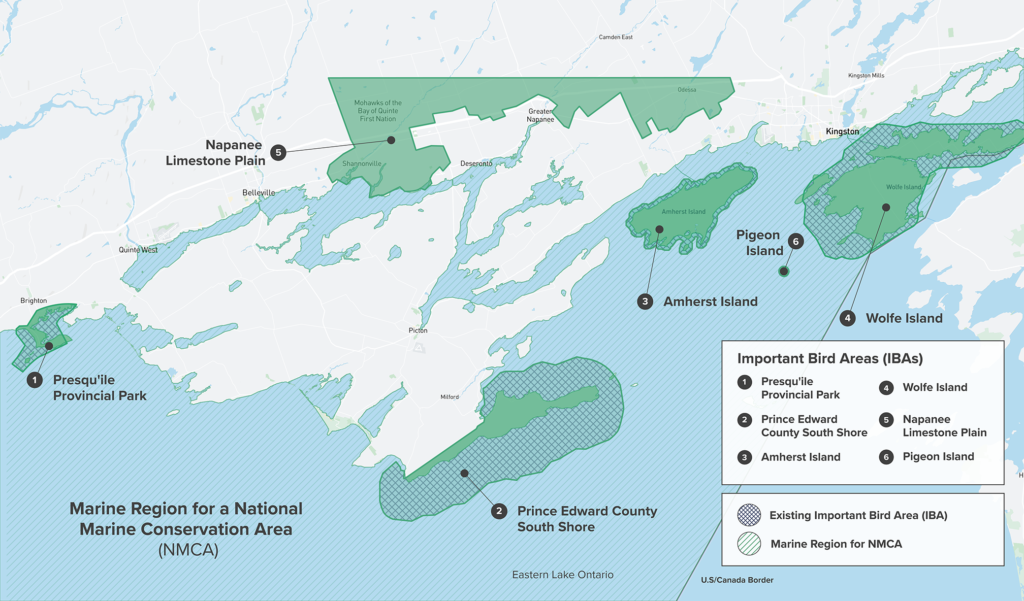
Parks Canada has expressed its intent to establish NMCAs in all five of the Great Lakes. Currently, NMCAs exist in Lake Superior and Lake Huron.
But Laforge said that because the Great Lakes fall under both federal and provincial jurisdictions, an MOU must be signed with the Ontario government before a feasibility assessment can be undertaken.
“Parks Canada has the funding and they have stated that they are interested in protecting the Great Lakes,” she said. “So we just need the province to come to the table and negotiate that.”
That is what Kingston councillors are asking for, and Nature Canada is hoping other communities along the shores of Lake Ontario will do the same.
“By no means is this a closed door, like the province walks in and negotiates and then all of a sudden there’s a Parks Canada site involved,” Laforge said. “Once that memorandum of understanding is signed, that opens up the feasibility study process in which everyone in the region gets a say.”
Global News reached out to the Ontario Ministry of Environment, Conservation and Parks but did not receive a response in time for publication.


Comments
Want to discuss? Please read our Commenting Policy first.