


The Snowbirds’ wings are being clipped temporarily as the iconic aerial performers await new and improved aircraft, Defence Minister David McGuinty says.

Those aircraft are expected to arrive in the early 2030s, McGuinty said Tuesday while visiting 15 Wing Moose Jaw in Saskatchewan. His visit came amid speculation about the future of the nine-plane aerial acrobatic squadron.
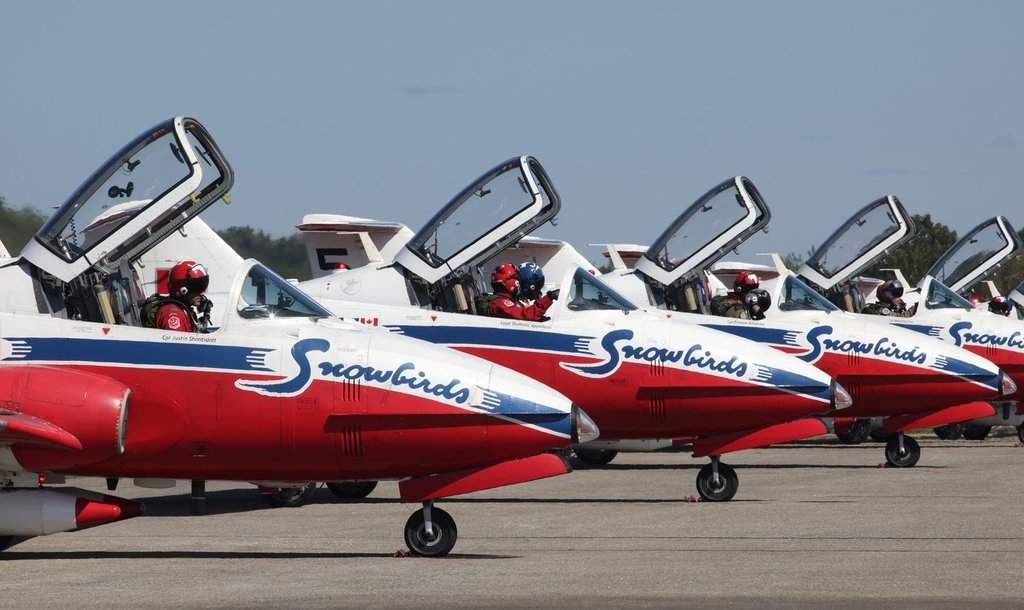
This year, the Royal Canadian Airforce performance group will fly the aging CT-114 Tutor jets for their final season. They will be replaced with CT-157 Siskin II, the minister said.

Like the Tutor jets, these newly procured planes will be used for training, as well as Snowbirds’ air demonstrations, according to the minister.
This new fleet will remain at the Moose Jaw base, he added.
“As Canadians gather to watch the Tutors fly one final time, we will also celebrate the generations of pilots, technicians, engineers and support personnel who made the Snowbirds one of the most respected air teams in the world,” the minister said.
One of those Canadians watching the Snowbirds was Prime Minister Mark Carney.

Get breaking National news
“I inherited a situation where the planes literally had come to the end of their lives. They were unique in many respects – they didn’t have the parts and other things to safely fly,” Carney commented from Quebec.
McGuinty, who was appointed by Carney, said the aging jets have been on his radar since he became defence minister last May, but the fleet is still safe for this last season.
“We’re moving forward with conviction, speed, responsibly and efficiently,” the minister said.
New Siskin II planes will arrive as soon as possible, he added, saying negotiations with a manufacturer are underway. It is unclear, for now, how many jets will be procured, McGuinty said.
“It wouldn’t have been our first choice. The reason I say that is as a G7 nation, all the (other) G7 nations that are flying aerobatic teams are flying jet aircrafts,” said Dan Dempsey, the secretary at the Snowbirds Alumni Association. He also served in the RCAF and was the commanding officer for the performance fleet.
“You can’t perform the same kind of show with a turbo prop trainer that you can with a jet. You don’t have the vertical performance and so on, and so forth. You can still put on a show.”
Reducing the number of aging jets as needed until 2030, to ensure the shows go on and performers stay well-rehearsed, would have been an ideal solution, Dempsey said.
“The Tutors have served us so well,” he added.


“Through the Future Aircraft Training (FAcT) Program, Canada is making one of the most significant investments in military aviation training in history. The program represents more than $9.4 billion in long-term investment and will modernize how the next generation of Royal Canadian Air Force personnel are trained,” McGuinty said.
This modernized training program is being rolled out in Moose Jaw and two bases in Manitoba, according to the RCAF’s website.
“This transformation is essential to ensure we are ready to defend Canada’s sovereignty and remain a trusted, capable and credible partner in an increasingly complex and contested global environment,” said Lt.-Gen. Jamie Spicer-Blanchet, commander of the RCAF – who flew one of the aging jets during her training.
Tutor jets were introduced to the Air Force in the 1960s, and the Snowbirds have performed at thousands of shows since they were formed in 1971.
Plans to replace the aging aircraft fleet were previously considered in Ottawa in recent years – including a $30-million contract, signed in 2021, intended to keep the jets in commission until 2030.
In the meantime, DND said other RCAF groups will support airshows and other community engagements. Then, after the season wraps up, squadron members will be reassigned to similar roles, according to the Air Force commander.
“We are concerned about the loss of core expertise that’s going to happen. When you stop flying low level aerobatics, it’s something you have to work (back) up very, very, carefully,” said Dempsey.
“I don’t know how the RCAF is going to be able to easily transition onto a new aircraft after four or five years – you’re literally going to be starting from scratch.”
Moose Jaw locals with Snowbird-adjacent jobs will also be looked after, said Tim McLeod, one of the area’s MLAs. Efforts are being made to keep them in the community, he said.
The Snowbirds’ first performance of the Tutors’ final flying season will be at the Montreal Grand Prix later this month.
— With files from The Canadian Press


The Canadian government has known for years that the snowbirds were aging… Yet they totally ignored it time and time again it’s absolutely disgusting that you are now grounding them and nothing’s going to be done until 2030? We have enough going on with the USA against Canada with the tariffs and this on top of it destroying our Canadian heritage? I highly doubt that’ll happen. Believe me when it comes election time, I will remember who said what and did what!
The CT-114 is solid and with a huge number of these aircraft having been built in the 60s, there are enough already in service plus more in storage that can be reactivated to fly the Tutor beyond 2030 if anyone wanted to. Now that the glass cockpit upgrade has happened this little jet is quite capable. No shortage of J85 engines. It’s not a supersonic aircraft, so the stresses on the airframe are not like that of faster jets. If my local recruiting office is anything to go by it’s an embarrassingly obvious manpower issue not an aircraft problem causing the grounding.
Relegating our iconic Snowbirds from jets to turboprop aircraft is, as one former defence minister put it, like replacing those beautiful horses in the RCMP muslical ride with Shetland ponies. Please don’t!
The wrong tool for the job. I would not waste my time to go to an airshow to see this embarrassment for the RCAF. If we can’t afford jets for the Snowbirds just shut the whole thing down.
Seems like an ideal opportunity to move in Grippen aircraft…
Bombardier doesn’t make military aircraft, so are we throwing another billion their way in this cost saving move.
The Canadian military usually over performs with below average government support and equipment. This – government – is probably planning a way to get out of NATO so they don’t have to pay the 2% plus gdp military expenditure minimum. I can see the spin now, “Carney stands up to Trump over NATO requirements!”
Yay! Canada!
Everyday I read of how this government is trying to bring us closer to the third world. This is a disgrace, but constantly putting off the upgrade isn’t new. We’ve been hearing about Canada’s investment in the F-35 since 2002 and the purchase deal the F-35 deal since 2010, then again in 2017. In 2026 an entire generation has grown up and we still have not taken ownership of a single F-35 fighter, which is now an old plane.
We really don’t need the snowbirds show anymore. Why use up resources and add to pollution?
I am waiting for the Liberals to suspend the RCMP musical ride for 5 years on the excuse they need to procure new horses. Lol
Any bi-planes with wing walkers in the running for the new LIB Air-Farce?
So Canada is now going to showcase a turbo prop? All other G7 countries use jets and so did Canada with the current Tudor Snowbirds. Why is Canada taking a step down?
Blame Justin, this problem was raised 9 years ago and the Liberals ignored the calls to re-fit. We are one of the few nations without a demonstration air contingent for national and international events. Like celebrating birthdays without cake, candles, cards and presents,
\
Meh, it’s just a circus sideshow anyways.
How long until public opinion forces a rethink on replacing CT-114s with a turboprop?
Spend the money elsewhere where it’s direly needed. Waste of money.
Yet another Canadian icon bites the dust. Elbows up comrades. You’re next.
Given the pathetic state of our military its surprising this didnt happen sooner
Canada always wants is mediocre and bottom of the barrel. The turboprop purchase is like buying a blade steak and pretending it is a Filet Mignon
What a ducking joke, replacing a jet trainer with a turbo prop, when there’s plenty of jet trainers around the world to chose from that meets the air forces requirements, this is a disgrace to the Canadian people and air force pilots, all because the federal liberal government is cheap, the snow birds will become a laughing stock of nato, and the snow birds will never be the same or respected again, and the snow birds will be dead for me and many other Canadians.
Scrap the whole program, such a waste of tax dollars
@Michael. F-35s are a superior aircraft. Unless you want to go to Russia for their fighter jets.
Canada is a mediocre country and Carney decisions shows this. Replacing the Canadian made Tudor for a foreign turboprop. Turboprops can’t do the same manoeuvres like a modern jet. All other G7s Nations use jets as the demonstration aircraft.
It should make for a great choice of trainer but not overly impressive when you consider WW2 prop driven fighters were faster over 80 years ago.
Canada a laughing stock. Again! This prop is a huge step down from the Tudor jet.
What a Canadian move.
A lame, flaccid, visually weak and uninspiring aircraft.
The slipper definetly fits.
we cant even have demonstration planes. no wunder the us pulled us out of the military office today. never went anyways and wont go when they run but wow. gooo carney
So why don’t we use the totally useless F-35’s we overpaid for and can’t use in combat. At least we would get some use out of them, and show the USA how they should be flown.
A prop plane! Not what people want to see!!! Wakey wakey!!
A prop plane??? Not what people want to see!!!
So Carney moves to a turboprop? All other G7 nations fly jets as the demonstration aircraft. How embarrassing
Wow, Wayne, lighten up a little!
When I first saw the Golden Hawks I was impressed, but after that, who wanted to watch the same stuff over again. Are airshows worth the waste of money, fuel and dragging a kid around, who keeps asking “why are we not at a beach” So I don’t see a reason, it was boring 60 something years ago and never gets better.
The have money for all these “Refugees” from Sudan an Eritea and other places, but not for this!
So again with the clickbait news. The snowbirds are not grounded. They will be getting new planes at the end of the year. They will not be performing until they are proficient with the new planes.
With Canadian pilots, that should not take long.
The end of an iconic era. The new pilatus aircraft is techincally amazing but will never have the same “cool” factor of the CT114.
I remember being at the century of flight airshow in Dayton Ohio. The nearly exclusive american crowd was far more impressed by the snowbirds than by the thunderbirds and blue angels.
A proud moment being from Moose Jaw. Canadians dont have many of those anymore.