


With each trip to the grocery store feeling more and more expensive, a motion passed Tuesday by Edmonton city council aims to increase competition by removing restrictions on properties around the city.

A restrictive covenant is a legally binding agreement that goes on a property title and limits how that property is used or developed going forward — even after it is sold to a new owner.
The tool has been used over many decades in Edmonton — in many cases by grocery stores to prevent competition from setting up shop nearby — and has become a headache for the city.
“Food deserts are a real thing,” said Mayor Andrew Knack. “There are communities that have not had the opportunity to have a local grocery store, in some cases, for decades because of the way the rules and these covenants have been designed.”
In some cases, a grocer has moved out or no longer owns the land, but the restrictive covenant prohibits another grocery store from replacing it or being built nearby.
Councillors note this restricts Edmontonians’ access to grocery stores in their own neighbourhood, creating accessibility and affordability issues for many.
“(It) leaves a lot of communities without access to fresh, healthy food and really creates food deserts,” said city councillor Ashley Salvador.

It’s especially problematic in the city’s older neighbourhoods.
“I think about folks who live in the communities that I represent who might not own a car, who might rely on walking, biking, taking public transit to meet their daily needs. Having to travel further has real implications,” Salvador said.
One such example is in south Edmonton, where a grocery store moved out of the Lansdowne Centre strip mall on 122 Street at 51 Avenue.

Get daily National news
The space sat vacant for years until Find thrift store moved in 15 years ago.
“Find has a lease there. Find is operating a furniture store. I don’t think Find is gonna pack up overnight and move,” said area city councillor Michael Janz.
But as more dense housing options like apartment buildings are going up in that area of the city — plus, down the road when the standalone Stollery Children’s Hospital opens across the street in a decade or so — there may be greater interest in the space returning to a grocery store.
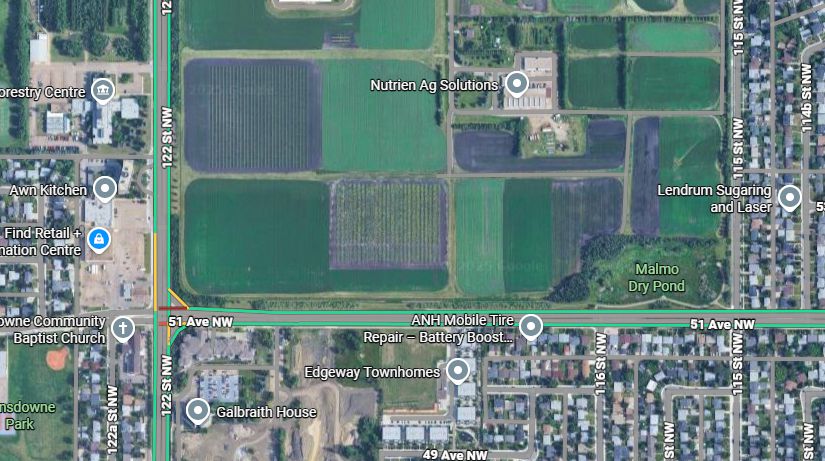
“So when it comes time for lease renewal, Find may want to go somewhere else. They may want a bigger space and whoever has that property now has more opportunity for what to do with it,” said Janz.
“So really, this is one of those small changes that can have an outsized impact, but it may take a little bit of time to be realized.”
The city cannot change the property rules when it comes to restrictive covenants, only the province can — which is why the advocacy is needed.
Janz put forward a motion at city council that would see the mayor, on behalf of council, advocate to the province to enable grocery store competition by the removal of restrictive covenants and exclusivity controls for grocery stores.
Mayor Knack noted at Tuesday’s council meeting that this has been discussed over the years, but it has never gotten much traction until now.
The conversation started up again after Manitoba enacted a bill that removed 23 grocery property controls, spurring competition in the grocery sector.
“I think there is an opportunity to say that this really isn’t helping the vast majority of Albertans. So this isn’t an Edmonton-only thing, this is an Alberta-wide thing and I hope there’s a way to make some progress,” Knack said.
City councillors say with Manitoba’s work — and interest from grocers — it could mean changes for the city. Janz said some city representatives recently met with corporate relations staff from the country’s major grocery chains.
While businesses don’t generally want to give their competition the upper hand, Janz said the nation’s grocers read the room when it comes to the cost of living and accepted restrictive covenants no longer hold up to public scrutiny.
“They were interested in making changes here, but they want to do so in a way knowing that everybody else will as well,” Janz said of the meeting with the grocery corporations.
“So this is clearly one of those instances where the industry is willing — if the regulator makes the change, you’ll see a more favourable outcome.”
Red Tape Reduction Minister Dale Nally says a motion by city council wasn’t needed as the province has already been monitoring what’s been happening in Manitoba to see how it could work in Alberta.
Restrictive covenants in Edmonton date back more than a century and include more than just commercial properties.
The Glenora neighbourhood, which is a century old and one of Edmonton’s most sought-after neighbourhoods, was established in the 1910s with a restrictive covenant in place in some sections called the Carruthers Caveat.
It was named after the businessman who sold the land the city with the caveat that only single family homes and wide expansive lots be allowed, to maintain his vision of Glenora as a prestigious residential area.




Comments
Want to discuss? Please read our Commenting Policy first.