


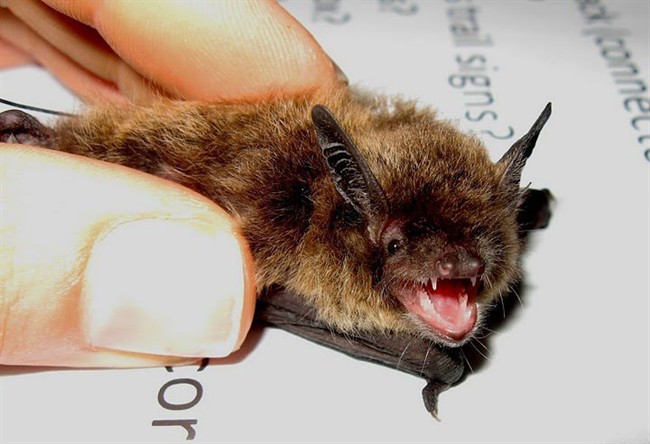
<p>CALGARY – A University of Calgary study suggests bright lights and big cities are proving to be an irresistible lure for bats who are flocking to urban areas in droves.</p> <p>But the promise of a better life for the furry flying mammal is proving an empty one.</p> <p>”Putting up trees, putting up buildings, watering lawns and creating more habitat for insects – we thought this would actually have a beneficial effect and to find out that wasn’t the case certainly is a surprise,” said co-author Robert Barclay, a biological sciences professor at the university.</p> <p>The study looked at 1,600 little brown bats (Myotis lucifugus) which are plentiful in and around Calgary. They are also found over much of North America.</p> <p>Barclay said it is reasonable to assume the study’s findings are applicable to other Prairie cities.</p> <p>Researchers had expected that city bats would have an enhanced body condition and better reproductive rates than their rural relatives. But the city’s tall structures and imported landscape aren’t providing them with what they need.</p> <p>”It’s not unlike drawing all the people into the city and there are no jobs. The densities are quite high and so then you’ve got all these individuals competing for the resources that are available and the resources aren’t sufficient to go around,” said Barclay.</p> <p>The number of insects in city settings is roughly the same as in the country, but the number of bats is far higher, he said.</p> <p>”The high numbers certainly increase competition for food and it may not be as good as we thought in terms of insect abundance. They’re competing for the same resources that their country cousins don’t have to compete so hard for.”</p> <p>Barclay concedes that the amount of light may also factor into the equation. In the country, insects are drawn to the lights on a farmstead which serves as an easy feeding ground. In Calgary, there’s light everywhere.</p> <p>The study’s lead author, Joanne Coleman, looked at how much fat bats had packed on, particularly late in the year, when getting ready to hibernate. She found city-dwellers didn’t have nearly as much as farm bats – which could result in lower reproduction the next year or a lower survival rate over the winter.</p> <p>”I was really surprised. I fully expected bats to benefit from the expected increase in availability of roosts and food, insects, in the city. Instead, I found no evidence to support my hypothesis,” she said.</p> <p>”I figured that if urbanization was going to benefit any bats anywhere, it was particularly likely to do so for little brown bats in the Prairies,” said Coleman, who is currently teaching biology at the University of Calgary’s Qatar campus.</p> <p>An article about the study appears in the online journal PLOS One.</p>



Comments
Want to discuss? Please read our Commenting Policy first.