


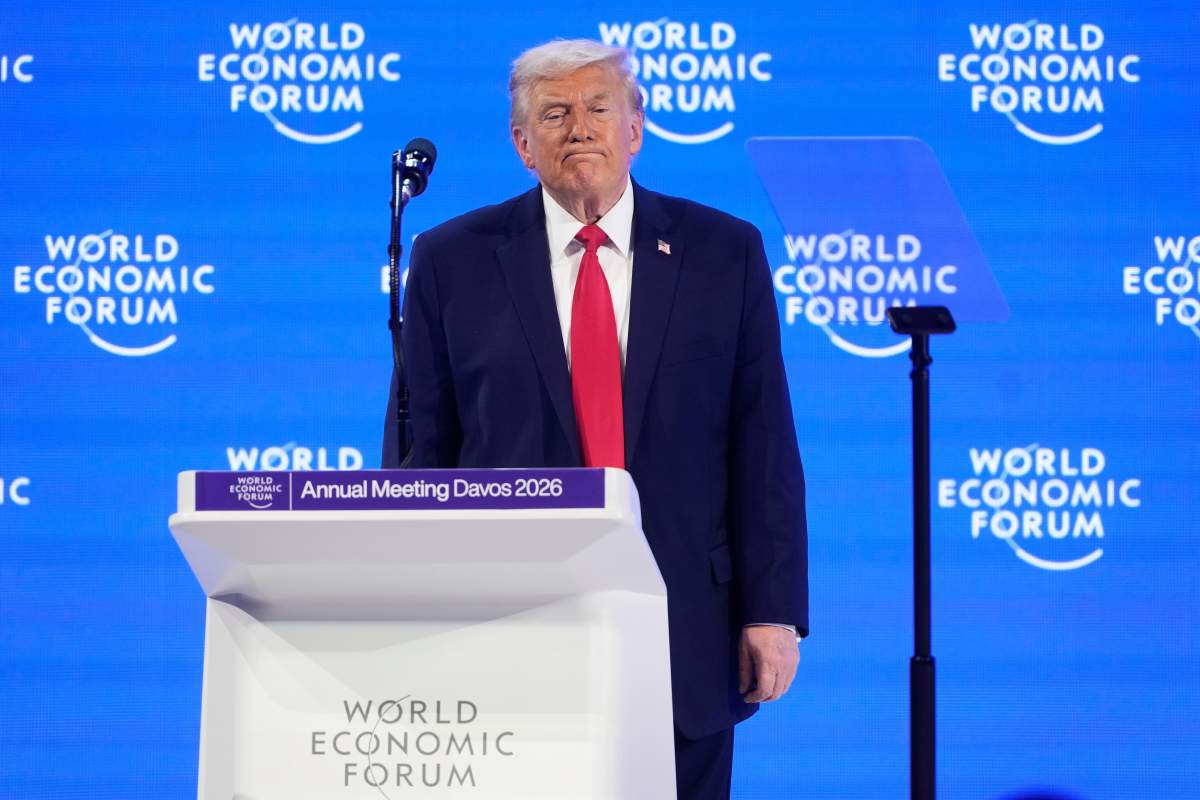
Much of the global reaction to U.S. President Donald Trump’s speech at the World Economic Forum on Wednesday has focused on his plans for Greenland amid threats to acquire the semi-autonomous Danish territory — but several other notable moments may have been overlooked.

The speech lasted more than an hour and touched on tariffs, the U.S. central bank and prescription drug prices, among other topics.
There was also a reference to new “weapons of warfare,” with few other details.
Here are some of the key takeaways from Trump’s speech beyond what he shared on Greenland and his comments on Canada.
Jerome Powell and the Federal Reserve
Trump said he plans to announce a new chairman of the U.S. Federal Reserve shortly as well.
Central banks like the U.S. Fed and the Bank of Canada have a mandate to keep economies stable by adjusting interest rates to maintain price stability while also encouraging growth.
They reach these decisions independently, based on expert analysis and data, while strongly opposing outside influence from government leaders and agendas.
“I’ll be announcing a new Fed chairman in the not-too-distant future. I think he’ll do a very good job. See, I gave away some of it — he. I did give that away,” Trump said at Davos.
“So we have something. You get something. But somebody that’s very respected, they’re all respected. They’re all great. Everyone that I interviewed is great. Everyone could do, I think a fantastic job. Problem is they change once they get the job, they do.”
He continued: “You know, they’re saying everything I want to hear. And then they get the job, they’re locked in for six years. They get the job and all of a sudden, ‘let’s raise rates a little bit.’ I call them: ‘Sir, we’d rather not talk about this.’”

Get breaking National news
“It’s amazing how people change once they have the job. It’s too bad. It’s sort of disloyalty. But they’ve got to do what they think is right. We have a terrible chairman right now, Jerome ‘Too late’ Powell. He’s always too late. And, he’s very late with interest rates, except before the election. He was just fine for the other side,” Trump added.

The future of drug prices
In his speech, Trump claimed that prescription drug prices were going to come down worldwide, then said he used tariffs to pressure French President Emmanuel Macron to raise some prices in France.
This comes after the White House announced in December 2025 that nine major pharmaceutical companies would slash the prices of medicines for the government’s Medicaid program and for cash payers in Trump’s latest bid to align U.S. costs with those in other wealthy nations.
“Drug prices are going to be coming down tremendously in all the nations, and I appreciate them doing it. But they did it. In all fairness, without tariffs, I wouldn’t have been able to get it done,” said Trump.
“Under my most favoured nation policy for drug prices, the cost of prescription drugs is coming down by up to 90 per cent, depending on the way you calculate.”


Trump’s “most favoured nation policy” aims to bring down some prescription drug prices in the U.S. to levels comparable to those in other nations, which may pay less for the same products.
Trump continued:
“‘No, no, no,’ he said. ‘Here’s the story, Emmanuel. The answer is you’re going to do it. You’re going to do it fast. And if you don’t, I’m putting a 25 per cent tariff on everything that you sell into the United States.'”

New 'weapons of warfare'
At one point in his speech, Trump referred to new U.S. “weapons of warfare,” without getting into specifics.
“So now our country and the world face much greater risks than it did ever before. Because of missiles, because of nuclear, because of weapons of warfare that I can’t even talk about,” said Trump.
“Two weeks ago, they saw weapons that nobody ever heard of. They weren’t able to fire one shot at us. They said what happened? Everything was discombobulated.”
It isn’t clear what instance Trump was referring to where these “weapons” were used, but the timeline of “two weeks ago” is close to the timing of the U.S. strikes on Venezuela and the capture of President Nicolás Maduro on Jan. 3.
Earlier this month, CNN reported, citing multiple sources, on the purchase by the Pentagon of a device the report said is believed to be linked to the “Havana syndrome” cases that have plagued U.S. and Canadian diplomats in Cuba, beginning in 2016.
Global News has not independently verified CNN’s reporting, and Trump gave no further details on what type of weapons he was referring to in his speech.


Comments
Want to discuss? Please read our Commenting Policy first.