

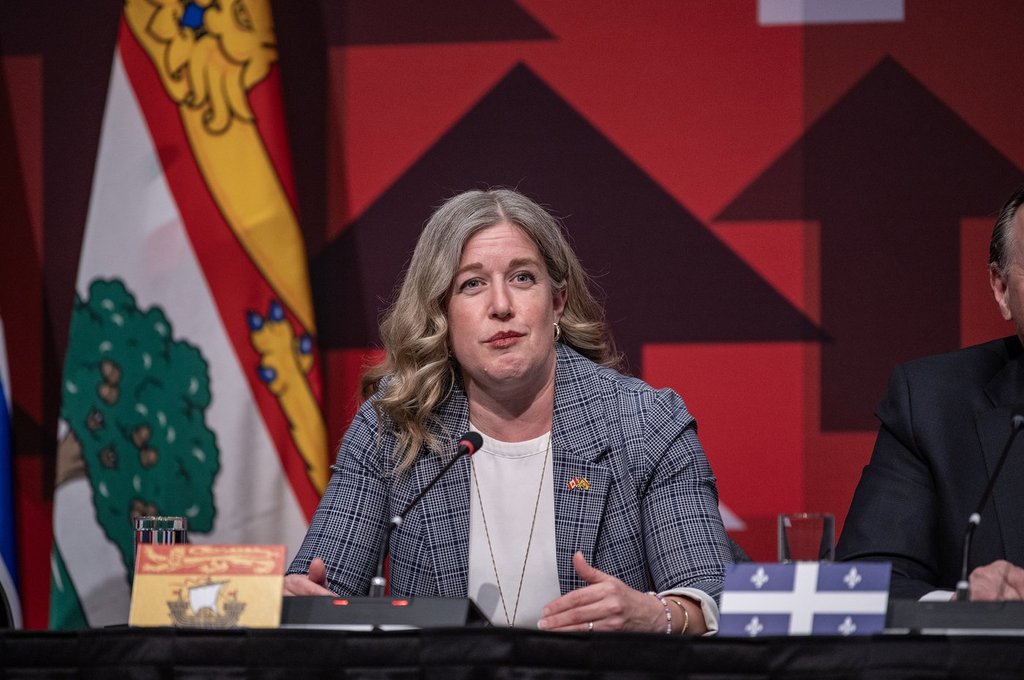
With increased pay for nurses, a $270-million deal for doctors and 11 new collaborative care clinics, New Brunswick Premier Susan Holt says her party spent the year building a foundation for health care and that patients should start seeing results in 2026.

There were “so many big moments” in 2025, the first full year since Holt took office, the premier said in a recent interview.
After winning the October 2024 election, the Liberals made good on a promise to pay full-time and part-time permanent nurses $10,000 retention payments by the end of that year. In October 2025, Holt’s government signed a new contract with nurses that included a 12.5 per cent wage increase over four years and raised premiums for weekend and night shifts.
Then, Holt fulfilled a campaign promise to open 10 collaborative care clinics this year, and last week announced the opening of the eleventh such primary care centre.
“We knew it was an ambitious promise. The previous government had promised four (clinics) and couldn’t get those done,” Holt said.
In November, the New Brunswick Medical Society voted in favour of a new $270-million agreement that incentivizes doctors to work in team-based clinics.
“These are some of the shifts that are gonna change the foundation of health care for New Brunswick that we can then build on,” she said.
-
![]() Flu cases surge across Canada with H3N2 as the dominant strain of the virus
Flu cases surge across Canada with H3N2 as the dominant strain of the virus -
![]() B.C.’s representative for children and youth has concerns for the new guidelines for youth in involuntary care
B.C.’s representative for children and youth has concerns for the new guidelines for youth in involuntary care -
![]() AHS pauses bell ringing ceremony for cancer patients at the Stollery
AHS pauses bell ringing ceremony for cancer patients at the Stollery -
![]() Ask an Expert: Mental health strategies for the holiday season
Ask an Expert: Mental health strategies for the holiday season


The past year was not without its struggles, Holt said. Among the greatest challenges came from U.S. President Donald Trump’s tariffs on Canadian goods and the historic summer wildfire season.

Get weekly health news
New Brunswick is considered among the most at-risk Canadian provinces to U.S. tariffs, due in large part to its forestry sector that has historically relied on American business. A CIBC provincial forecast from October says New Brunswick and Quebec are seeing two of the biggest declines in trade as a result of the tariffs.
“The economic challenge has been certainly one of the biggest challenges we’ve faced, in part because it wasn’t forecast. In 2024, we had imagined the same trend of economic and GDP growth as we had been seeing,” Holt said.
New Brunswick has signed memorandums of understanding on free trade and labour mobility with four provinces, and has established a new loan program of up to $5 million for businesses to help maintain operations, among other supports for workers and companies.
Holt’s government tabled a $14.3-billion budget that was driven deep into deficit by the increases in health-care funding and a contingency fund to deal with U.S. tariff threats.
The premier said the other top challenge that stands out this year was the wildfire season, which had 448 fires that burnt more than 34 square kilometres of forest.
In 2024, there were 281 wildfires that burnt 2.3 square kilometres of New Brunswick, and the province’s 10-year average is 256 fires over 4.6 square kilometres of forest.
“The magnitude and extent of the fires really challenged everyone in our system. And boy did they step up and perform in the face of the kind of fires we haven’t seen in generations, and then that had a ripple effect,” Holt said.


Dry conditions that led to the fires resulted in struggles for the agricultural sector, the premier said. “We’re seeing smaller apples and blueberries and cranberries and yields from a lot of our agricultural producers. That’s challenging for the economy as well.”
Holt said she remains focused on supporting the sector, and is continuing to looking at ways of addressing the high cost of living.
One way the government brought down costs, she said, was through tackling gas prices. She had pledged in the 2024 election campaign to remove the portion of the carbon adjuster tax on diesel and gas, but that decision was quashed earlier this month by the province’s energy regulator.
However, Holt said, “we didn’t want to let it go.”
The province’s energy regulator sets the maximum price at the pump across the province. And Holt said a member of her team had discovered that the regulator was using conventional gas in its price-setting formula, despite the fact that “every gas retailer” in the province is selling E10 — a blend of regular gasoline and ethanol that is less expensive.
Holt’s cabinet approved an order-in-council on Dec. 12 to change the price used in the formula. The next morning, “we saw the price for regular gas go down by those 7.9 cents,” Holt said.
The premier said this move is an important one to address everyday costs in a rural province like New Brunswick, where jumping in a vehicle for work, school and other necessities is “not often a choice.”
“We weren’t going to stop, and we still won’t stop. We are going to constantly be looking for ways to make sure that New Brunswickers aren’t paying a penny more for gas, and that they’re paying the right, competitive rates for the services they buy here.”
Comments