


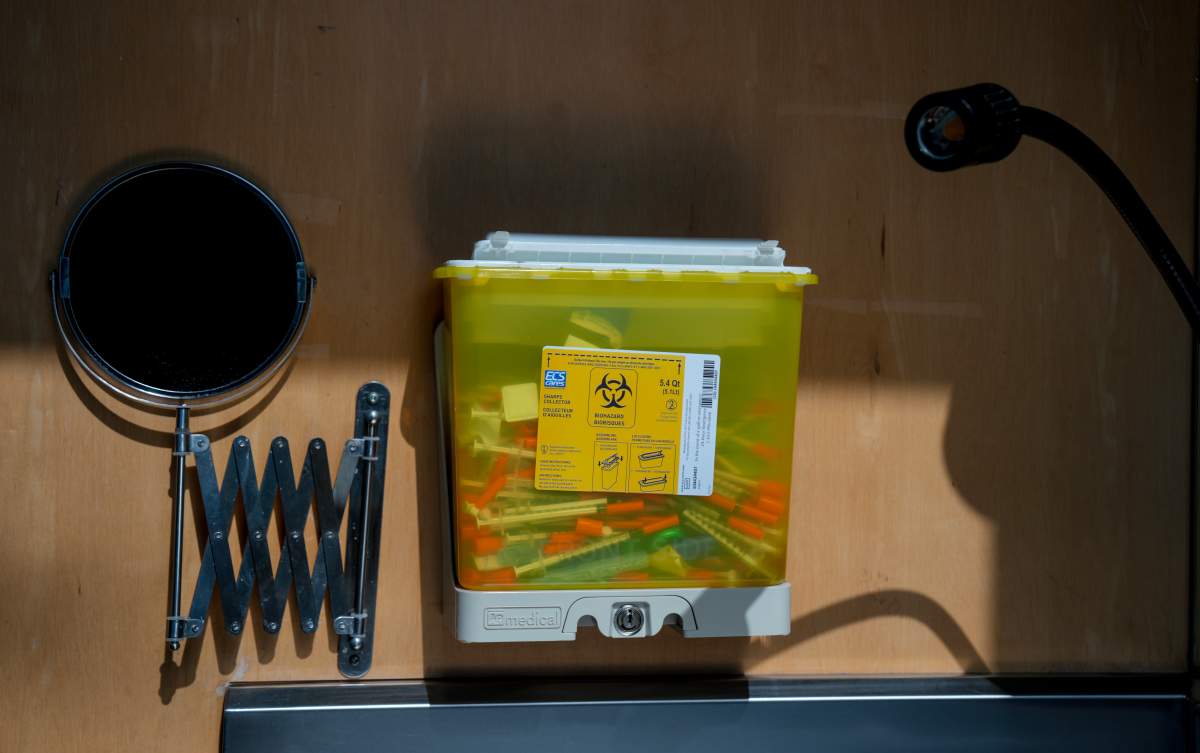
Months after the Ford government pulled funding and forced several supervised consumption sites to close, the City of Toronto is reporting an increase in visible drug use and calls to clean up needles.

Originally, all drug injection sites in Ontario were slated to close on March 30 under a sweeping provincewide ban that was temporarily halted by an ongoing court challenge.
While some were able to stay open, others still closed in April after the province cut funding, telling them that to keep receiving money, they would have to transition into intensive addiction recovery hubs.
The government has repeatedly said closing supervised consumption sites would reduce crime around them and help people get access to addiction supports and a recovery plan.
Critics argue it will send illegal drug users back onto the streets and lead to a spike in preventable overdoses.
Now, new information from the City of Toronto’s board of health reveals early signs the closures are having a noticeable effect in parts of the city.
“With the three sites left in Toronto, we’re certainly going to see an increase in their site utilization; they’ve already seen an increase since the closures in April, so it’s going to just get worse,” said Gab Laurence, director of harm reduction services at the Parkdale Queen West Community Health Centre

Get weekly health news
The board of health also reported that some areas are seeing growing public drug use.
The city’s safety network said Jane and Finch was seeing an increase in “visible substance use on the street,” while Parkdale had also “raised concerns” about an increase in “open use of substances in public spaces.”
Regent Park said it had seen more overdoses occurring on storefronts.
Meanwhile, the number of calls to the city to clear up used syringes showed a modest increase.
Between April and September 2024, there were 731 calls, compared to 766 for the same period this year, after the sites closed. The increase is equivalent to roughly five per cent.
Chris Moise, chair of Toronto’s board of health, said the province isn’t properly funding its HART Hubs, which were introduced to replace safe-injection sites with support services for people dealing with addictions and homelessness.
- Family fighting to bring B.C. senior home after she fell into a coma in China
- Albertan in perpetual pain amid diagnosis delays demands change: ‘Just want my life back’
- 33% of Canadian women wait more than 2 years for menopause care: survey
- City of Calgary reaches major milestone in repairs to Bearspaw feeder main


“It’s been a piecemeal approach that has left people behind,” he said. “That’s why you’re seeing an increase of people using in alleyways and in our parks and on our street corners.”
Provincially, there has been a drop in the number of emergency calls for overdoses compared to last year. Toronto’s top doctor said it was too early to say whether the closures had had any impact.
“It was declining before these closures happened,” medical officer of health Dr. Michelle Murti said. “And I think that’s really the narrative we need to be telling. We can’t be linking these numbers to the landscape in what we’re seeing in terms of services available.”
The minister of health was not available at Queen’s Park on Monday to comment on the data, but her office touted statistics for the HART Hubs program overall in a statement.
“Since HART Hubs opened, nearly 30,000 client interactions have been served, and data from the Chief Coroner has shown a 41 per cent decrease in opioid-related deaths,” a spokesperson said.
“Across Toronto, HART Hubs are providing comprehensive mental health and addictions services, including addiction treatment, supportive housing, primary care, community case management, and mental health services.”
— with files from Global News’ Matthew Bingley


Comments
Want to discuss? Please read our Commenting Policy first.