

Calgary artist Paul Van Ginkel is not an overtly religious person. He describes himself as spiritual.
But over the years, Van Ginkel and his wife Kristin have decorated their home with a unique collection of crosses from around the world -the one symbol that is so immediately identified with Christianity.
"I’m spiritual. And I’m Christian. Kristin and I are spiritual and we do believe in the Higher Power. We don’t follow a particular religion, per se. We’re both very mindful of the religious component of this collection," says Van Ginkel.
"But that’s not first and foremost in our desire to collect. It’s the esthetic. The beauty of it. The shape itself in terms of the strong vertical and the cross shape, of course. That shape in itself I’ve always been drawn to sort of consciously and subconsciously. I like things vertical, because to me there’s more power to them."
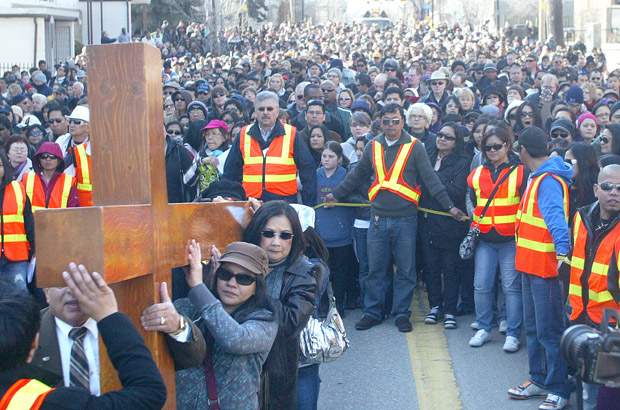
The power of the cross is something Christians will reflect on today -Good Friday -as they remember the crucifixion of Jesus Christ. Many will gather downtown in front of St. Mary’s Cathedral this morning for the traditional, annual Outdoor Way of the Cross, where, in prayerful meditation, they contemplate the suffering and journey that led Christ to the cross. It is one of the most powerful symbols in the human psyche.
Van Ginkel has 28 hanging crosses, two large grave markers and 15 self-standing smaller crosses.
The majority are from Mexico, but also from places like Serbia, Lithuania, Africa and Santa Fe, N.M. And they are made from wood, steel, tin, ceramics, beads and even fishbone.
It’s a collection that will continue to grow, says Van Ginkel.
"One of the main reasons why we’re drawn to the crosses from Mexico is a lot of the ones we have are covered with milagros. A milagro translates as miracle in Spanish. What they are are little sorts of religious folk charms used for healing purposes," he says.
Calgary Roman Catholic Bishop Fred Henry says the cross points people to Good Friday and the crucifixion of Christ.
"It’s the first kind of way of effectively repairing the dysfunction and the disjoint caused by sin in the world," he says. "All of a sudden, we have someone who can fully identify with us. Was totally open to God. Totally capable of hearing the Father’s word and of doing it. And truly being obedient."
Christ seeks to do God’s will in everything "to the point of giving His life as an innocent victim. So it becomes a most profound type of expression of love and generosity imaginable," says Henry.
"This shows us something about the incredible love of God who was willing to pursue us to the point of giving His only begotten Son totally."
The crucifixion of Jesus "is perhaps the most dramatic gesture of how highly God prizes human beings that he yearns for them once again to be reconciled, to be in union with Him that he pays the highest price imaginable . . . the death of his Son," says Henry.
"We have them in precious metals like gold and silver and many people wear them. For some, it’s purely a sign of cosmic jewelry, but for those who understand what it’s all about, man this is really powerful stuff."
Rev. John Pentland, of Hillhurst United Church, remembers being in Nicaragua in 1986 during a time of war. He was in a Catholic Church and after the service walked outside the building.
In the courtyard was a stone crucifix. It had the figure of Jesus, but the hands and feet were broken off due to the violence of war. Under the statue, someone had written with chalk in Spanish the words, "Yo no tengo manos, tu eres mis manos," meaning, "I have no hands, you are my hands."
"It was a powerful reminder that we are the hands, feet, voice of the sacred in the world," says Pentland.
"The cross speaks of the suffering of humanity and our call to work for peace and justice. It symbolizes a call to speak up and out in the world."
The cross is often mistaken just as a piece of jewelry, but it is historically a sign of suffering and execution, adds Pentland. For Christians, it is a reminder of the cruel crucifixion and that suffering and loss are present-day realities.
For more than 40 years, Al Gerritsen has sculpted crosses out of wood. They can be found in churches and schools all over Calgary and area.
In the 1960s, he was a Franciscan who did a lot of whittling. He apprenticed with a sculptor in Lumsden, Sask. -at a retreat house the Franciscans had just built.
He then went to the retreat house in Cochrane and continued his work there. Gerritsen left the Franciscans in 1970, but has continued to do his work -his ministry -to this day.
"I found a niche when nobody else was doing it. But at the same time, I usually try to kind of put a message in it. I think a lot of crosses just kind of become decorations. Mine usually draws attention to them because they’re different," he says.
"The whole idea is that our salvation came through the cross. Through the crucifixion. It’s at the centre of our whole Christian belief."
Pastor John Van Sloten, of New Hope Church, says the cross is a symbol of sacrifice and death and a pointer to the atoning act of Christ in dying on the cross.
"But for me, it’s always been kind of the wrong symbol for Christianity," he says. "I mean it’s part of the story, but it’s only the intro of that seminal event -of the Easter event. The real story is an open grave. And Christ who’s resurrected."
Calgary Herald



Comments
Want to discuss? Please read our Commenting Policy first.