


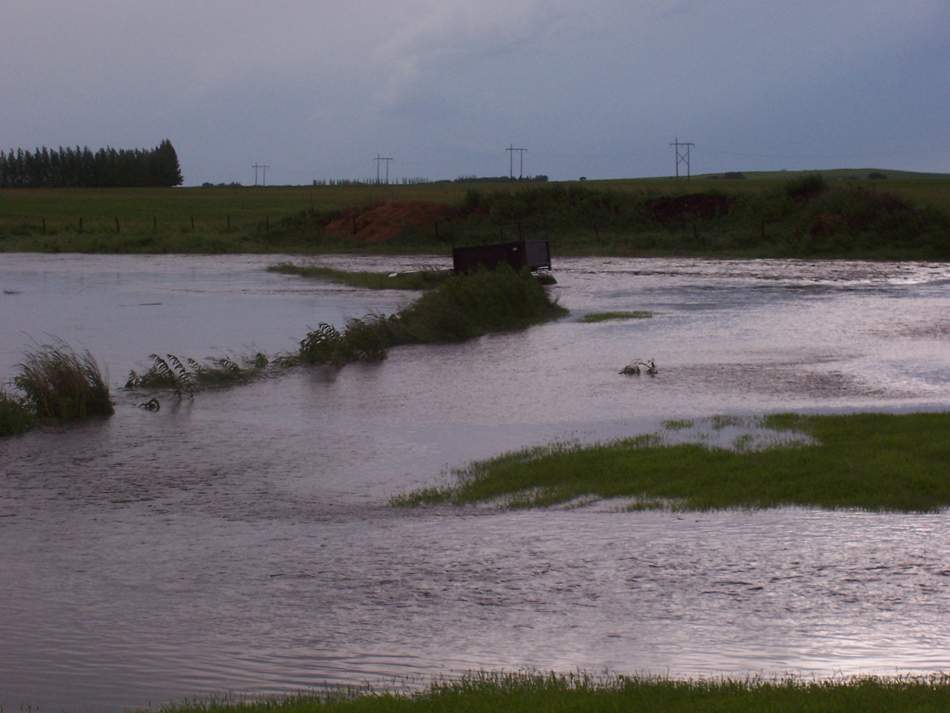
Flood conditions worsen in Canada’s Prairie provinces as rising water levels prompt evacuations and states of emergency.
A voluntary evacuation alert was issued to 650 homes in the Medicine Hat area of southern Alberta on Tuesday evening.
Both the City of Medicine Hat and Cypress County declared local states of emergency after water from the Seven Persons reservoir was released in order to protect an eroding spillway on the earthen dam.
The St. Mary’s River Irrigation District was trying to mitigate the amount of water going into Seven Persons Creek, but 28 homes around the creek were placed on mandatory evacuation.
"We’ve been prepared for something for a week. We just weren’t expecting this," said Brandy Calvert from the City of Medicine Hat.
"It’s serious business. We were looking at 500 homes but that has been upped to 650. There’s a mandatory evacuation for Cypress County and our evacuation centre is going. We’re on."
Calvert said the water velocity had been about 37 cubic metres per second and the number had risen to over 50 as the evening progressed.
"We’re looking at a rise of at least two to three feet of Seven Persons Creek alone and that’s the good side," she said. However, she admitted it was too soon to say if flooding would actually occur.
An evacuation centre was set up in a banquet room at the Stampede Grounds.
Medicine Hat sustained more than $50 million in damage in last summer’s flooding.
In southern Saskatchewan, flooding has forced the evacuation of a hospital.
Nine patients have been taken from the All Nations’ Healing Hospital in the town of Fort Qu’Appelle because a nearby creek spilled its banks.
Gail Boehme, the hospital’s executive director, says there’s no water in the facility itself but access roads are under more than 30 centimetres of water.
The Saskatchewan Watershed Authority warned yesterday that parts of southern Saskatchewan could see near-record flooding.
The Qu’Appelle River is expected to overflow along the entire Qu’Appelle Valley and that’s where the hospital is located.
The watershed authority says that over the next week or so, towns, villages, residences, cottages and farms should expect levels almost as high as 1974, when flooding caused millions of dollars damage.
Water levels are high because of a wet summer and fall in 2010 and more snow than usual this winter.



Comments
Want to discuss? Please read our Commenting Policy first.