




Officials in British Columbia say a tsunami advisory issued Tuesday due to a magnitude 8.8 earthquake that hit the Far East region of Russia was a good practice run for a more serious future event.

Emergency Info BC, which provides response and recovery information during emergencies, cancelled the alert at 6:07 a.m. Pacific daylight time (PDT) on Wednesday.
“Local government, regional governments all worked together well, got the message out to get people off the beach and made sure that people were as safe as possible, and thankfully, this time it was a low-key event, but next time we’ll know we’re ready,” Premier David Eby told CKNW’s The Mike Smyth Show Wednesday morning.

The advisory was issued Tuesday evening as an upgrade to an earlier tsunami watch, with tsunami waves expected to hit parts of Canada, the U.S. and Japan.
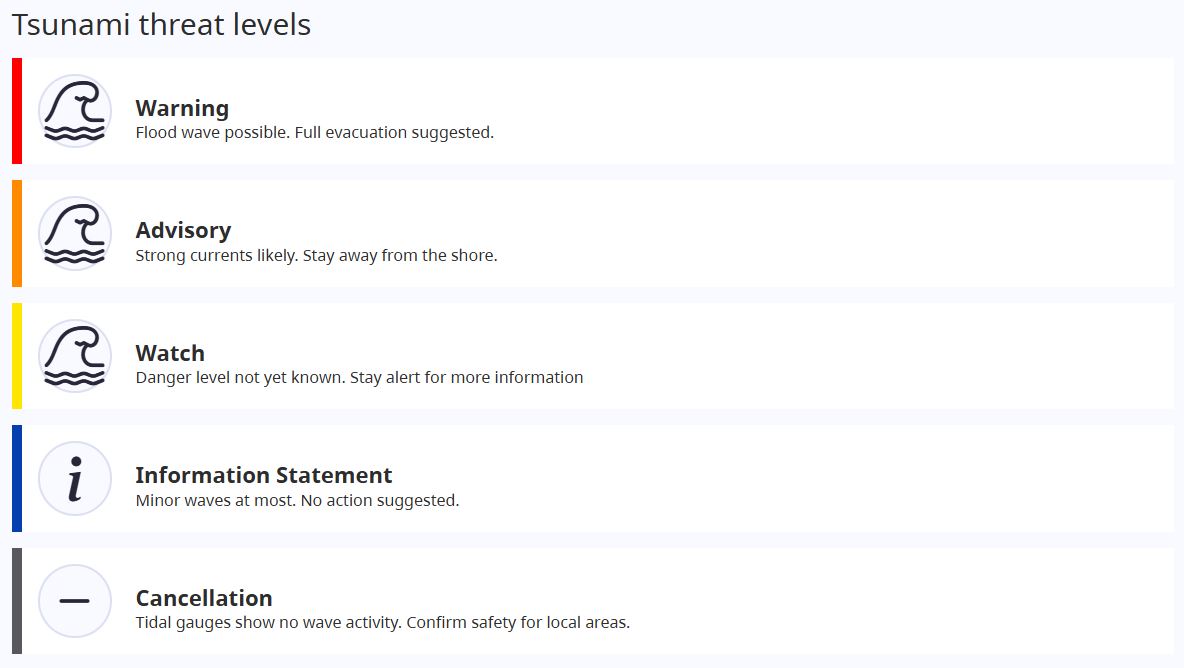
A tsunami watch is the lowest level of alert, issued when officials don’t yet know the danger level, while an advisory is issued when strong currents are likely and people should keep away from shorelines. A tsunami warning is the highest level of alert, which is issued when flood waves are possible and a full evacuation is suggested.
“Tsunamis are tricky, obviously, because they rely on the sensors that are placed out in the ocean, some of which are monitored by the U.S., some of which were monitored by Canada, there’s local government involvement, and then there’s international involvement,” Eby said.

Get daily National news
“This earthquake started off in Russia and so what happened last night was a really cautious approach that we take in these kinds of scenarios, led by the public service that are experts in this area, and trying to determine what the impact would be on B.C. and to warn people without knowing actually exactly how it was going to show up — because by the time it hits our sensors it’s really almost too late to really get people out of the way.”
On the west coast of Vancouver Island, beaches in Tofino were closed by 8 p.m., with widespread signage deployed to keep people away from the shoreline.
Ultimately, the impact on B.C. ended up being muted.


The U.S. National Oceanic and Atmospheric Administration noted in regional observations that an “observed maximum tsunami height” of six centimetres was observed at Langara Island overnight. Winter Harbour, Tofino and Bamfield also saw waves of 27 cm, 21 cm and nine cm, respectively.
Japan’s Meteorological Agency said a tsunami as high as 40 cm was detected in 16 locations as the waves moved south along the Pacific coast.

Several countries issued tsunami watches, advisories and warnings as a result, though as of Wednesday morning, some of the warnings in Hawaii, Japan and other parts of Russia have been downgraded.
“The warnings, the advisories were great, the system worked, the Pacific tsunami system worked as it should,” said SFU earth sciences professor John Clague.
“I think we were lucky, as far as I know, there were no fatalities from this gigantic earthquake, which is pretty rare when you get an earthquake of that size.”
Clague added that given the size of the earthquake, a series of aftershocks in the area is likely.
The waves were triggered by what is believed to be the strongest recorded quake since the 2011 earthquake that hit Japan and caused a massive tsunami.
Several people were injured in Russia, but no deaths have been reported so far.
— with files from The Canadian Press and The Associated Press


Comments
Want to discuss? Please read our Commenting Policy first.