


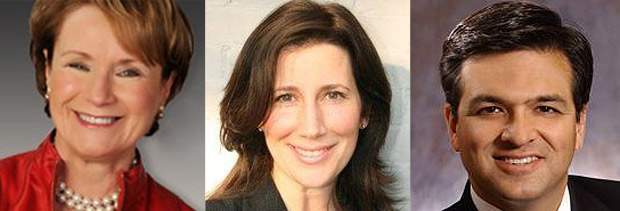
Global News hosted a live online debate with party strategists Goldy Hyder (Conservative), Penny Collenette (Liberal) and Kathleen Monk (NDP) on April 7, 2011.
A bit about the panelists:
Goldy Hyder – Conservative
Twitter: goldyhyder
Biography: Conservative strategist worked on Conservative campaign in 2000 (as Joe Clark’s Chief of staff) and also worked on the 2004, 2006, and 2008 – as a communications advisor for the Conservatives.
Now with Hill and Knowlton in Ottawa in government relations.
Penny Collenette – Liberal
Twitter: penottawa
Biography: Candidate last election 2008, in Ottawa-Centre, senior advisor in Michael Ignatieff’s leadership bid, and prior to that Senior Director in Jean Chretien’s PMO 1993 to 1997. National Director for the Liberal Party of Canada in the 1993 election campaign.
Presently with the University of Ottawa and as adjunct-professor of law.
Kathleen Monk – NDP
Twitter: kathleenmonk
Biography: NDP Director of Communications, Monk was a journalist before joining the NDP and has also often acted as a pundit for the party. She was appointed this June.
Here are the highlights of our second debate:
Goldy Hyder: GH
Penny Collenette: PC
Kathleen Monk: KM
Q: During the campaign this week, the level of control in the Conservative leader’s tour in particular has come under fire for limiting the number of questions journalists can ask and for throwing people out of rallies. Why are politicians so concerned with controlling the campaign?
PC: Campaigns are hectic and conducted under enormous media scrutiny. Canadians are entitled to get as "up close" and personal as possible – that’s our democracy. The only reasons to restrict access are for security or safety reasons (i.e crowd control, fire regulations). But other than that, any leader who wants to control what should be a very open and participatory process risks his/her credibility.
KM: Jack Layton’s rallies are open to the public. We advertise our rallies in local newspapers and do voice mail broadcasts in addition to using flyers and posters. I think that if you are running for public office you should make yourself available to the public.
GH: Like it or not campaigns, particularly Leader’s Tour are "scripted" designed to execute a strategy with a view to achieving the party’s objectives. The tour is, in essence, a tactic that supports the overall strategy. In today’s 7-24 media world managing (some say controlling) the message is central to be able to reach the targeted audience needed to achieve a party’s objectives. The strategy is obviously driven by "reality" of where a party is in the standings, how much human and financial resources it has etc…
Q: Does controlling the leader’s tour have an impact on the outcome of the election?
GH: Leader tours, in my opinion, are overrated for their impact on the final outcome. People do not vote for someone because they ran a good tour (though, on flipside, they might not vote for a party if its tour was pathetic and the mindset is that if you can’t manage a tour, how can you govern a country?) The debates matter a lot more than the leader’s tour.
KM: That’s an interesting question. I think that in the end very few Canadians make it to political rallies as most people are too busy with their day to day lives. That said, does controlling rallies have an impact on the campaign? It could — if the mainstream media continue to focus on this aspect of the campaign. I think people want to hear new ideas and what they leaders have to say on the issues that matter most to them: health care, jobs and making like more affordable.
PC: I guess the question should be turned back to the media. What do your viewers say they want to watch or listen to? The fumble or the policy?
Q: This week the media has talked a lot about the control on the Harper campaign and candidates in the Liberal campaign. As strategists, you think people care about these things or is it just a sideshow?
KM: Candidates aren’t side-shows … they are the individuals who are asking to be elected to public office. That is why the questions that were raised this week about some of the vetting process for the Liberal candidates both in Quebec and Alberta are concerning.
GH: People do not care – certainly not "normal Canadians" who don’t spend their time inside the political/media bubble. Remember something like a few percent of Canadians even belong to a political party. The more the coverage is about scandal, process, gotcha the less interest people have and the proof is in the pudding look at the decline in voter participation down to an all time low of 59 per cent in 2008. The central question voters have in their minds is "what are you going to do to help me?" It’s not selfish, it’s a very legitimate question and it is why I think this past week has been a disappointment that if the trend continues will produce yet another record low voter turnout.
PC: Yes, I do think people care because when you vote, your vote represents a collage of images and impressions. But people also remember the history of why they are voting. I think Canadians care a great deal about this country and have meaningful discussions with family and friends. But sometimes, we are a little reserved about saying how much we care or what has affected us. I never ever underestimate the intelligence of the voter.
KM: Goldy makes a good point. There are very few Canadians that are watching this political campaign as closely as we do. That said it is incumbent upon the media to ask questions on behalf of Canadian voters and raise the concerns that we heard both yesterday regarding Liberal candidate Andre Forbes and today with Liberal candidate John Reilly.
GH: I will say this about those who do vote though and it is one of my main takeaways from involvement in politics. Do not underestimate just how smart the Canadian voter is in producing precisely the outcomes it seeks – just look back at all the elections since 2004.
Q: Let’s talk about what the parties are going to do to help Canadians. The Liberals and Green Party both released their platforms this week. Do you think that platforms are still relevant, especially during this campaign that seems to be focused on winning strategic ridings in key regions?
KM: Ideas are always important. Demonstrating you have a costed, practical plan for Canadians during an election is necessary but so is acting on them when in office. I think Canadians have the right to be dissapointed in past governments for not living up to promises – despite having the resources to do so.
GH: Platforms are important – they represent the playbook by which a party intends to govern and as such a means of checks and balance on the part of the public. Who doesn’t remember the Liberal promise of 93 to do away with the GST? Platforms matter. It is for this reason i think you are seeing the Conservative platform take a cautious/responsible approach to promise making with so many – including today’s to double the tax free savings account – being contingent on "only after the deficit is zero."
PC: A platform is like the spine of the campaign. Everything feeds off it – behind every platform are hours and hours of discussion and debate.
Q: Let’s talk about the policies that were unveiled this week, starting with the Liberal platform. What do you think about the ‘Family Pack’ and is it affordable?
KM: Layton joked this week that the Liberal Family Pack was a Xerox copy of the NDP platform (which was a good thing) the problem is the Liberals tend to also use shredders because they consistently fail to deliver on their promises to Canadians.
GH: Conservative Party platform will be released Friday but unlike the Liberal one it will not try and be all things to all people and promise to take care of them from cradle to grave and again with respect unlike the Liberal one the math will add up. These platforms are really going to underscore the striking difference in approach to governance and the people will have clear choice between big government, higher taxes, more programs versus lower taxes, smaller more efficient government.
KM: Also interims of the Liberal plan on education — while well intentioned — their high grant / high tuition plan doesn’t address the problem of rising tuition costs. Tuition is rising faster than the rate of inflation. The Liberal plan does nothing to solve that.
GH: Liberal Party platform doesn’t add up. No line item for the Quebec City arena their Leader has committed to. No line item for the $2.2B HST payment to Quebec. No line item for the bridge in Montreal. No costing on the high speed rail proposal. I could go on.
PC: Seniors under the Liberal platform are getting an entire package to make sure no one gets left behind. An increase in the GIS and a new Secure Retirement Option will offer Canadian seniors a simply, voluntary tax deductible savings option.
Q: From our audience: We are facing a national student debt crisis and no one wants to do anything to help us end it/fix it. It is fine to offer future students and graduates relief by offering grants and easier access to loans, but what are you going to do about the graduates who have been out of school for years and who still haven’t found work in their chosen field and cannot ever pay off their debts?
PC: Under the Liberal platform, students will get $1000 a year deposited in their RESP accounts in order that everyone who gets the grades, get to go as Mr Ignatieff says. This money is up front and will be made available by a Liberal government who will save money by not giving corporations another tax break.
Q: Let’s turn the spotlight towards the NDP for a moment. Mr. Layton announced a gang-strategy focused on prevention. Does this logic make sense?
KM: Jack Layton announced today the New Democrat’s approach to making our streets safer and our neighbourhoods stronger. Everyone agrees Canadians should feel safe on the streets of their communities, but that’s not always the case. Layton’s plan focuses on better prevention, protection and prosecution – measures to get more police on the streets of our communities, divert kids away from crime and go after gang recruiting.
PC: Prevention and punishment need to be balanced. Can’t have one without the other.
GH: This Conservative Government has a record it can be proud of on law and order legislation. There is no question where it stands and therefore I invite you to compare the platforms. Liberal Party itself needs to come clean on its positions of the crime legislation before parliament – its silence speaks volumes. As for the NDP, I don’t disagree with the need to include prevention, education, and a more holistic approach to the issue.
KM: Layton announced today our plan to increase the Youth Gang Prevention Fund to divert at-risk youth away from crime; create a comprehensive shelter system for women fleeing violence; and double and make permanent the Police Officers Recruitment Fund — something the Conservatives promised but never delivered on.
PC: Goldy, I can never understand why the conservative party is apparently so "tough" on crime but "soft" on guns. Register them!
Q: The Conservatives also made a policy announcement today — a promise to bump up the annual tax-free savings account to $10,000. Will this proposal actually get people saving more? What do you think of the timelines?
KM: Sadly the Conservatives announced another phantom promise today. Families need help now, not in four years from now.
GH: The proposal to double the c once the deficit has been eliminated is yet another strong initiative that helps people lower their tax burden and increase their savings. Already 4.7 million Canadians participated in the current $5k savings plan.
PC: The Conservatives proposal today is just fine if you already have money in your TFSA account. But many people don’t and yes, especially students who are trying to cope with debt. Like many other Conservative promises, they often favour those who are already doing well…
GH: I trust viewers are seeing the dilemma here for the Conservatives! Every response results in another request for more spending by the NDP/Liberals. If families have to live within their means so too should government. If families have priorities so too should governments. This is after all the people’s money!
Click here to watch the blog replay of our second debate on April 7, 2011.
Click here to read the highlights of our first debate on March 31, 2011.



Comments
Want to discuss? Please read our Commenting Policy first.