

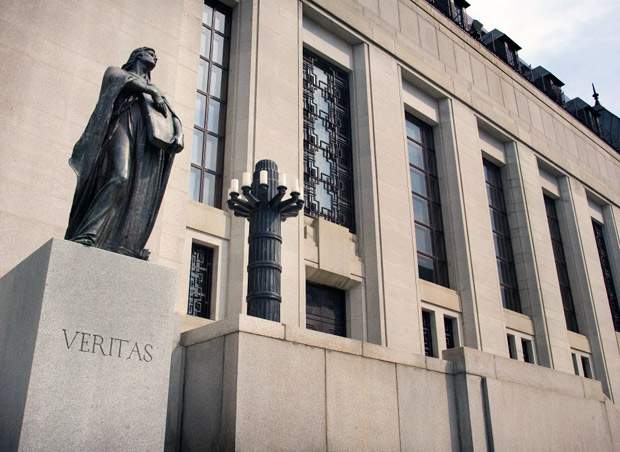
OTTAWA – Restrictions on journalists in public areas of courthouses and rules preventing them from broadcasting the official audio recordings of hearings are justified under the Constitution, the country’s top court said Friday.
in a unanimous decision, the nine members of the Supreme Court of Canada rejected arguments by several media organizations seeking to overturn a 2005 directive from the Quebec government. The ruling acknowledged that the restrictions were an infringement on freedom of expression, but that it was justified under the Charter of Rights to ensure the "fair administration of justice" and protect the decorum of the courts.
"Courtrooms have always been heavily regulated," wrote Justice Marie Deschamps in the ruling. " This regulation ensures, inter alia, that witnesses can participate as calmly as possible in the truth finding process."
Although Quebec media had, for years, had access to official audio recordings of civil and criminal trials, and were using them for broadcast, the new government rules from 2005 stopped the practice. The directives also required media to conduct interviews, take photographs, and film images only in designated areas of the courtroom, away from the hearing rooms.
At the time, the government argued that the media were disrupting courtroom activities, often leading to "excesses" such as blocking hallways or jostling with witnesses, lawyers and others in the public areas.
The top court agreed that the rules were justified.
"Like litigants, the media have an interest in contributing to the fair administration of the judicial system," wrote Deschamps. "An approach under which only the immediate interest of a few journalists indifferent to the proper functioning of the courts are taken into account would not foster freedom of the press. The press would be far less useful, if, in seeking to fulfil its function of reporting information of public interest, it were to compromise the serenity of hearings and the search for the truth. The presence of journalists would then be not ineffectual, but harmful."
In a separate but related case involving Stephan Dufour, a man acquitted of charges of assisted suicide, the Supreme Court agreed that a trial judge was justified in preventing media from rebroadcasting evidence of an interview the man gave with police. The ruling concluded that the court must decided in each case what impact the broadcasting of such a statement could have on a trial or a vulnerable individual.
Deschamps also noted that other countries have similar restrictions on coverage of the courts that are sometimes "even stricter" than the measures challenged in this case.
"For example, in the United Kingdom it is prohibited to take any photograph or even to make any sketch in court of any participant in legal proceedings, including in the building and its precincts, and to broadcast recordings of judicial proceedings," she wrote. "France also prohibits the use in courtrooms of any device for recording or broadcasting sound . . . This national, indeed international consensus confirms that measures intended to regulate the work of the media in courthouses are necessary to maintain the fair administration of justice."
The appeal to the Supreme Court was launched by the Canadian Broadcasting Corporation, along with Groupe TVA inc, the newspaper La Presse and the Federation professionnelle des journalistes du Quebec after the government rules were upheld in Quebec Superior Court on Oct. 20, 2006 and again in a split decision of the Quebec court of appeal on Oct. 10, 2008.
The Supreme Court heard arguments in the case in a hearing on March 16, 2010.



Comments
Want to discuss? Please read our Commenting Policy first.