

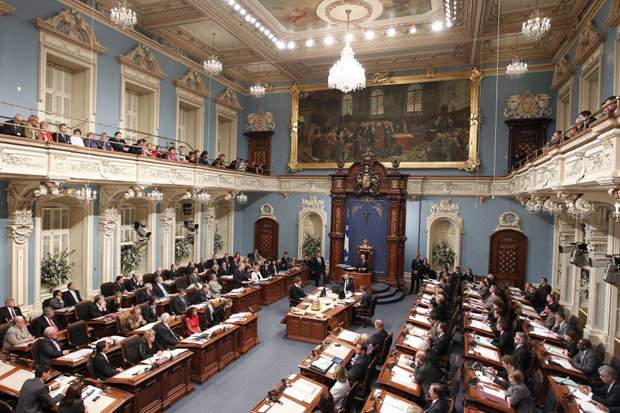
Marcel Blanchet, Quebec’s chief electoral officer, says he finds it "troubling" that Premier Jean Charest’s government wants to suspend until June 30 his powers to redraw the electoral map.
Bill 132, presented Wednesday in the National Assembly, would strip Blanchet of his powers. It is the government’s response to a regional coalition concerned about Blanchet’s plans to redraw the map, reflecting population shifts. Blanchet wants to eliminate three underpopulated, rural ridings.
Before 1979, elected assembly members redrew the map to account for population changes. Since then, the chief electoral officer, an independent non-partisan official, has set the boundaries for Quebec’s 125 provincial ridings.
The three seats to be eliminated -including Kamouraska-Temiscouata, where the Liberals hope to win a Nov. 29 by-election -would be replaced by three seats in Montreal’s off-island suburbs, where the population is growing.
"We are the place in North America where the (population) imbalance is the largest," Blanchet told reporters.
Gaspe riding has 27,503 voters, while Masson, north of Montreal, has 65,408, meaning the weight of a Gaspe elector is 2.4 times that of a Masson voter, a report Blanchet issued this year notes.
"They have turned everything every which way, and obviously there is a constitutional framework that must be respected," he added.
The Supreme Court of Canada doctrine of "effective representation" gives the chief electoral officer some leeway in setting boundaries, but generally he must stick to the rule of not deviating by more than 25 per cent from the 43,000-voter average for Quebec’s seats.
Liberal government House leader Jean-Marc Fournier and his Parti Quebecois counterpart, Stephane Bedard, told reporters the "criteria" for setting boundaries could be changed to keep the smaller regional seats.
"Until June, there is a pause in the drawing of his map," Fournier said, noting that the parties could propose changes in the law which the chief electoral officer must follow in making the new map.
The smaller opposition parties, who want proportional representation, could propose such a solution, he said.
But Bedard indicated proportional representation is a non-starter. "We are talking about a grey car," he said. "And now you tell me about a white fridge?"
Bedard said there is not enough time to change the whole electoral system, appealing to Fournier to speed up the process and accusing him of "improvisation."
If MNAs cannot agree on a new electoral map, it is possible the next election, to be held by 2013 at the latest, would use the present map, based on the 2001 census.

Comments
Want to discuss? Please read our Commenting Policy first.