

Nana Mouskouri
Event Ended- Where
- Northern Alberta Jubilee Auditorium - View Map
- When
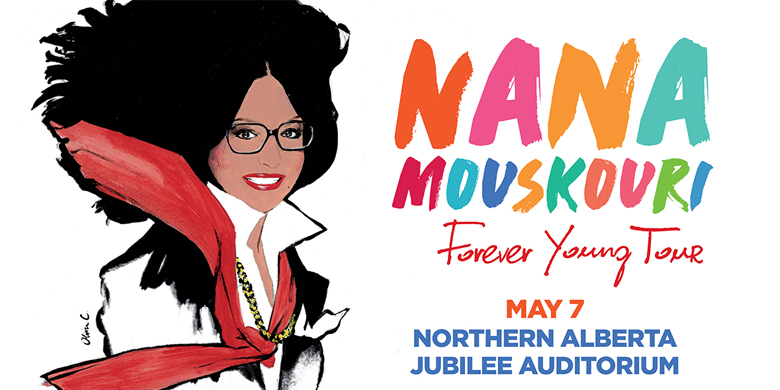
NANA MOUSKOURI
FOREVER YOUNG TOUR
MONDAY, MAY 7, 2018
NORTHERN ALBERTA JUBILEE AUDITORIUM – EDMONTON, AB
Doors: 6:30PM Show: 7:30PM
TICKETS ON SALE FRIDAY, OCTOBER 20 @ 10AM
Tickets available at www.livenation.com
Charge by Phone 1-855-985-5000
Tickets (incl. GST) $46.50, $59.50, $76.50, $125.00
(Plus Service Charges)
**RESERVED SEATING / ALL AGES**
The moon is made of paper And the seashore is fake
But if you believed in me a little It would all become real
Hartino To Fengaraki (Little Paper Moon) (Manos Hadjidakis/ Nikos Gatsos)
The Forever Young Tour is a new journey, going back to the beginnings through the waters of youth. Dreams do not wither — neither do songs. They are bubbles of eternity embracing our memories, the soundtrack of our lives. Nana Mouskouri devotes her inspiration to the artists she’s met along the road, people from countless countries, who taught her to love words and notes. Just like Dorothy who, in The Wizard of Oz, the movie from Nana’s childhood, shares so many destinies, adventures and talents along the Yellow Brick Road. 60 years of music and fantastic friendships : Manos Hadjdakis, Nikos Gatsos, Michel Legrand, Quincy Jones, Bob Dylan, Leonard Cohen, Bobby Scott, Simon and Garfunkel, Serge Gainsbourg, Pierre Delanoë, Claude Lemesle, Mark Knopfler, Tony Visconti, Serge Lama, Joni Mitchell, Francis Cabrel… And so many others from here and there, from yesterday and today. “No matter what you want to achieve, all that counts is the way to get there. Why, how and with whom you travel!” she claims. A progress in love and music, a way to learn and understand, a course to be served and honored…
She is affable and smiling, simple and sweet, at once cheerful and grave. Her long sentences are winding and emotional, her phrasing draws on several languages and the almost childish elocution is a distinguishing feature of hers. This poetry full of tenderness has become her language of peace. Her purpose is vast, spirited and philosophical, and her speech might twist and turn, yet it leads steadfastly to a single destination, a sacred temple: Music. Music is the alpha and omega of her existence, her very DNA. As a Singer, Nana has always strived for the right word, the absolute meaning, the unadorned truth, when calling up that fate which took her far further than she could have imagined. The destiny of a Greek girl, a war child born in destitution, who could not even picture such incredible countries at the other end of the world, the foreign languages she would be speaking, the millions of records she would sell, and the looks of so many admirers upon her. “I just wanted to sing, you know…” she says, as if surprised by her good fortune — she all but apologizes for all the glory, she feels a trifle guilty, and obsessed with the huge responsibility that fell to her : to serve music unfailingly. To become a soldier, but a soldier of peace. Always discreet and careful, Nana talks about herself in veiled terms, never abandoning her doubts and fears, or that insecurity of hers which is not a pose at all but the consequence of a discomfort, a feeling of alarm that no triumph could ever soothe. Since the days of her childhood beneath war skies, fear and shame have nestled into the secret recesses of her soul. Only music and the ecstacy of singing could save her from her old demons.
“I often wonder what she would have done, had music not existed”, Charles Aznavour muses about Nana Mouskouri.
A life without singing is quite simply inconceivable. “I would have become a criminal…” she claims directly. Music is not a choice, it is self-evident. It is not just a passion, it is her very self. Her blood, her laughter and her tears, her soul and her heart, music is everything she is. The stage is her land of welcome and her only way in life. Nana Mouskouri went into singing as some go into the Church. She took the veil, though a diaphanous one, chiffon or silk. But the desire to attain to the absolute is quite the same. Each show is a port of call that transforms her. The life of a woman singer is a crossing she shares with so many travelling companions: the audiences who welcome her, the musicians who follow her on the road, the composers and songwriters who feed her.
At first, in Greece in the late 1950s, young Nana was a blank page in search of her words and notes. The ink flowed from her masters: at the Athens Conservatoire, she met Verdi, Puccini, Mozart and Schubert. On the small screen of her father’s open-air theater, Marlene Dietrich, Fred Astaire, Ginger Rogers, and little Dorothy from The Wizard of Oz. In her dreams, the most famous Greek woman in the world, Maria Callas. In nightclubs and talent shows, Nat King Cole, Sarah Vaughan, Billie Holiday, Frank Sinatra, Ella Fitzgerald… Nana was drunk with music, and she quenched her thirst to every spring: jazz, rock or opera. “Music is a rainbow that breaks through the language and style barriers” became her credo.
However, it was Greece that offered her an identity card, or even better, a passport to the world. As Manos Hadjidakis lent credibility to Greek pop, Nikos Gatsos provided his poetry and wisdom — Nana would be their voice and most loyal servant. With two jewels in her hands, Kapou Iparhi Agapi Mou (My Love is Somewhere) and Hartino To Fengaraki (Little Paper Moon), she won first prize at the Greek Song Festival, both in 1969 and 1970. A witness to her second triumph, a man was about to change her destiny: Louis Hazan, head of the Phonograph Record Company, a subsidiary of the giant Philips group. As his wife Odile, he had fallen under the spell of young Mouskouri’s voice. He talked of taking her to Paris…
Still in 1960, Nana left Greece for the first time: Barcelona and its Mediterranean Song Festival awaited her. Again, she won the day. As soon as her victory was announced, Nana received an unlikely phone call backstage. Having heard her performance on the radio, Louis Hazan was in seventh heaven. Two friends of his wanted a word with Nana: a Michel Legrand and legendary Quincy Jones, the genius trumpet player and a friend of Duke Ellington’s, Ray Charles’s and Sarah Vaughan’s… The three of them contemplated meeting in Paris or New York. Nana was stunned by such a surreal perspective: the gateways to the world were opening slowly without her having had time to decide or dream about it.
Newborn Europe was looking for devoted children and Nana Mouskouri was about to become one of them… Manos composed the soundtrack of a documentary film called Grèce: terre de rêves (Greece, a Land of Dreams), and Nana lent her voice to five of the songs. The film won an award at the Berlin International Film festival, which earned Nana the opportunity to record two tracks in German. San Sfirixis Tris Flores became Weiße Rosen aus Athen (The White Rose of Athens). It was a thundering success! Within six months, the single sold one million and a half copies. Beneath the outward shyness, Nana’s formidable adaptability and faculty for learning stood out. She got caught in the game and learned German, out of respect for the audience greeting her, and in a will to get closer to them and earn her place. Nana saw every new language as a sweet music, both a game and a challenge, and above all, a token of her commitment and responsibility. Tape recorders, dictionaries and textbooks became her weapons of choice. Weapons to serve peace and bring people together. German in particular was quite a symbol for this war child. Learning a new language meant holding out her hand to others. She caught English from Jazz, Italian from her mother’s origins in Corfu, German from her first success out of Greece and there she was, in Paris, invited by Louis Hazan and his wife Odile, and unable to string two words together. A 4-track album first saw the light: Un roseau dans le vent, La montagne de l’amour, Le petit tramway and Retour à Napoli. An awful lot of unpronounceable sounds and a great strain on the newcomer’s nerves. Nana stuck at it, dissected each and every syllabe, each and every sonority. Listening to the recording 60 years later, one finds it hard to believe that the singer grew up so close to the Parthenon! After attending an Edith Piaf’s concert at the Olympia, Nana was so deeply shaken by Piaf’s talent that she feared she could not aspire to a career in the same country. The Hazans reassured her and incidentally convinced her to lose a few pounds. They taught her how to dress and make up like a true Parisian. Nana became pretty, no out of vanity but to better serve her art. While success was long in coming in France, Quincy Jones kept his promise. In June of 1962, Summer was jazz and the Greek girl was American. At nightfall, she met with Sarah Vaughan, Ray Charles, Miles Davis… for real. During the day, she recorded her first American album. No Moon at All, That’s My Desire, Love Me or Leave Me, Smoke Gets in Your Eyes… 55 years later, The Girl from Greece Sings album has become legendary.
Back from America, in London Nana prepared for a big European event: the 1963 Eurovision Song Contest, in which she flew the flag for Luxembourg with A force de prier (By Persistently Praying). Her performance and the song in itself were not particularly memorable, and she did not know yet that through that failure, she was staking her visa to the whole world. Patience was required — fate is a mischievous genius and defeats are promises of victories to come, if you know how to see through them and you are ready to roll up your sleeves. That same night, Harry Belafonte was in London watching television. He wanted Nana and no other to join his new North American tour. From 1964 to 1966, they travelled five times throughout America together and recorded a two-voice album in Greek, An Evening with Belafonte and Mouskouri, a must full of mellowness and elegance. With patrons like Quincy Jones for her records and Harry Belafonte for the stage, Nana Mouskouri enjoyed the American Dream of music. Across the Atlantic, she enriched her background with folk and country music, and soon borrowed titles from Joni Mitchell and Dolly Parton, which she performed in several languages, like From Both Sides Now or Love Is Like a Butterfly, and also from Bob Dylan, Leonard Cohen and Joan Baez, whom she all befriended. Nana was Dylan’s voice in Amour moins zéro (Love Minus Zero), Le ciel est noir (A Hard Rain A-Gonna Fall), Tomorrow Is a Long Time, I’ll Remember You, Adieu Angelina (Farewell Angelina), Every Grain of Sand and again this year in Forever Young. She also was Leonard Cohen’s in The Guests, Suzanne, You Know Who I Am and her very sensitive version of the Ballad of the Absent Mare, (Ballade du chien-loup). From her friend Joan Baez, Nana borrowed The Lily of the West and All My Trials — the latter she performed in three different languages.
The 1963 Eurovision contest also made another encounter possible, which was about to transport Nana Mouskouri all around the world. Her name was Yvonne Littlewood. A producer for BBC Light Entertainment, she thus directed the Eurovision Song Contest and was straightaway impressed by Nana’s voice and, most of all, her disarming sincerity. Yvonne spontaneously invited Nana to a Saturday night programme on the British channel. Four years later, she entrusted her new protégée with a show, Nana With Guests, in which Nana performed alone or in duets with prestigious guests. The adventure lasted for thirteen years, with several shows a year. Thanks to the unique magic of television, Nana’s albums got instant popularity throughout the Commonwealth : her music conquered Australia, New Zealand, Asia, South Africa, North America, as well as Scandinavia, most European countries — especially Holland, Belgium and Great Britain of course, where her LP Over and Over, released in 1969, topped the UK charts for two years. She also went to Canada most frequently, both in the French- and the English-speaking provinces, and found a land of welcome there. She even appropriated Un Canadien errant (A Wandering Canadian), an anthem she dedicated to Prime Minister Pierre Trudeau.
While she travelled across America with Belafonte, France finally fell under the spell of Nana Mouskouri, accompanied by The Athenians, a band led by her husband, guitar player Georges Petsilas. André Chapelle, her new artistic director, was the alchimist of this sweet enchantment — which was to become a lifelong commitment –, through tailor-made tracks like L’enfant au tambour, adapted from a popular Christmas song in English (The Little Drummer Boy), or C’est bon la vie (59th Street Bridge Song (Feelin’ groovy)) by Simon and Garfunkel, Adieu Angelina (Farewell Angelina) by Dylan, and later Au cœur de septembre (Try To Remember), borrowed from Harry Belafonte, Guantanamera, Le cœur trop tendre, Le jour où la colombe, Le temps des cerises…
Nana’s signature is a repertoire wide open to the world. She is a messenger, and her voice is a bridge between two shores, uniting different peoples and cultures. Though being an international singer, Nana has established herself in an unprecedented way as a national singer in each and every territory that greeted her, and has embraced local folklore. In France, from 1973 to 1978, she released Vieilles Chansons de France and Nouvelles Chansons de la vieille France, two LPs of traditional songs including Voici le mois de may, Le pont de Nantes, Ah si mon moine, La belle est au jardin d’amour, Le roi a fait battre tambour, A la claire fontaine or Dans les prisons de Nantes. Suddenly, France remembered its folklore, and it was a Greek woman who refreshed its memory. In 1976, in the UK, Nana recorded Songs of the British Isles and in 1979, in Germany, songs for children. Later, in 1991, she released thoughout the Hispanic world an anthology of Spanish and South American songs.
Nana Mouskouri is a gentle conqueror and, in the 1980s, she annexed new territories to her musical empire. In addition to Asia, all European countries, America and Oceania, she encharmed Latin America. On a continent battered by dictatorship, she sang of freedom. Libertad and Liberdade, the Spanish and Portuguese adaptations of the Chorus of the Hebrew Slaves from Verdi’s Nabucco, were on everyone’s lips, from Chile to Mexico, to Argentina and Colombia, Brazil and of course Spain and Portugal. In 1981, the hymn to peace, Je chante avec toi Liberté, had already sold 65000 copies a day in France, while other parts of Europe and the world stroke up Song For Liberty and Lied der Freiheit.
The 1980s also marked the child prodigy’s homecoming. In 1984, Greece celebrated the tenth anniversary of ifs return to democracy after seven years under the Regime of the Colonels: on July 23rd and 24th, Nana Mouskouri did not miss the date with history, at the foot of the Acropolis, under the star-studded sky and in a frame of ancient stones — the Odeon of Herodes Atticus. Quite a symbol, and the climax of a long journey that had taken her all over the world to sing the Greek soul. Nana was to meet at last the Greek songs that had created her legend. On the night screen, she could see memories unreel, the childhood of a girl who wanted to sing and the face of her mother, who had passed away a few years earlier. The show ended with Schubert’s Ave Maria, in the arms of president Caramanlis and Melina Mercouri, then Minister for Culture.
Still in 1984, Only Love — the English version of L’Amour en héritage — was a worldwide success and Nana forestalled both Madonna and Michael Jackson on top of the UK charts. Far from going to her head, her ever-growing success intensified her sense of responsibility and her self-demanding nature: be up to the gift you were given and deserve it, follow your own path with righteousness and dignity – were Nana’s credos. She never slackened in her quest for truth and meaning. In 1988, the double LP Classique (The Classical Nana) was a faithful illustration of her concern for consistency: a return to the source of her musical training and to opera singing, which would have been her father’s preferred choice as a career for his daughter. A father who was once disappointed not to have a son at last rejoiced in seeing that his name would outlive him, beyond his greatest expectations, thanks to little Nana. The wounds of the past were mending: music is a rare healer.
One world tour followed another and discreet Nana went on her long-distance journey to serve her art. But in 1993, the Singer decided to dedicate herself to great causes, as a citizen and a humanist: she became a very active Unicef Goodwill Ambassador, then a Member of the European Parliament from 1994 to 1999. Time went by and though her passion remained intact, Nana started wondering about the future: times had changed, shouldn’t she drop out and let the younger generation take over? The voice of reason prompted her to tiptoe out, to set about the last great journey, her Farewell Tour. She spent three years taking her leave of her audience all over the world, thanking all who had placed their trust in her for so many years, who had given her love and a reason for existing. One night, in July 2008, the time came to say her farewells. Standing once again at the foot of the Acropolis, like a vestal in majesty, she dismissed her songs and her audience with a shattered soul. She appeared to close the door of her dream behind her, and on the giant screens her face was bathed in tears. Suddenly, darkness engulfed her and she receded backstage, hidden by the ancient stones of her open-air theater. “In that moment, it seemed to me that I was getting into my coffin”, she revealed afterwards.
Nana Mouskouri has never dwelled on numbers and has humbly left praise aside, along with the 300 gold and platinum discs that have punctuated her glorious career. While she’s looking away, let’s mention that the Singer — as her husband and producer André Chapelle tenderly calls her — sold about 350 million albums. A wonder that enabled her to rank second, behind Madonna but before Céline Dion, of the best-selling female recording artists of all time. In 2018, Nana will celebrate her 60 years of success in music, and she just recorded her 134th album. 134 albums, 42 of which in French, 33 in English, and 26 in German. An outright record, 1600 tracks in 19 different languages, including Greek, Spanish, Italian, Dutch, Portuguese, Mandarine, Taiwanese, Korean, Japanese, Hebrew, Corsican, Latin, Gaelic, Irish, Catalan and even Maori. And we haven’t heard the last of her yet, for more languages are goading her enthusiasm and curiosity…
No, we haven’t heard the last of Nana Mouskouri. She’s singing again and it’s a dream going on. Her dream and ours. A dream for the makers of words and notes she never stopped honouring and serving. For Dylan, whom she kisses again, so tenderly and infinitely, as she resumes her journey around the world — her Forever Young Tour…
May you build a ladder to the stars And climb on every rung
May you stay forever young Forever young, forever young May you stay forever young