

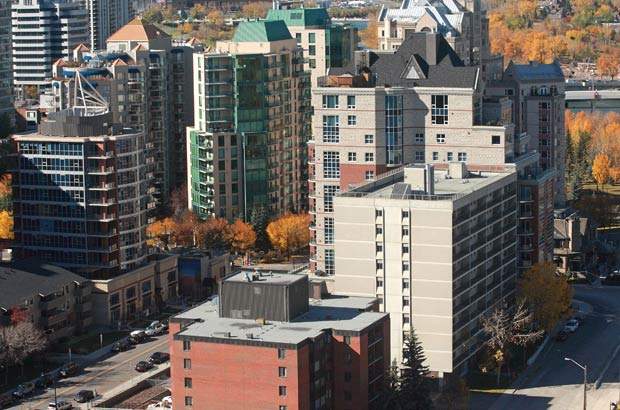
CALGARY – The new affordable housing apartments the city built downtown with a private developer cost taxpayers about four times more than it would have cost to refurbish the units in a nearby building the city will soon demolish, according to figures city officials have quoted.
Calgary Housing Company abandoned an aging, unpainted concrete 72-unit complex on 1st Avenue S.W. and moved residents this year into the 88-unit Louise Station project three blocks away, as part of a controversial land deal.
The Louise Station tower cost the city and provincial governments about $28.7 million, or $320,000 per unit, council was told two years ago.
That same 2007 report to council said that bringing the then-35-year-old Eau Claire Apartments building on 1st Avenue up to modern standards was not "financially reasonable," and would have forced the elimination of eight units. But the city didn’t give a dollar figure to explain what "financially reasonable" meant.
The updates would have run taxpayers $80,000 to $90,000 per unit, James Robertson, the city’s director of land servicing and housing, told the Herald.
Regardless, the building was both an economic and social problem, according to Robertson.
"We knew that building had requirements, and we wanted to make sure that it wasn’t going to be a continued problem," he said in an interview. "And if you go by Louise Station, it is a fantastic building and a fantastic facility for the City of Calgary."
However, the city’s use of provincial tax dollars on the Louise Station project was part of the reason the province cancelled this year its so-called block funding program for affordable housing.
Alberta Housing Minister Jonathan Denis admonished the city for not tendering the contract on the project and said he’s concerned the city misspent provincial tax dollars. All provincial projects, he noted, must be put out to tender — a process that is more cost-efficient than sole sourcing.
"When you’re talking millions and millions of dollars, I think it’s in the taxpayers’ interest to go and have these items tendered," Denis said Sunday, adding the average provincial cost for affordable housing is $97,500 per unit. "It can’t be just affordable for those who are the clients. It also has to be affordable to the taxpayer."
Denis said the provincial funding program that helped build Louise Station was cancelled earlier this year because of a lack of provincial control over how the money was being spent by municipalities across Alberta, including Calgary.
"The best way to deal with this on a go-forward basis is to go through the RFP (request for proposal) process rather than simply handing the money over to the city," said Denis. "Whoever becomes the new mayor is going to get a call from me about the RFP process."
The former head of the Calgary Homeless Foundation said he also had concerns that a city with a major affordable housing crisis wasn’t getting the most out of the provincial grant money flowing in.
"With the provincial money, we’re trying to get the maximum number of affordable housing units," said Wayne Stewart, now running for mayor. "We should be doing it in the cheapest possible way."
A few blocks from Louise Station sits Sundial Apartments, a 1960’s highrise that’s seven years older than the Eau Claire building the city plans to pay to demolish and make way for a private developer’s condo project.
Sundial was purchased last year by the Calgary Drop-In Centre, so the homeless agency could turn the building into affordable housing. At $18.5 million for 119 apartments — plus a $500,000 systems upgrade — the complex ran less than $160,000 per door.
"You’re able to close up within 90 days as opposed to three to four years to build it," drop-in financial director Alan Facey said of the advantages of using an old building over constructing new. "And, of course, the economy of it. It’s much cheaper to buy than it is to build, certainly at those prices."
It’s an additional question about taxpayer value in the city’s complex arrangement with LaCaille Group Inc. to scrap one housing project and build a new one.
The Herald reported last week that council agreed to sell the 1st Avenue property, where the old building now sits vacant, to LaCaille as if the land were bare, and despite internal staff warnings that the appraised value of the property was out of date by the time aldermen approved it in 2007.
According to internal documents obtained by the Herald, the city agreed in 2007 to sell the site for $4.5 million, with the transaction not taking place until the completion of the affordable housing project on 4th Avenue.
The final sale price won’t be disclosed until LaCaille completes the sale, which it’s been able to do since July. The proceeds are supposed to help pay for the $28.7-million Louise Station housing tower, which is mostly covered through provincial grants and city reserves.
Today, the 1st Avenue property is assessed by the city at $12.3 million.
Mayoral candidates Barb Higgins and Naheed Nenshi expressed concerns the city squandered millions on the land deal for the 1st Avenue property. The wide gap in costs to refurbish the old building and build units at the new one suggests millions more — largely in provincial grant money — could have been saved for other housing projects.
Asked last month about the cost comparison, Mayor Dave Bronconnier said it’s somewhat of a moot point, given the city’s intentions to replace the building.
"That may be a valid question that I’m sure was asked at land committee," said the mayor, who never sat on that committee as mayor.
"What was presented to city council for approval and approved was a complete rebuild of a new property, meaning a totally different environmental standard."
A confidential 2005 Calgary Housing Company report obtained by the Herald laid out the case for what the agency called "reprofiling" the 1st Avenue housing structure.
It notes that Eau Claire had transformed into a high-end condo neighbourhood in the decades since the social-housing property’s construction — and the site had become a magnet for street crime and prostitution.
What’s more, the site, while structurally sound, was 1.5 metres below the modern environmental standard for flood prevention. For the property to be brought up to grade, the heating and electrical systems would have needed to be elevated from the ground floor to another level in the 11-storey building, resulting in a loss of units, city spokesman Ed Conway explained.
"While it is structurally sound, its location and original design place it in significant risk due to future flooding of the Bow River," the report said, also noting "its inability to contribute appropriately to the redevelopment of the Eau Claire residential district."
The agency recommended later that year to dispose of the building by selling the site and finding another developer willing to buy "one of the best riverside downtown properties" and help the city construct a replacement property nearby, another report states.
The $80,000-to $90,000-a-unit modernizing figure was not included in either report — nor in any publicly available reports to aldermen. But Conway confirmed that was the cost estimate.
The city has also said the new building provides more energy efficiency than Eau Claire apartments, as well as more meeting space and 11 accessible suites.
jmarkusoff@calgaryherald.com and swilton@calgaryherald.com



Comments
Want to discuss? Please read our Commenting Policy first.