

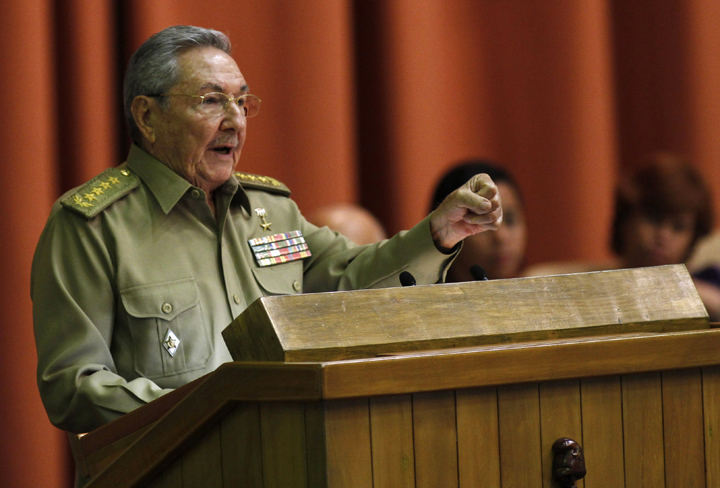
HAVANA, Cuba – Raul Castro spent the lion’s share of a prominent speech Sunday scolding his countrymen for all kinds of bad behaviour, everything from corruption and theft to public urination and the odoriferous practice of raising pigs in cities.

Speaking before legislators at one of parliament’s twice-annual sessions, the Cuban president railed against decaying morals, a deteriorating sense of civic responsibility and vanishing values like honour, decency and decorum.
Castro aired a laundry list of complaints about illegal activities that he said do the country harm: unauthorized home construction, illicit logging and slaughter of livestock and the acceptance of bribes, to name a few.
He also fulminated against baser examples of “social indiscipline”: shouting and swearing in the streets, public drinking and drunk driving, dumping trash on the roadside and even people who relieve themselves in parks.
At times, the 82-year-old’s speech sounded like a generational broadside against disrespectful youth who do as they please, a diatribe that could have crossed the lips of many a grandfather.
“When I meditate on these regrettable displays, it makes me think that despite the undeniable educational achievements made by the Revolution … we have taken a step back in citizens’ culture and public spirit,” Castro said. “I have the bitter sensation that we are a society ever more educated, but not necessarily more enlightened.”

Get breaking National news
Other examples of bad behaviour cited by Castro:
– People showing up late to work.
– Graffiti and vandalizing of parks, monuments, trees and gardens.
– Loud music that disturbs neighbours’ sleep.
-
![]() Christmas light show marks Brussels cathedral’s 800th anniversary
Christmas light show marks Brussels cathedral’s 800th anniversary -
![]() Christmas light-clad leopard tank roams streets of Poland
Christmas light-clad leopard tank roams streets of Poland -
![]() Modular homes arrive in Hinton for Jasper evacuees: ‘Gotta take care of your neighbours’
Modular homes arrive in Hinton for Jasper evacuees: ‘Gotta take care of your neighbours’ -
![]() ‘So much joy’: Spain’s ‘The Fat One’ Christmas lottery spreads riches in wildfire-hit area
‘So much joy’: Spain’s ‘The Fat One’ Christmas lottery spreads riches in wildfire-hit area


– Raising pigs in cities despite the public health risk.
– Scavenging metal from phone and electrical lines, sewers, signs and traffic lights.
– Fare evasion on public transportation.
– Failure to comply with school dress codes, and teachers who accept bribes for higher grades.
– Lack of deference to the elderly, pregnant women, mothers with small children and the disabled.
– Children throwing rocks at cars and trains.
“All this takes place right in front of our noses without inciting public condemnation and confrontation,” Castro said.


“It is not acceptable to equate vulgarity with modernity, sloppiness and negligence with progress,” he added. “Living in society entails, in the first place, accepting rules that preserve respect for decency and the rights of others.”
The Cuban leader also spoke of the corrosive effects of official corruption, quoting his elder brother Fidel as saying such activity poses a greater risk to the Cuban Revolution’s success than any outside forces.
Castro’s biannual speech to parliament has sometimes been a moment to announce new initiatives, but Sunday’s was short on specifics. Perhaps his most notable comment was a reiteration of the importance of doing away with Cuba’s unique dual currency system.
Most citizens get paid in Cuban pesos, while a second currency, the dollar-pegged convertible peso, is used in tourism and to purchase most imported goods.
Castro told legislators that the Cuban economy is advancing “positively” even if those gains have yet to be felt by the average Cuban family.
On Saturday, Economy Minister Adel Yzquierdo reported to the body that GDP growth for the year will likely be between 2.5 and 3 per cent, short of a previous forecast of 3.5 per cent.
Castro also voiced support for Latin American allies’ apparent willingness to grant NSA leaker Edward Snowden asylum, though he did not say whether Cuba itself would offer him refuge or safe passage.
Comments