


It’s the newsflash you dread – a key piece of infrastructure along of your daily commute needs to be repaired. Sweat begins to form on your brow as you hear what follows: construction is expected to last until the next ice age.

Road-weary commuters, whether by car, train, subway, streetcar or bike, know this scenario all too well (after all, we’re Canadians. Next to winter, “construction” is our most talked-about season).
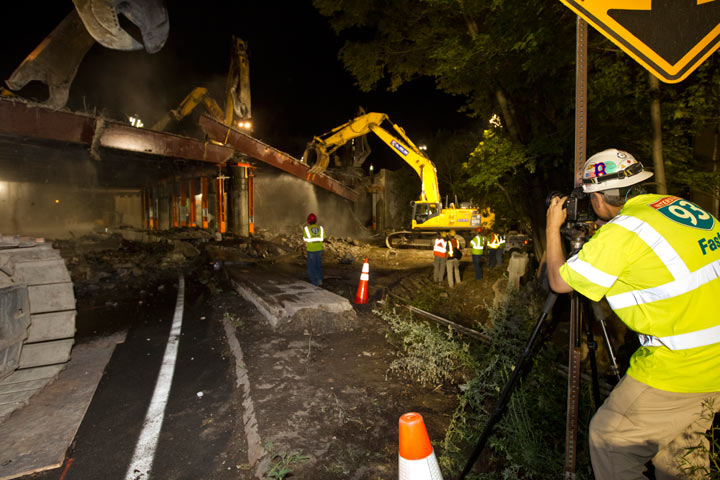
But for some in Ottawa, the replacement of a 600-tonne bridge is expected to start and finish within a 24-hour period.
This weekend, the province is replacing the 55-year-old Kirkland Avenue Bridge on Highway 417.
The bridge, which carries about 136,000 vehicles per day, needs to be widened to accommodate the future widening of Highway 417. Government officials estimate that a project of this size would normally take between two and three years to complete.
Highway 417 will close down at Kirkwood from Saturday at 6pm, reopening on Sunday at 11am.

Get breaking National news
The Kirkland Ave. project is the latest in a string of “rapid bridge replacements” across Ontario in the last few years.
The technique allows for bridge replacements with minimal disruption to traffic and lower project costs compared to conventional methods.
Generally, the new bridge is built on a site nearby. When it’s ready to go, the old bridge is removed and the new one lifted into place.
In 2007, Ottawa’s Island Park Bridge was the first in the province to be replaced using rapid replacement technology. The bridge replacement was completed in 15 hours.


In 2010, Hamilton’s Aberdeen Bridge on Highway 403 was replaced in a 51-hour period. It was the first multi-span bridge to be replaced using the rapid technology. As residents looked on, engineers live tweeted from the construction site.
In 2011, 14 bridges along Massachusetts’ Interstate 93 were replaced over 10 weekends.
If you don’t have plans this weekend, you can watch the Kirkland Avenue Bridge replacement here.


Comments
Want to discuss? Please read our Commenting Policy first.