

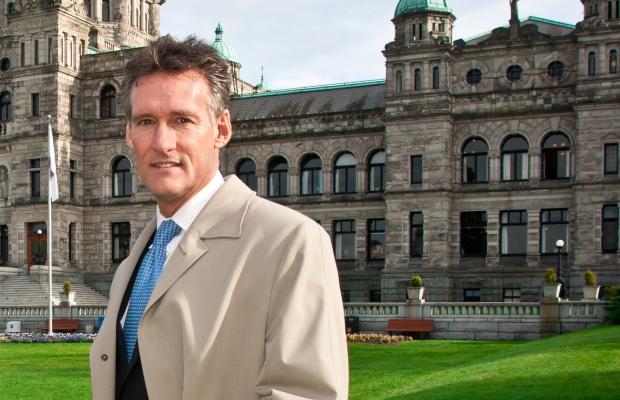
The architect of B.C’s controversial immediate roadside prohibition program for drunk drivers has stepped down as the superintendent of motor vehicles.

After six years, Steve Martin left the position Tuesday to help implement the government’s proposed Community Safety Act, Justice Minister Shirley Bond said in a statement.
Former RCMP superintendent and current ministry employee Sam MacLeod has replaced Martin.
“The depth of Steve’s personal and professional interest in furthering road safety has been a real asset as we’ve pursued an aggressive agenda — one that’s saved dozens of lives on B.C. roads,” Bond said in the emailed statement. “His experience in implementing our tougher impaired driving law will be invaluable as the Community Safety Act is built on the similar concept of providing an administrative alternative to the court process.”
Nanaimo MLA Leonard Krog, justice critic for the provincial New Democrats, questioned the move so close to an election.
“If it has anything to do with the drunk driving laws: it’s not his problem,” Krog said. “It’s the fault of the government who passed that legislation initially without allowing the legislature to debate it appropriately.”
The public deserves to know any time top-level bureaucrats shift positions, Krog said. “If you believe in open and transparent government, why wouldn’t you announce new appointees?”

Get breaking National news
Bond said, “When public servants choose to accept another position, take a promotion or leave government, it’s not typical nor appropriate for government to announce any of these changes publicly through news release or otherwise.”
Under Martin, the stringent and controversial rules targeting drunk drivers touted by government and law enforcement were quickly challenged in court as being unconstitutional.
In September 2010, the blood alcohol threshold for driving was lowered to .05 from .08 and penalties including stiff fines, automatic licence suspensions and vehicle seizures were introduced. Just two months later, B.C. police forces recalled the province’s 2,200 roadside breathalyzer devices, to have them adjusted to allow for a margin of error.
The new rules are being challenged as unconstitutional in the B.C. Court of Appeal by the B.C. Civil Liberties Association, which is arguing that the current law criminalizes drivers who refuse or fail a roadside blood-alcohol test.
The case, which is now being heard, stems from a lower-court ruling that resulted in Justice Ministry tweaks to the 2010 legislation.
The penalties for about 1,200 motorists, who were handed immediate roadside prohibitions before the unconstitutional ruling, were reviewed this February by Martin’s office. Legal challenges on behalf of 17 of those 1,200, prompted the review and resulted in the decision to overturn their penalties, which included punishments like being forced to install ignition interlock systems and attend safe-driving classes.

-
![]() Royal Rift: Will Prince Harry’s move back to the UK help heal his relationship with William?
Royal Rift: Will Prince Harry’s move back to the UK help heal his relationship with William? -
![]() Business Matters: Champagne, Macklem represent Canada at U.S. meeting of G20 finance chiefs
Business Matters: Champagne, Macklem represent Canada at U.S. meeting of G20 finance chiefs -
![]() Back-to-School Tech Picks That Parents Will Love
Back-to-School Tech Picks That Parents Will Love -
![]() Start your engines: Tom Cruise, Anne Hathaway tease ‘Days of Thunder’ sequel
Start your engines: Tom Cruise, Anne Hathaway tease ‘Days of Thunder’ sequel


Acting Deputy Solicitor General Brent Merchant said 1,087 penalized drivers have now had theses penalties cancelled, and less than half of those who already attended classes will have their fees reimbursed.
“Let’s be clear: none of these drivers are off the hook,” Merchant said in a statement emailed Sunday. “They’ve all been held to account with mandatory roadside penalties – a 90-day licence suspension, a financial penalty and vehicle impoundments.”
In a Vancouver Sun interview last year, Martin explained that for drinking and driving, he went toward the roadside suspension model — where impaired drivers face immediate penalties ranging from $600 to more than $4,000, as well as loss of a driver’s licence and vehicle — because it draws a direct connection between the crime and the punishment.
“It’s behavioural intervention 101. It’s bringing the consequence to immediately follow the behaviour,” Martin told The Sun’s Jonathan Fowlie. “The fact that these are immediate, they happen at the roadside, people lose their vehicles.”
In his new position, Martin will help implement the Community Safety Act. The act would allow people to report so-called crack shacks and other problem properties in their neighbourhood to a new agency rather than police, according to Bond.
With a file from The Canadian Press
-
![]() Royal Rift: Will Prince Harry’s move back to the UK help heal his relationship with William?
Royal Rift: Will Prince Harry’s move back to the UK help heal his relationship with William? -
![]() Business Matters: Champagne, Macklem represent Canada at U.S. meeting of G20 finance chiefs
Business Matters: Champagne, Macklem represent Canada at U.S. meeting of G20 finance chiefs -
![]() Back-to-School Tech Picks That Parents Will Love
Back-to-School Tech Picks That Parents Will Love -
![]() Start your engines: Tom Cruise, Anne Hathaway tease ‘Days of Thunder’ sequel
Start your engines: Tom Cruise, Anne Hathaway tease ‘Days of Thunder’ sequel


Comments
Want to discuss? Please read our Commenting Policy first.