

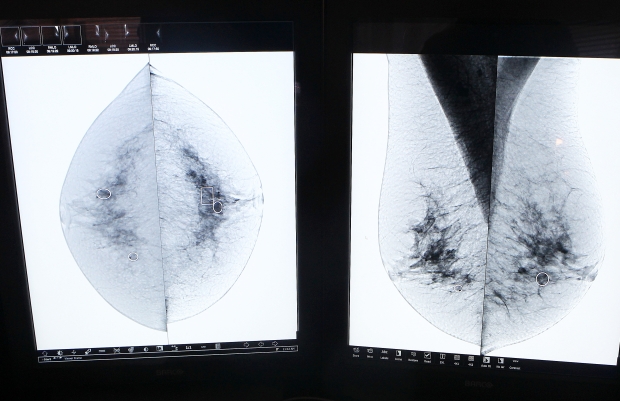
Health Minister Margaret MacDiarmid expects a heated debate over new B.C. guidelines that may mean doing fewer mammograms to screen for breast cancer.
As a result, she said, she will not unveil the new guidelines until after the provincial election, though she said they reflect federal recommendations that call for fewer routine mammograms.
“This is a noisy time,” she said, referring to the month and a half until the May election. “I just felt that everything gets politicized around this time. And breast cancer is a non-partisan condition.”
MacDiarmid, a physician and breast cancer survivor, said the BC Cancer Agency recommended the updated guidelines last fall after a panel of experts spent two years studying the latest cancer research.
The new guidelines would apply to women at average risk — those who have no personal or family history of breast cancer, no known genetic predisposition to breast cancer and no other risk factors.
The federal guidelines recommend ending routine mammograms for women in their 40s and suggest some women over 50 should get mammograms every two to three years instead of every two years.
For the past about 15 years, B.C. women aged 40 to 79 have been able to get mammograms every two years.
When the new federal guidelines were released in 2011, leading B.C. experts predicted an increase in cancer cases and deaths if women followed the “alarming” recommendations. Some of those experts were on the BC Cancer Agency panel, which explains why the recommendations put to MacDiarmid were apparently not unanimous.
MacDiarmid said there has been about a one per cent drop in women seeking mammograms in B.C. since the new federal guidelines. While B.C. changes could have the “unintended consequence” of even more reductions, she’s hoping that the opposite occurs and that more of the women eligible for mammograms get them. Only about 60 per cent of B.C. women eligible for mammograms take them.
The screening program, started in 1988, costs about $30 million a year.
Every year, about 100,000 B.C. women in their 40s go for routine screens and about 200 cancers are detected. About 200,000 women in the 50 to 74 age group get mammograms every year and about 1,000 cancers are detected.
Several recent studies have shown that annual mammograms provide no advantage when it comes to cancer detection over scans every two years.
On average, about 12 per cent of women who go for screening are told they have an abnormality, but only seven per cent of those abnormalities turn out to be cancer.
The false positives lead to unnecessary, invasive tests, and even surgery, and takes a psychological toll on women. A study published recently in the Annals of Internal Medicine showed that over a 10-year period, one out of every two women who gets a mammogram will receive a false positive. On top of the anxiety of the cancer scare, one in 11 will be treated for a breast cancer that doesn’t require prompt treatment.
MacDiarmid said she hopes to get groups such as the Canadian Breast Cancer Foundation to help educate women on the rationale behind the updated guidelines.

Dr. Carolyn Gotay, one of a few dozen experts involved in the BC Cancer Agency review panel, said she understands why the health minister is delaying the changes.
“There may be some women who feel like the government is taking something away from them and that there are economic factors driving the changes, which is not the case, but we’ve seen that play out in other places like the U.S.,” said Gotay, who is the Canadian Cancer Society Chair in Cancer Primary Prevention at the University of B.C.
“This is a thorny, highly emotionally charged issue and there are outspoken advocates on all sides,” Gotay said, adding that it’s frustrating there aren’t better screening tools to detect breast cancer.
She said while some people trivialize the potential harms that come from procedures after false positives, “I am one who knows about that first hand,” she said. She said she had a biopsy based on a false positive and it resulted in a complication.
Gotay said she doesn’t doubt MacDiarmid is correct that there may be a drop in mammograms.
“Many women don’t like having them, so this may well give many a reinforcing reason not to do them.”
Mike Farnworth, NDP health critic, said he thinks the government is making a huge mistake by not releasing guidelines until after the election.
“What they are doing by sitting on the report is creating the very conditions they say they fear and it’s a classic example of their habit of campaigning and not governing,” said Farnworth, who got choked up as he recalled his mother’s death from breast cancer when he was 16 and she was only 38.
Farnworth said he doesn’t know why the government is taking responsibility for releasing the report; that should be done by the cancer agency.


Comments
Want to discuss? Please read our Commenting Policy first.