

OTTAWA – Canada’s First Nations need a “commitment to action” from Prime Minister Stephen Harper when he meets with Aboriginal leaders in the coming days to discuss treaty agreements and economic development, says a spokeswoman for the Idle No More movement.

Harper indicated late last week he would meet with native leaders on Jan. 11 after weeks of protests.
One of the most prominent protests has come from Theresa Spence, chief of the northern Ontario First Nation Attawapiskat, who began refusing solid foods on Dec. 11. The wider Idle No More movement has also featured disruptions of railways and highways around the country for the past several weeks.
Despite Harper’s agreement to meet, demonstrations by both Spence and the wider Idle No More movement have not stopped.
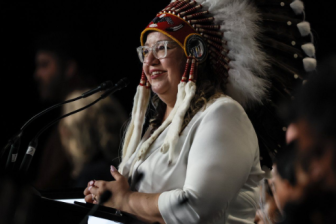
Pam Palmater, a lawyer and spokesperson for the Idle No More movement, said a commitment to do something – as opposed to mere words – is what’s needed from Harper for the demonstrations to end.
“There’s nothing he can say that’s going to say ‘situation resolved,’ because that’s all we ever get from politicians is all of their flowery wording,” Palmater said during an appearance on the Global News program The West Block with Tom Clark. “And similarly, one meeting that’s being called a first step isn’t going to cut it either because we’ve had 5,000 first steps. What we need is the next step forward; an actual commitment to action.

Get breaking National news
“So I think at this meeting, the best Prime Minister Harper could do is come in and say, ‘Listen, we’re going to put some good faith on the table and here’s what it is: we’re going to deal with the crisis in First Nation communities around lack of water, housing, sanitation, education, and we’re going to do that immediately. And then we’re going to set up a process – a longer-term process – to deal with how we’re going to deal with the lands and resources.’”
- Industry experts question Saab’s pitch to bring 10,000 jobs to Canada
- U.S. national security strategy warns of ‘civilizational erasure’ in Europe
- Carney, Trump and Sheinbaum talk trade in Washington at FIFA World Cup draw
- Former Alberta premier Jason Kenney says politician recall legislation being misused


If progress is not made, Palmater warned that natives could begin taking more serious actions.
“We have to do something, or there’s going to be a much greater flashpoint at some point in the future,” she said.
Palmater was asked about how some of the Idle No More protests – which recently involved a blockade at a U.S. border crossing in Cornwall, Ont. – will benefit the native cause.
“By causing temporary, minor border slowdowns and handing out leaflets and giving out information, that’s a really direct way of informing both Canadians and Americans about what’s happening … In some of those slowdowns, we actually have people get out of their cars and join us on these slowdowns and want to ask more questions.”

She said the Conservatives must also repeal segments of their two omnibus budget bills, which native groups say affect their rights to protect their own lands, as well as several other pieces of legislation that have not passed yet.
“It’s not just C-45 and C-38, for example,” she said. “There’s about 14 pieces of legislation that’s being imposed on First Nations without their knowledge, consent and against their will. That’s a very easy thing for the prime minister to do; all those bills that haven’t passed yet, take them off the table until they get First Nation consent.”
Greg Rickford, the parliamentary secretary for Aboriginal Affairs Minister John Duncan, was interviewed later in the show. Asked if the government would consider repealing legislation that First Nations communities object to, he defended some of the government’s moves that are being criticized.
“There are numerous examples of where we have performed extensive consultation (with First Nations on government legislation) and responded directly to the request of First Nations chiefs to provide them with more flexibility,” he said, specifically addressing clauses in Bill C-45 that allow First Nations to lease out their land.
Asked about the native protests that have been happening for almost a month, Rickford said: “In this country, people have the right to demonstrate and express their points of view peacefully as long as they obey the law and certainly don’t, from a public safety perspective, jeopardize transportation infrastructure,” he said. “I think the Canadian population expects everyone will obey the law in holding such protests.”
Comments