


Global News cameraman Trevor Owens will be giving a behind-the-scenes look at covering the Summer Olympics in Rio de Janeiro throughout the Games.

In Rio de Janeiro, a new community is being built after residents were ordered to leave their homes when the Brazilian city won the bid for the Olympics in 2009. Some watched helplessly as their homes were demolished in Vila Autodromo, a low-income neighhourhood, or favela.
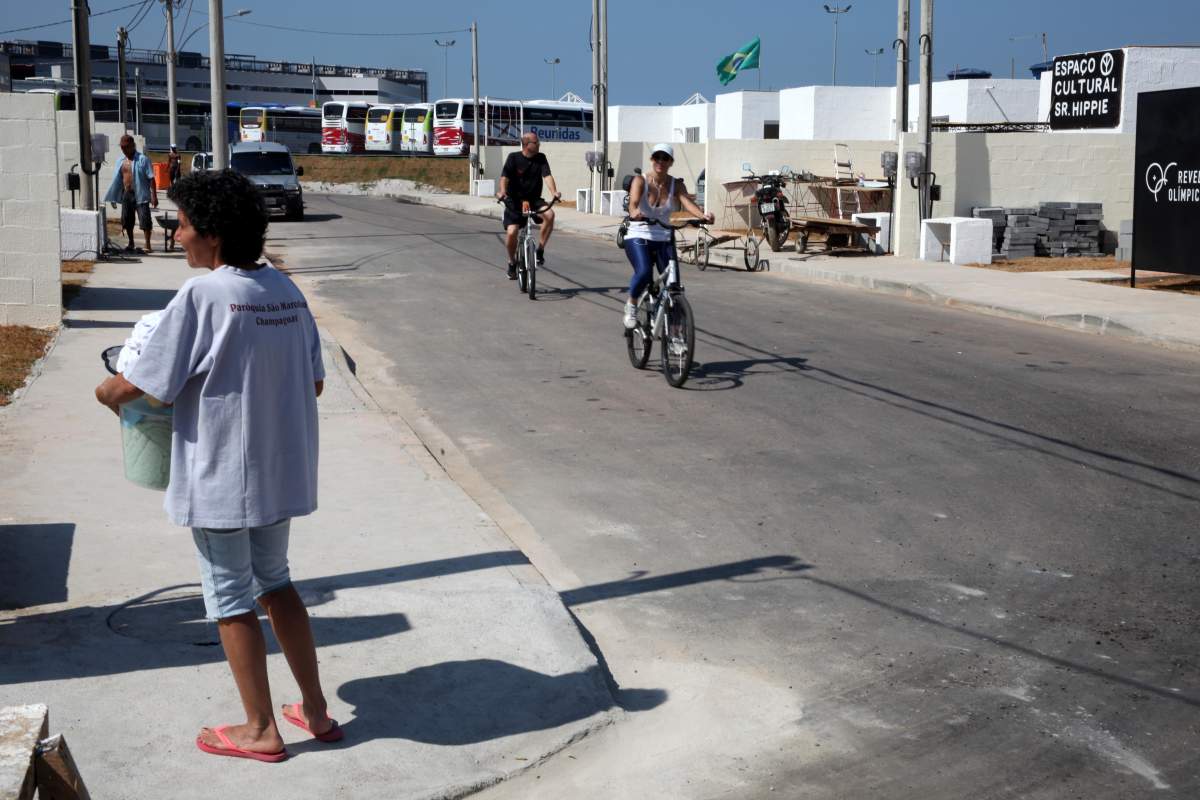
I planned to go and capture some footage of the new Vila Autodromo, so I wandered over to the small row of homes near the Olympic park. The homes on the outside look beautiful — bright, white, and glimmering under the sun. The new community, built for 20 families, is next to Olympic Park and residents here, while pleasant, are not entirely satisfied with what the government has provided. Many of the 800 residents of Vila Autodromo were relocated to slums, some here still don’t feel this is an upgrade.
Read more: Global News cameraman gets lost on the streets of Rio de Janeiro
I’m learning during my time covering the Summer Games in Rio that things aren’t always what they seem. In the neighbourhood I met Delto de Oliveira, wearing a blue t-shirt and khaki shorts. He’s pleased to stop working on his home to show us around. De Oliveira has a sign on his property that reads “Casa lua e sol.”
It translates to “house of moon and sun,” but what he showed me was a stark contrast from the bright exterior and de Oliveira’s sunny disposition. I didn’t need Google translate to understand his problems.
He removed a well cover to show me the water for his house. It had garbage floating in it and the water was brown. We moved down a few feet toward the backyard and he removed another cover, which revealed a well for his kitchen. It looked ready to explode. It was bubbling, had chunks of garbage in it and the water was black.
De Oliveira motioned for me to follow him into his house. It had new tile flooring and looked spacious. Quickly he pointed out that the electrical panel cover was broken, and then he played a song on the tiles where the keys transitioned from sounding solid in areas and hollow in others. After the tile jingle, he showed me large cracks in the floor that ran from one room to another. He says his roof also leaks.

Get daily National news
Watch Below: Delto de Oliveira shows Global News the problems with his brand-new house.


De Oliveira is part of a family of seven. He and his wife and their five children used to live in a two-storey house and now live in a single storey. In 2009, Delto and his family were just one family of 275 ordered to leave Vila Autrodromo so the land their homes occupied could be used for access roads and services related to the Olympics.
All residents were offered public housing, money and in some cases both as compensation by the Rio government. The homes in Vila Autodromo, according to officials in Rio, weren’t built properly and are close to lagoons. About 500 people were relocated to other areas of the city, not necessarily favelas. Four hundred of them agreed to move to Parque Carioca, an affordable residential complex built by the city.
Read more: Covering the Olympics in Rio — and staying safe
De Oliveira told me that it’s been hard for him to cheer for the Summer Games. All he really wants is his home back, the one he watched get torn down piece by piece. Ultimately, he says he wants his children to be happy. He insists that instead of acting out he hangs this beautiful, handmade sign, to protest how the new Olympic venues have impacted his family’s life.
After the interview he continued fixing his house while helping other residents of this seemingly beautiful community erect a sign that says ‘welcome.’
Comments