

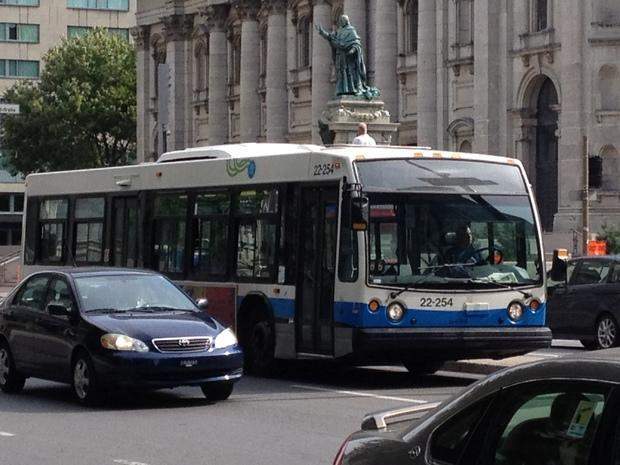
MONTREAL – Starting in 2014, Montreal public-transit users will start getting some useful information: the exact location of the next bus on their route and the time when it will show up.

The Société de transport de Montréal this week approved a $90.8-million contract to equip its 1,900 buses with a system that, among other things, monitors the location of buses using GPS and relays that data to users via the Web and smartphones.
On buses, coming stops will be announced via speakers and displayed on screens. Screens featuring the time of upcoming buses will also be installed at busy bus stops and some métro stations.
Many other cities, including Laval, have installed such systems to encourage people to use public transit by making trip-planning easier and reducing frustration over late buses.
In Montreal, the STM’s system will be called iBus.
The $90.8-million contract was given to INIT, a German firm with Montreal offices.

Get daily National news
It will supply and install the GPS technology, software, speakers and screens, as well as new two-way radio equipment for bus drivers.
Installation is to begin in late 2014 and will take about two years to complete, said STM spokesperson Odile Paradis.
The system will be phased in as installation progresses.
At the moment, the STM only provides scheduled bus times to passengers, via its website, smartphone apps and printed timetables.
With iBus, “passengers will know, in real-time, when the bus will come,” Paradis said.
“If there’s a schedule change, or if the bus is late because of a fire or some other reason, we can alert people.”
The STM says iBus will also allow it to better manage its fleet by, for example, reducing bus bunching – where two or more buses on the same route arrive at the same stop at the same time.
If buses are bunched up, the operations centre can, for example, order one bus to skip a few stops and pick up riders waiting later on the route.
In addition, using new radio-communication equipment, “drivers will be able to alert us when buses are overcrowded so we can dispatch more buses,” Paradis said.
INIT was one of three companies that bid on the contract. The other two companies were disqualified.
One of the other bidders, Trapeze Group, has publicly complained about being shut out even though its bid came in lower than INIT’s.
Paradis defended the STM’s public-tender process.
“It wasn’t a question of price,” she said. The two other bidders “did not fulfill many of the eligibility requirements contained in the tender documents, so they were disqualified.”
The STM says the overall price tag for iBus will be $200.6 million. The INIT contract does not include the cost of renovating the STM’s bus-network operations centre and integrating iBus into the STM’s other systems.
Last year, STM buses travelled 85 million kilometres. Combined bus and métro ridership was 405 million.


Comments
Want to discuss? Please read our Commenting Policy first.