


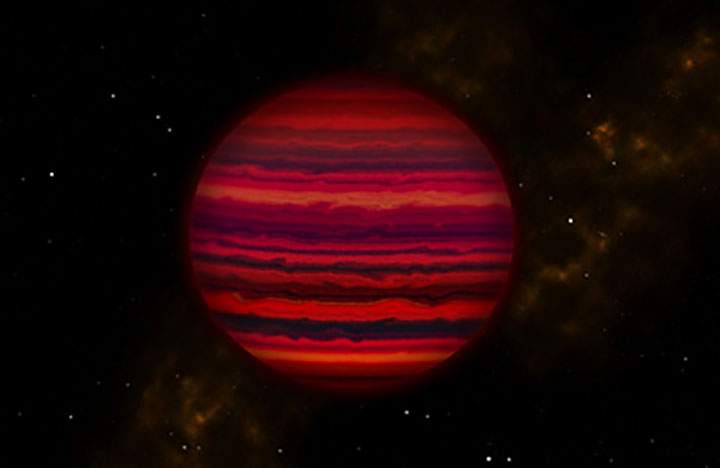
Astronomers from the University of California Santa Cruz have detected clouds on a brown dwarf just 7.2 light-years from Earth.

Brown dwarfs are sometimes referred to as “failed stars.” They are large celestial bodies that formed out of gas and dust, with a mass between 15 and 75 times that of Jupiter. But unlike stars, their core could not fuse hydrogen into helium, which is what characterizes a star.
READ MORE: Lonely planet: Astronomers discover world orbiting star in largest-known solar system
Using the Gemini North Telescope in Hawaii, a research team studied the composition of the brown dwarf known as WISE 0855, the coldest-known object outside of our solar system. It’s so cold that even using infrared — which detects heat from objects — it is barely visible. After studying the brown dwarf, they found strong evidence to suggest that WISE 0855 has clouds of water or water ice. This is the first such discovery.
“We would expect an object that cold to have water clouds, and this is the best evidence that it does,” said Andrew Skemer, assistant professor of astronomy and astrophysics at UC Santa Cruz.

Get breaking National news
If Jupiter — the largest planet in our solar system — had 80 times more mass, it could ignite into a star. WISE 0855 has about five times the mass of our largest planet and, though colder, has a similar temperature to that of Jupiter. This makes it an interesting subject for astronomers to study.
READ MORE: ‘The biggest and baddest planet in the solar system’—Jupiter by the numbers
The scientists came to the conclusion after developing atmospheric models of the brown dwarf, which predicted the water vapour.




Comments
Want to discuss? Please read our Commenting Policy first.