


Global News and Journalists for Human Rights have teamed up to send four Global News reporters to Africa as part of the Shaw Africa Project.

Barry Acton of Global National and Laurel Clark of Global Edmonton were recently in Liberia. Global News followed their journey and their work over the course of several weeks.
I pride myself on being able to forgo the conveniences of the developed world.
No air conditioning? No problem.
No electricity to keep the fridge cool or get work done on my laptop? Big deal.
But no shower?
When the power goes out in our Monrovia apartment (a daily occurrence) the water pressure plunges. We can time our work around the outages, but you can’t always predict when you need a good shower.
And on the +30 degree days when I’m caked in sweat after touring the muddy backroads of rural Liberia, I really, really need a shower! (Just ask my roommate Barry!)

Get breaking National news
You can’t complain…Not when you recognize that hundreds of thousands of people in this capital city live without electricity every day of their lives. Many sell goods by candlelight and cook their food with fire.
It’s an odd feeling to walk through neighbourhoods without streetlights. It’s even more strange when you see a city of one million people from above and spot just a few strips and speckles of light.
Very few have electricity because Monrovia is run on generators powered by diesel. According to the Liberia Electricity Corporation, they burn $800,000 in fuel each month. As a result, the electricity rate is about five times what Canadians pay. It’s a luxury for well-paid Liberians and an unattainable utility for low income residents (many make less than $1 USD a day).
Decades ago, Monrovia had a power grid – supplied in part by hydro power – but it was absolutely decimated during the 14-year civil war.
Looters took everything. Shahid Mohammad, of the Liberia Electricity Corporation, says not one piece of metal was left on power poles, transformers, or at nearby Mount Coffee’s hydro power plant.
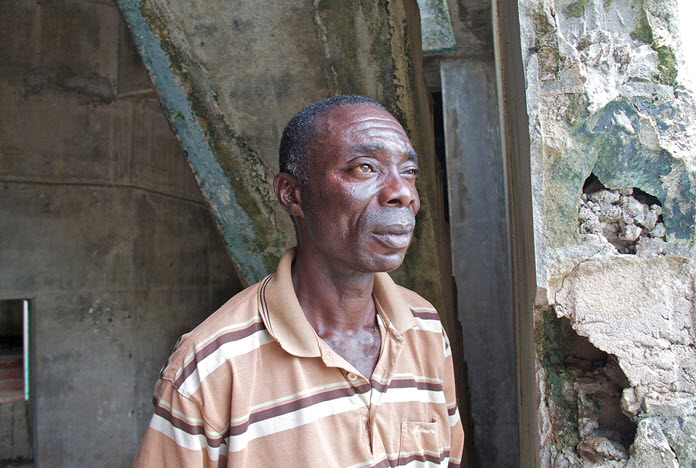
I saw the destruction on a visit to the plant just a few days ago. Imagine a massive concrete structure sitting on a picturesque river. It once housed four giant turbines, a control room and large glass windows. It’s now an empty shell riddled with bullet holes. When you take the steep steps down to the lower floor, you see scraps of metal and garbage and hear the rustling of bats.


Former technician, Goodrich Zodehgar, watches over the site. He is a friendly man, but you see the sadness behind his eyes when he talks about the past.
“It’s painful. It’s hurtful to see this place like this because it has denied thousands of Liberians job opportunity,” he said.
I asked how it felt to see the plant in such a state – knowing how productive it once was for Liberia.
He said, “If I explain to you, I want to shed tear.”
The Government of Liberia is determined to fully restore the grid and bring power to tens of thousands of residents. Local workers are setting up power poles, stringing cable, and connecting one community at a time. The country plans to rebuild the hydro power plant within the next four years.
International donors are contributing to the effort – but it is a Canadian company managing and leading the project. I’ll tell you more about the connection on Global National in the coming days.
For now, I’m going to grab a shower while I can!


Comments
Want to discuss? Please read our Commenting Policy first.