


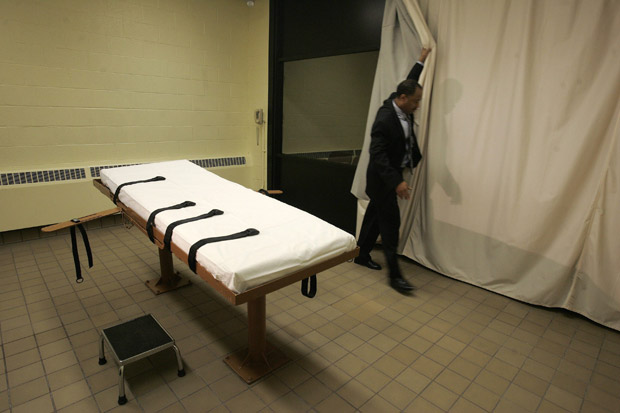
On Wednesday night, Georgia executed a man for the 1989 murder of off-duty police officer Mark MacPhail. Despite numerous vigils across the U.S. and Europe, and an 11th-hour request to the Supreme Court for a stay of execution, Troy Davis was killed by lethal injection at 11:08pm ET.

To this day Davis insisted it was a crime he did not commit. “I did not have a gun,” he told relatives of MacPhail. Supporters of Davis mourned, insisting the the state of Georgia had executed an innocent man.
Global News looks at other death row controversies:
Jesse Tafero
American Jesse Tafero was convicted in the 1976 murders of highway patrol officer Phillip Black and Canadian constable Donald Irwin.
He was executed by electrocution. The machine, called “Old Sparky” malfunctioned during the execution, causing flames to shoot out of Tafero’s head. After 13 minutes and 30 seconds, and three shocks of electricity, Tafero was declared dead. His fellow inmates claimed that “Old Sparky” had been tampered with to make the execution akin to torture.
Tafero’s case and brutal execution became a prime example among capital punishment opponents why the practice should be abolished.
Johnny Frank Garrett
In 1992, Texas inmate Johnny Garrett was executed for the 1981 rape and murder of a 76-year old nun, Sister Tadea Benz. During Garrett’s trial, a forensic psychiatrist found he had suffered severe childhood trauma, had significant brain damage, as well as multiple personalities.

Get daily National news
Before Garrett’s execution, a group of Texas bishops urged a stay of execution in a statement reading, “We believe that the courts should take into consideration not only the fact that he was a juvenile at the time of the crime, but also that there is evidence, not admitted in the previous court proceedings, that he had suffered brain damage, was abused as a child and was addicted to drugs.”
In one of his last letters, Garrett wrote, “A lot of bad stuff has been said about me that if given the chance, I could have proven, not only beyond a reasonable doubt, but beyond any doubt, of my innocence. You, society, did not give me a chance to do so.”
In 2004, DNA evidence identified Cuban native Leoncio Perez Rueda as the murderer of Narnie Box Bryson, an elderly Amarillo woman who was killed four months before Sister Benz. The murders of Bryson and Benz had striking similarities, and Rueda’s fingerprints, which were previously unidentified, were found in Sister Benz’s room. In the documentary film about Garrett’s execution, “The Last Word,” Rueda admitted on camera to both the rape of Bryson and a nun in Amarillo.
Cameron Todd Willingham
On December 23, 1991, a fire broke out in Cameron Willingham’s Texas home. Willingham escaped the blaze, but his three daughters were killed.
Police investigation determined that the fire had been started with a liquid accelerant, and it was alleged that the fire was started deliberately.
Willingham was charged with murder in January 1992. During his trial deputy fire marshal Manuel Vasquez testified that a liquid accelerant was used to intentionally burn the floors, front threshold of the house and front porch. Witnesses testified that as the fire burned, Willingham refused to attempt to rescue his children, and that he showed no grief over their deaths.
Willingham was sentenced to capital punishment in August 1993, and was executed by lethal injection on February 17, 2004. On the day of his execution Willingham said, “I am an innocent man convicted of a crime I did not commit…I have been persecuted for twelve years for something I did not do.”
In 2009, The New Yorker published an investigative report that thrust Willingham’s case back into the public eye.
Advancements in arson investigation and fire science since 1991 revealed that the original claims that the fire was arson were unlikely. The report drew upon a 2004 investigation by Dr. Gerald Hurst. Hurst examined the arson evidence originally collected by the state deputy fire marshal. After extensive examination, Hurst rebutted all 20 of the indications listed by the fire marshal that accelerant had been used to start the fire. In 2009, the Texas Forensic Science Commission published a report that came to the same conclusion.
Hurst’s report, which concluded there was “no evidence of arson,” was sent to the Board of Pardons and Paroles, and to Texas Governor Rick Perry’s office – neither responded to Willingham’s appeal for clemency. When asked later about the case, Perry called Willingham “a monster…who murdered his three children.”
Since the original investigation, numerous top fire experts have examined the original evidence, also concluding that evidence presented during Willingham’s trial was based on flawed and outdated science.
Watch this October 2009 CNN report “Texas death row cover-up?” below:


Comments
Want to discuss? Please read our Commenting Policy first.