


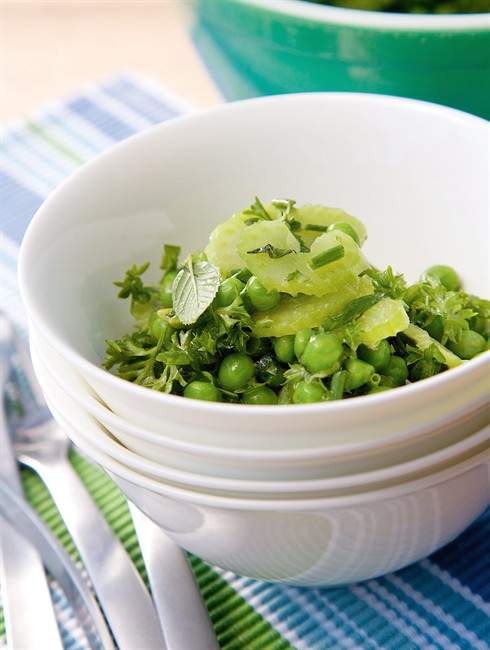
TORONTO – Brilliant green and full of folate, fresh peas are coming into season and Mairlyn Smith, for one, can’t wait.

The registered dietitian and author of “Healthy Starts Here!” loves eating the sweet morsels out of hand.
“That’s one of my favourite summer snacks and because it’s such a short season I really indulge when they’re out,” the Toronto-based Smith said in an interview.
Bill French, owner of Lennox Farms near Shelburne, Ont., says that many customers who buy from his retail stand also enjoy eating them fresh.
“I would guess probably 99 per cent of the peas that we sell as fresh market peas people eat them like candy,” he says. “They probably would not shell them and put them in a pot of water to boil them for dinner. They would just buy them and eat them like snack food, eat them fresh.”
Not only are fresh peas delicious, but they are low-fat, low-calorie and very healthy. Rich in vitamin C and the B vitamin folate, which protects DNA, peas are also high in soluble fibre, which helps reduce cholesterol, says Smith.
Peas have more than twice as much folate per a 250-millilitre (one-cup) serving as do their cousins, snow peas and snap peas, which are a cross between garden peas and snow peas.
Smith describes soluble fibre as a sponge. “When soluble fibre goes through your body, it picks up the bad cholesterol and helps get it out of your body. It gets the LDL cholesterol out of your arteries and veins,” she explains.

Get breaking National news
Soluble fibre is also found in barley, eggplant, apple peel and kidney beans.
French grows Utrillo peas, a summer variety more resistant to heat than spring varieties. Utrillo peas, with their bigger pods which contain eight to nine peas, take 72 days from planting to harvesting versus earlier varieties that take 53 days to mature to picking. He has 35 hectares of his 142-hectare farm planted in peas. His other big crop is rhubarb and brussels sprouts. He also grows strawberries, as well as some beans and sweet corn for his retail stand.
“Because peas come so fast when they’re mature we basically want to pick an acre (0.4 hectare) every day, so we plant an acre every day. So we start harvesting usually the 15th or 16th of July. The first planting went in the 11th of May and then we finish putting the last planting in around the 10th or 11th of July and it usually picks the last week of September.”
All his fresh-market crop is hand-picked and sold in the pod.
Wet weather this spring delayed planting for many farmers. “Peas won’t be scarce but not as plentiful as some years. The market’s not going to be flooded, that’s for sure,” French says.
Smith, who trained as a home economist before joining the Second City comedy troupe in Toronto, uses peas to add more nutrition to stir fries, hot side dishes such as rice or quinoa and cold grain salads or mixed bean salads in warm weather.
“I just love them so much. A lot of people have corn or carrots as their go-to vegetable. Ours in my house has always been peas.”
She uses them year round.
“I always have frozen peas in my house,” Smith says. “When the fresh peas aren’t in season I just rinse them under cold water and throw them in salads.
“I will just fold in frozen peas (to hot food) and they’re going to get thawed in the heat of the dish and then maybe sprinkle some fresh chives on just to give a bit of a different flavour, just to bump up the nutrition. The colour is beautiful too.”
The fact that peas are a water-soluble B vitamin “is another reason you don’t want to cook the living daylights out of them because folate is water soluble it’s going to leach into the water. So one of the reasons having them raw or lightly cooked or added into something is the better idea than boiling the heck out of them,” Smith says.
When shopping, look for peas that are firm and brilliant green. Like corn, as peas mature they begin turning starchy and won’t taste as sweet.
“Think super model versus some diva. You want young, firm, bright, taut. You don’t want wrinkled, limp and loose. There’s nothing worse than getting a big old fresh pea. They taste terrible,” says Smith.
If peas are soft it means they’ve been out in the sun and haven’t been refrigerated properly to preserve their freshness, French says. When harvesting, “they come from the field to the cooler every hour and we try to chill them down as quick as possible to hold the flavour and sweetness.”
He transports the peas to Toronto’s food terminal in a refrigerated truck and he encourages store owners to keep them refrigerated.
“They’ll be good for three days if they’re kept cold, but they should be eaten fairly fresh.”
The top five producers in Canada are Ontario, Quebec, Alberta, British Columbia and Nova Scotia, according to Statistics Canada’s June 2011 report Fruit and Vegetable Production.


Comments
Want to discuss? Please read our Commenting Policy first.