

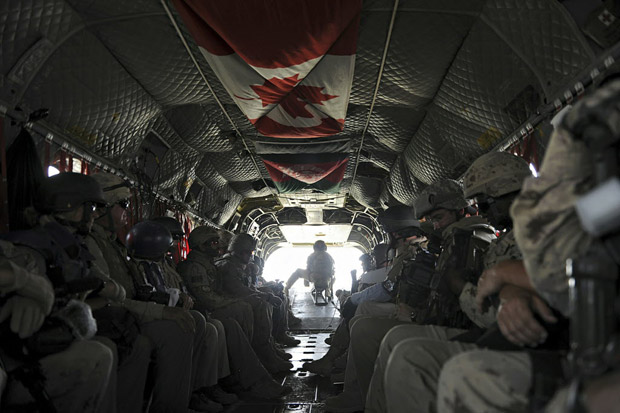
MA’SUM GHAR, Afghanistan – Canada’s desert war effectively came to an end Tuesday when soldiers of the Royal 22e Regiment formally handed over their battlefield to American units and began to take stock of years of bloody combat.
The country’s legal command responsibility for the western Kandahar district of Panjwaii will continue for several days, but Brig.-Gen. Dean Milner’s headquarters will be directing U.S. combat units.
Almost all Canadian troops are now out of the killing fields of Kandahar, save for a handful of soldiers who will serve for perhaps a few more weeks, attached to American platoons.
It has cost lives of 157 soldiers, one diplomat and one journalist.
For more than five years, Canada has made war in the wasted farmland and dust-choked villages of this brutal, backward country. Yet rarely did those in authority use the "W" word to describe what happened here.
Politicians, diplomats and bureaucrats routinely shied away from describing it in comfortless terms, especially in the beginning when former defence minister Gordon O’Connor was chided for refusing to say the word "war."
"The lawyers will get all over it and say you can’t call it war, but that it’s an armed conflict," Gen. Walt Natynczyk, the chief of defence staff, said in a recent interview with The Canadian Press.
"For the young soldiers, sailors airmen and airwomen, it feels like war because someone is shooting at them."
Parliament ordered an end to the Canadian combat mission in southern Afghanistan back in 2008, setting July 2011 as the deadline.
The Conservative government has since announced that 950 soldiers and support staff will carry out a training mission in the Afghan capital until 2014.
The transfer of battle group command took place at Ma’sum Ghar, the crusted, petrified volcanic mountain soaked in Canadian blood, much of it shed at the onset of Canada’s fight in Kandahar province in 2006.
The ceremony was an almost understated ending to a war that mesmerized and horrified the country in equal measure, but has now largely fallen off the public agenda.
If Kandahar was a national trauma, Ma’sum Ghar was at its epicentre – a base that’s become a symbol of the Canadian struggle over the last five-and-a-half years, said Lt.-Col. Michel-Henri St-Louis, the Van Doo battle group commander.
"Everywhere in battle where Canadian soldiers have sacrificed their lives, we have examples of similar places in a number of our conflicts," St-Louis said.
"Ma’sum Ghar is symbolic and had been at the centre of our deployment and was witness to much of our sacrifices."
Ma’sum Ghar is not Passchendaele, Dieppe, Ortona, Monte Casino, Juno Beach – or even Kapyong from the Korean War.
The sheer scale of slaughter in those battles makes a pale comparison, but Ma’sum Ghar has seared itself into the consciousness of a whole generation of young soldiers who will, for the rest of lives, remember Afghanistan as their war.
The mountain was first captured by troops in the summer of 2006 as fighting raged throughout the districts of Panjwaii and Zhari.
It was used as the launching point for the landmark autumn battle known as Operation Medusa, soon turning into a bustling hub that fed the burgeoning counter-insurgency war.
Most major Canadian combat operations in the region jumped off from Ma’sum Ghar, a popular target for the enemy’s 107-millimetre rockets and mortars. So common were the attacks, soldiers a few years ago erected a mock industrial workplace sign counting the number of days the place went rocket-free.
The formal signing ceremony took place in the corner of the base that now serves as a compound for Afghan National Army troops, whom Canadians have trained and mentored throughout the war.
Brig.-Gen. Ahmad Habibi, commander of the ANA’s 1st Brigade, 205 Corps, was full of praise and said Canadians "would be remembered forever in the hearts of the Afghan people for helping our country."
It was that sort of altruism that the Harper government tried to convince Canadians was at the heart of the war.
Yet, almost from the moment the first battle group under Lt.-Col. Ian Hope deployed in February 2006, public opinion polls consistently suggested Canadians were pining for the days when their soldiers were peacekeepers, not warriors.
To listen to focus group comments in Defence Department surveys, the idea of standing between two warring parties had a nobility and an irresistible romanticism for Canadians. It was almost gravity defying, even in the face of a pitiless counter-insurgency.
There was no peace to keep in Kandahar, which is why some back home wanted no part of it.
While he doesn’t declare traditional UN peacekeeping dead, Canada’s top soldier considers it part of a simpler, bygone era.
"There is a peacekeeping myth," said Natynczyk.
"The peacekeeping myth is that you have a very controlled environment where two consenting states come up with a peace agreement and invite United Nations or another coalition force to interposition and help them monitor that peace. That kind of situation is a rarity, and I’m not sure it’ll ever happen again."
The opaque, vicious nature of the fighting in southern Afghanistan horrified the Canadian public and soldiers alike.
The U.S. surge has allowed for an explosion of surveillance on and above the gnarled, baked farmland of Kandahar. Command posts were turned into space-age centres with multiple viewscreens and images from a blanketed battlefield.
It was reality television with a bite.
From those screens would pour all manner of inhumanity, including the time just recently when horrified Canadian soldiers watched as insurgents force a young boy to carry his machine gun, wrapped in a blanket, knowing troops wouldn’t shoot a child. The pair ended up in a firefight with a NATO patrol.
And then, there were the kids the Taliban would use to cut away the grilles protecting culverts from roadside bombs. Villagers, with a straight face, would tell patrolling soldiers to go ahead and shoot at the children in order to teach them a lesson.
It is that sort of ambiguous war that troops are leaving behind.
With Tuesday’s handover, the Canadian army stepped away from the battlefield for the first time in its history while a war still rages.
Lt.-Col. Steve Miller, commander of 3rd Battalion, 21st U.S. Infantry Regiment, said the region he inherited is much quieter than he expected.
"We actually expected this fight to be more kinetic than it had been in the last 30 days," Miller said. "This area has not seen the spike (in violence) that usually occurs here during the spring following the poppy harvest."
The majority of the lull can be attributed to the Van Doos, who uncovered and seized large weapons caches over the last six months, he said.


-
![]() Christmas light show marks Brussels cathedral’s 800th anniversary
Christmas light show marks Brussels cathedral’s 800th anniversary -
![]() Christmas light-clad leopard tank roams streets of Poland
Christmas light-clad leopard tank roams streets of Poland -
![]() Modular homes arrive in Hinton for Jasper evacuees: ‘Gotta take care of your neighbours’
Modular homes arrive in Hinton for Jasper evacuees: ‘Gotta take care of your neighbours’ -
![]() ‘So much joy’: Spain’s ‘The Fat One’ Christmas lottery spreads riches in wildfire-hit area
‘So much joy’: Spain’s ‘The Fat One’ Christmas lottery spreads riches in wildfire-hit area


Comments