

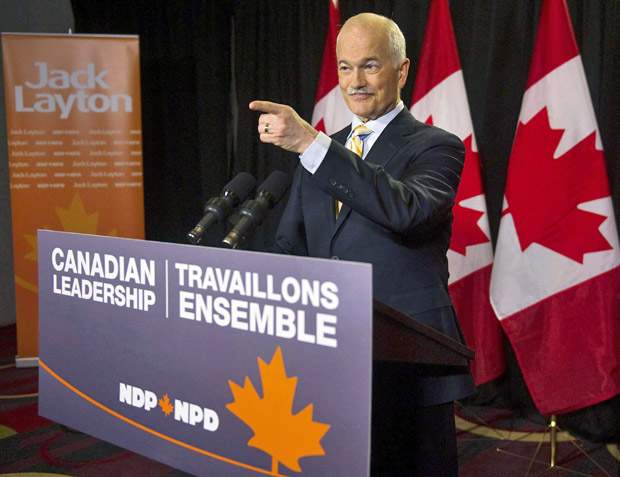
In the wake of this month’s historic federal election, it is a moment for soul searching by parties to the left of the Conservatives. By the most obvious standard it was of course a spectacular success for the NDP, but by some other measures, it is a time for reflection.
As impressive as was the explosion of New Democratic MP’s from Quebec, the newly formed 41st Parliament will afford the party less opportunity to shape legislation than the previous three parliaments when no party held a majority, and hence smaller parties had more leverage.
What this result of 103 seats does provide the NDP is the status of official Opposition, presenting unprecedented attention to promote the party’s platform and policies. More significantly, if the Harper government stumbles, it should be able to portray itself as the first alternative for governing.
I say "should be able", because much of that depends upon its political deportment during the next parliament. It will now be under increased scrutiny, and momentary lapses will have more serious repercussions than formerly.
This was illustrated by deputy leader Thomas Mulcair’s slide into whimsy concerning conspiracy theories, over the US raid on Osama bin Laden.
In past times, this mistake could have been more readily overlooked but the party will increasingly find that there are serious consequences from such slips in the future.
It might also be noted among all the "hosannahs" surrounding the triumph of "Happy Jack’s" campaign, how little his efforts this time differed from his three previous outings, that were less successful. It was the same leader with the same message and the same policy platform.
Unless one believes that it was the cane he carried with him, it suggests that NDP success was more about luck and timing. Soft nationalists in Quebec who had voted with the Bloc Quebecois through six previous election cycles seem to have concluded after twenty years, that a separatist party could only make limited accomplishments for Quebec in the federal parliament.
Why that realization occurred at this juncture rather than in the past, or at some future date is more difficult to explain, but that a social democratic party should be the beneficiary of the change, makes sense given the social policy similarities between the NDP and the BQ.
NDP support in Quebec increased exponentially from 12% to 43% of the electorate. The New Democratic rise elsewhere was closer to 6%, and seems to have been a result following the momentum from Quebec.
For the Liberals, it is difficult to resist using apocalyptic descriptions, and one of the biggest challenges they face is that their future prospects are no longer in their own hands. Their best opportunity to regain major party status probably depends upon the NDP messing up, or taking a hard ideological turn to the left.
Now that they are reduced to a poor third place, their greatest fear is not oblivion as some have suggested, but the fate of the British Liberals for the past century, that of perpetual also-rans. Having chosen two disasters in a row as leaders, they would be better advised to select an established presence like Bob Rae as leader, rather than an unproven neophyte like Justin Trudeau, who has little credential beyond a pedigree.
Still, l believe that decision is well off into the future.
Talk of a merger between the Liberals and the NDP is misplaced. The cultures of the party bases are simply too divergent. Many Liberals are probably more comfortable with the Conservatives than with the NDP.
There is precedence – the Ontario Conservative win in 1995, for a party to vault out of a poor third place to form the government but that required a recessionary economy and a vulnerable opposition leader as preconditions.
Ironically that election marked Bob Rae’s decline as provincial premier. A more promising consideration that would be mutually beneficial for both the Liberals and New Democrats would be to minimize the "vote splitting" problem by selecting a small number of strategically chosen constituencies, perhaps 12 to 15 each (less than 5% of the total nationally) where the two parties would agree to alternately get out of each other’s way.
These would be ridings where either one of the Liberals or NDP was normally competitive with the Conservatives, but the other was not. Kitchener-Waterloo is a local example of one where the NDP usually trails, and British Columbia is full of illustrations where the Liberals are uncompetitive.
The final irony of election night involves the other party of the left, the Greens. Leader Elizabeth May was able to achieve her long sought goal of winning a seat in Saanich-Gulf Islands, but in the process her party support level dropped 3 points to less than 4%. their worst aggregate result since 2000.
She will undoubtedly be a warm and colourful presence in the new parliament, but it isn’t clear that her party has a role beyond splitting left-of-centre votes even further, to the benefit of the Conservatives.
It is time for Canada’s progressive parties to be more strategic, and less partisan. The only beneficiary otherwise is Stephen Harper.



Comments
Want to discuss? Please read our Commenting Policy first.