


Canada owes residential school survivors and their families “more than remembrance,” Prime Minister Mark Carney said as Canadians marked the National Day for Truth and Reconciliation on Wednesday.

Carney spoke at an event in Edmonton and issued a statement beforehand in English, French and nine Indigenous languages, including Algonquin, Denesuline, Innu-Aimun, Inuktitut (Northern Baffin), Mi’kmaq, Michif, Oji-Cree, Plains Cree, and Western Ojibway.
“We owe them action. The Truth and Reconciliation Commission’s 94 Calls to Action remain a roadmap for that work,” Carney said in a statement.
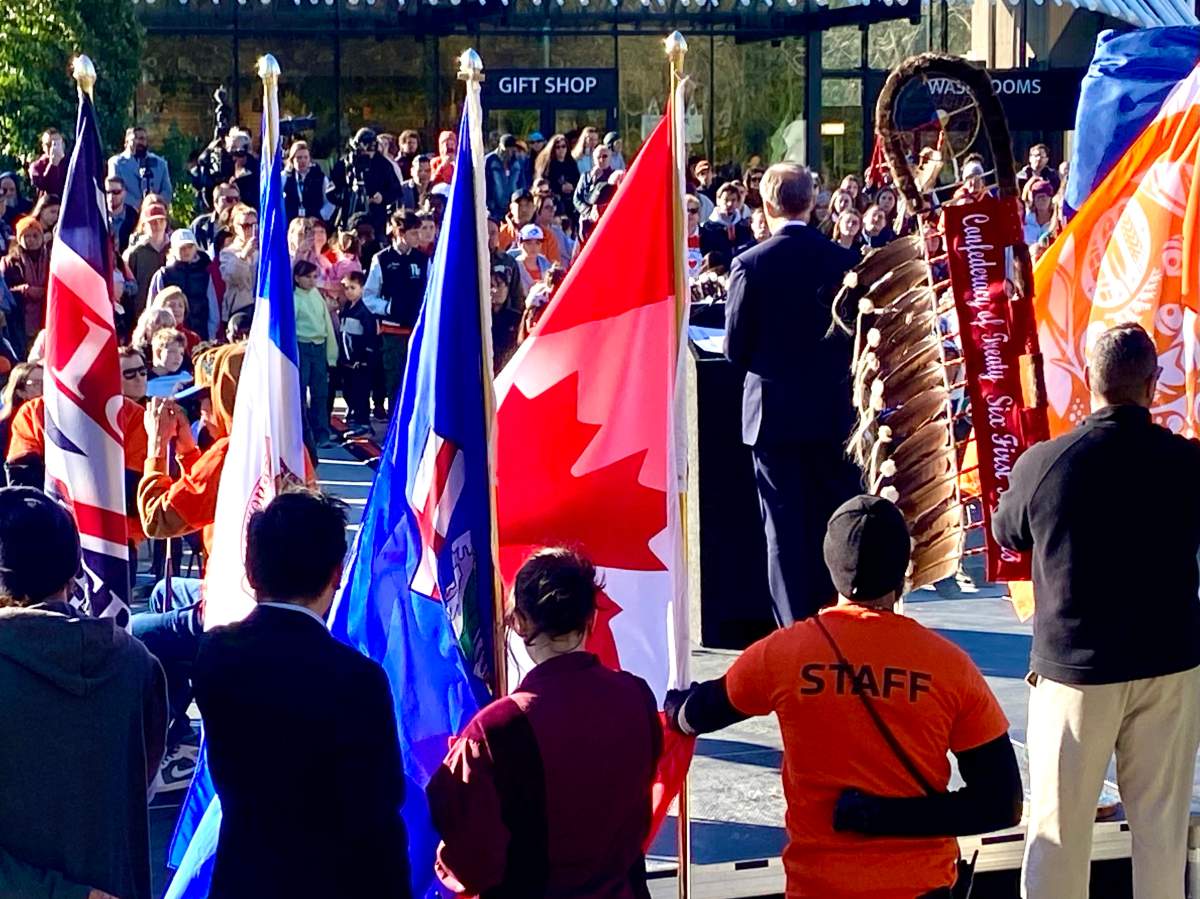
In his speech at Fort Edmonton Park, Carney said we shouldn’t choose which parts of history we remember.
“We shouldn’t admire the beadwork and forget the children that were forced into uniforms. We shouldn’t honour the drum and ignore the years that it was made to fall silent,” he said.
“And we should not hear the truth of residential schools and fail to act on it.”
Only 14 of the Truth and Reconciliation Commission’s 94 calls to action have been completed in the last 11 years, according to independent monitor Indigenous Watchdog. Another 41 recommendations are considered in progress, while 24 are stalled and 15 have not been started.

Conservative Leader Pierre Poilievre also attended the event in Edmonton. He wrote on social media that residential schools were a “massive intrusion of government coercion imposed on Indigenous families.”
“They removed children from their parents and communities, while attempting to break their connection to their very identity,” he said.
“On the National Day for Truth and Reconciliation, we honour these children, their families and their communities, and recommit to reconciliation built on self-determination, opportunity and true partnership.”
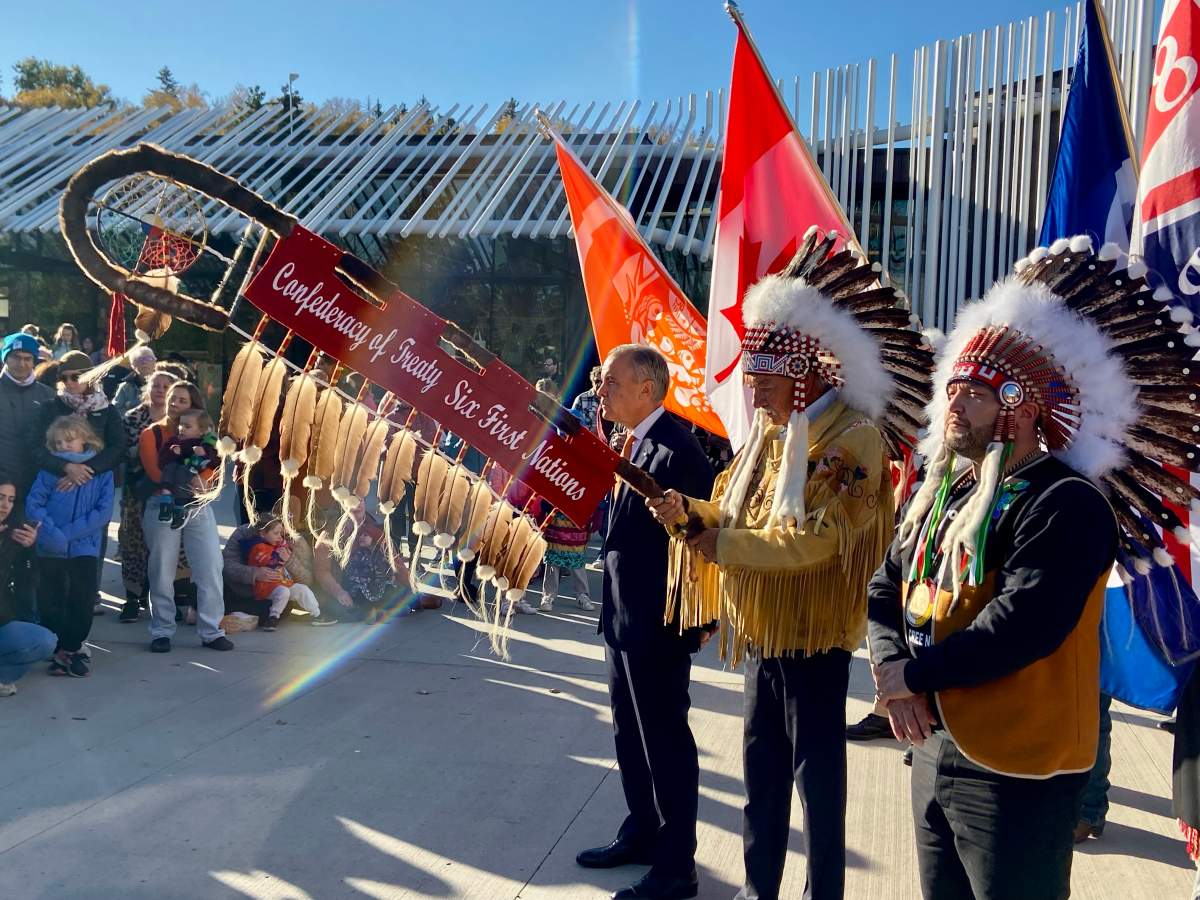
Beginning in the 19th century, more than 150,000 Indigenous children in Canada were separated from their families and communities and sent to church-run, government-funded residential schools where abuse, malnutrition and inadequate health care were rampant.

Get breaking National news
“The federal government established and sustained this system, and Canada bears responsibility for the profound and enduring harm it caused,” Carney said.
The Truth and Reconciliation Commission concluded in its landmark 2015 final report that the school system was a central element of a state-backed policy of cultural genocide.
The establishment of the National Day for Truth and Reconciliation on Sept. 30 was among the recommendations in the Truth and Reconciliation Commission’s report.
“More than 6,600 Survivors and witnesses came forward before the Truth and Reconciliation Commission to share painful realities Canada had too long ignored. Their courage ensured that Canada listened, remembered, and reflected,” Carney said.


Governor General Louise Arbour called for “honest dialogue, ongoing learning and concrete action.”
“Many Canadians, myself included, did not grow up knowing this history. Facing it can be painful and unsettling, but understanding the truth is essential to building a more just future,” Arbour said in a statement on Wednesday.
“We cannot change the past, but we can choose how we move forward,” she added.
The work of reconciliation “begins with listening with empathy to First Nations, Inuit and Métis voices,” she said.

CBC/Radio-Canada, APTN and the National Centre for Truth and Reconciliation hosted their annual Remembering the Children event on Parliament Hill.
The 90-minute ceremony featured speeches from residential school survivors, elders and Indigenous leaders. Performances by Tia Wood, Soleil Launière, Silla and Adrian Sutherland are also scheduled.
Guests and participants are encouraged to bring a pair of children’s shoes to place at the front of the stage to honour the children who attended residential schools.
Separate events to mark the day are taking place across the country, including in Toronto, Vancouver, Calgary and Iqaluit.
“On this day, we gather to honour every child taken by the residential school system and to stand in solidarity with those who survived it. As denialist voices seek to distort the past, our collective responsibility to uphold the truth is more important than ever,” said Stephanie Scott, the executive director of the National Centre for Truth and Reconciliation.
“Honouring these children means facing our history with unwavering honesty and ensuring that ‘Never Again’ is not just a phrase, but a binding commitment backed by meaningful action.”

Canadian Heritage Minister Marc Miller said the day is an opportunity for non-Indigenous and Indigenous Peoples to come together and reflect on the legacy of residential schools.
“Reconciliation is a responsibility we all share, and by connecting with each other and our history, we can help build a future grounded in understanding, respect and hope.”
— with files from Canadian Press


We owe them nothing. They owe themselves evolution.
Hey maybe if they start working towards truth (show us the buried remains) then maybe we can reconcile.
Actually, what makes me feel warm and fuzzy inside is the nice c um shot I got from my dad this morning. He bricked right up my azz. I can’t afford the rent so he says we have to pretend like i’m a little kid again, and play The Game. Then on my walk to work at McDonald’s, I found a chug OD’ing on the street, and I gave him a nice kick in the teeth. The cops saw, and they started clapping. Reconiliation is so fun! 🤣🤣🤣🤣🤣
THE A S S KISSING, PANDERING , CORRUPT CARNEY ! ANYTHING FOR A F/ G VOTE !!! WE OWE THEM F/ K ALL !!! MAYBE A BIG KICK AND A BIGGER PUNCH ! WE ARE F/ G TIRED HEARING ABOUT THIS GROUP !!! I SPEAK FOR MILLIONS ! TIRED SUPPORTING GENERATIONS OF L A Z Y BUMS !!!
I love that you hate being called a NAZl. It just makes me feel all warm and fuzzy inside. Because that’s exactly what you are. It just makes the past year that I’ve spent on this site harrasing racists like you so much more rewarding 😊
Also if I make up imaginary stories about how this Jay guy is getting thrashed by everyone “Mainly just me with 12 different profiles” then it makes it true!!!
Actually, i’m kidding. I don’t even know what a NAZl is.
But it looks like this Jay guy is getting thrashed by everyone. 🤣🤣🤣
Oh look the NAZl troll did another “No you”
Big shocker there 🤣🤣🤣🤣🤣
Myself
(i’m the biggest loser in BC) Can I blame Trump?
• I’m completely losing it because the NDP is set to lose
• DRIPA is going to be reversed, sorry chugs
• Crime will actually start getting looked at again, sorry chugs
• The biggest BC deficit in history will start getting reduced
• I can see drug crime being taken more serious, sorry chugs
• The healthcare disaster might start being addressed
• Probably less money spend on chugs
• More pressure to find them bones, sorry chugs!
• The cost of living crisis in BC will start getting looked at
• In 2025 the BC population actually shrunk for the first time in history, maybe people will start coming back
OneBC
The BC NAZl MAGA Party
• Spreading racist lies about First Nations
• Spreading misinformation about DRIPA and treaty rights
• Obsessed with residential school denialism
• Promoting conspiracy theories
• Supporting white nationalism
• Normalizing hate speech towards immigrants and LGTBQ
• Plans to privatize healthcare
• No clear plan for BC’s economy
• No official party status
Masks
Bones
the orange scam
The grift is real….
I’m so insecure that I constantly make up B S like, I was “away in Mexico golfing with buddies,” even though not a soul believes me. I’ve been here the whole time, but I get destroyed in the comments, so I just stay away from the PC and get sucked by my boyfriend for a few days. Golfing lol. The only hole that gets filled with something white is my own azz. 🤣🤣🤣🤣🤣
I sometimes wonder how do these aboriginals know it’s their land , do they have any documents to proove that . I don’t blame everything on them , but I blame our governments for beeing so stupid and give them more and more money . I would suggest to make them Canadians and stop giving them tax breaks and let them contribute to Canada by paying taxes .!but that is not going to happen while we have these morrons in goverment .
I’m away for a week and as soon as I come back and make a post you reply within minutes. You were waiting for me to come back this entire time Hahahahaha. I mean I knew you were a pathetic white nationalist coward that spends his entire life on the internet but now there’s proof!!
Seriously buddy you make this way too easy for me 🤣🤣🤣🤣🤣
You’re so jealous LOL
I see on the comments sections of every single internet site from Youtube to Facebook to official news media sites, the predominent feeling is, the natives are no longer owed anything. It’s time to give some attention to the “Truth” part of “Truth and Reconciliation.” No more grifting for them, sorry!
hahaha l don’t play golf. Did I fool you people? Golf requires money, and I spend what little I have on dirty little street chugs to suck my hog and supply me drugs. The other half goes to my parents as I rent their basement. Did you like my yelling and screaming about “fake profiles”? Yes, I know, there are no profiles here anymore. 🤣🤣🤣🤣🤣🤣🤣
“Ben
October 1, 2026 at 2:20 pm
Jay you can clearly see the protest was staged the protestors are all Indians that why their covered up !!! By the way what did you right on the banner ?”
Well if that’s the case then it definitely worked. Most of Canada already hates white nationalists so now they hate them even more. The mission was a success!! 😊
What a load of bull
They should sell shares and offer an IPO for this Reconciliation industry. With the amount of $$ constantly being given, the share value would only go up.
Dear dickless PM, you owe us all action but still…nothing but words.
Jay you can clearly see the protest was staged the protestors are all Indians that why their covered up !!! By the way what did you right on the banner ?
Keep hiding behind your masks and your little fake profiles. It just proves how cowardly you really are. I guess that’s why you never showed up at the Musquem golf course hey pussy. You didn’t have your little NAZl buddies with your white masks LOL
Man I had a great time playing golf in Mexico. I bet you were here the entire time. You’re such a pathetic loser with no life it’s hilarious LOL. Now after your little NAZl protest the entire country is pointing fingers at you guys and calling you cowards just like I’ve been saying all along 🤣🤣🤣🤣🤣🤣🤣
The smelly chugs have received enough $$. Why keep giving them more $$ when all they do is get drunk and buy drugs?? And all this stuff about Residential Schools is a big lie. They had it good there compared to what lives they would have lived. Enough with these animals.
“We owe them action” says the man who is all words and no action.
Meaningless platitudes. We have given them enough, they only result is more complaining.
What we owe them is citizenship and an end to their stone age way of life.
The white nationalist protesters with their little white masks are the biggest pussies in Canada!!
My “oral history” says I owe them nothing.
Oh, and by my calculations, they owe me money for the years of this grift. And I want the name of my neighborhood back!
And just how many generations that never even attended residential schools are we supposed to be responsible for?
Start digging, prove the mass graves, then we’ll talk, otherwise eff off.
How about the real truth before any reconciliation. The fact that this special group of people get to claim whatever they want on their so called “oral history “ without any supporting evidence is absolutely disgusting. This has to stop. Scrap DRIPA.
My thoughts on the indigenous: cancel the treaties, cancel the Indian Act. By 2040, or another date, all first nations lands are turned over to each band. The land should be split equally between each member over 18. You now own the land and Canada no longer owes them anything. Become a part of Canada, become tax paying citizens instead of the dregs of society. Each indigenous person is responsible for themselves.
This holiday has created more resentment than anything else.
I worked yesterday. Thanks to these folks, I have two paid long weekends in a row.
I owe them nothing. Nothing at all. I have done nothing to them. They cannot prove that it was Canada that did a damn thing anyway.
We owe them nothing. We’ve given them billions, tax free status and all the benefits of modern western technology. They should be grateful but they aren’t.
How ’bout some truth? Not just getting reconciled with big fat cheques that get squandered.
Who’s the guy in the picture with a beard, chief white man?
Raise the taxes and give them more money that’s reconciliation
I dont owe them a godamn thing
No other nation on earth treats their indigenous like Canada. Most countries helped their indigenous join society instead of herding them on to reserves and have them ever reliant on the government.
Acknowledging historical context is essential when considering our present-day responsibilities to Indigenous communities. My ancestors established generational wealth through land taken from Indigenous peoples without equitable compensation. Meanwhile, those Indigenous populations were systematically barred from similar economic advancement. The enduring legacy of this disparity highlights the importance of recognizing past injustices in conversations about modern restitution.
in honor of reconciliation day , Carney works on a partnership with The European Union to re creating colonization of treaty lands to the fullest ,and replace them with east Indians as first natives chiefs get pay outs under the table to block the Democracy of Alberta separation..
Enough with elbows whatever already. Any more commenter having to do with elbows deserve a kick in the azz.
We don’t owe these morons anything. Stop denying your obligations to capitalism and get a job. If you live in an engineered house, own a vehicle, and eat manufactured food; then guess what- you benefit from colonialism and are in every way a colonialist. Eventually colonialism comes for us all. You don’t just get to wipe your hands clean of it because of your bloodline. My entire bloodline had to go to work, and it continues with me, everyday. You don’t. Isn’t that reconciliation enough? In a world where we’re all slaves to capitalism and you’re not- you don’t have to work- isn’t that reconciliation enough? We’re even.
Carney you are wrong and caterng to & coddling Aboriginals! Typical frikking Liberal and you wonder why we are intolerant of AFN & the people & country are so divided?? The racism & harm isn’t sgainst Indigenous it is against those who are not Aboriginal and against Canada!! And just when I thought you were doing some good, Carney, in uniting this country & its people, you blow it!! And the law & rcmp don’t ever do anything about the aboriginal nationsl demonstrations/protests of destruction and violence, threats & fear mongering on piublic or private land. Like when they burn churches/buildings/the Canadian flag, tearing down statues, invading & stealing from farmers, etc. Double standards and discrimination, even favoritism/ no equality for canadians just all for afn!!
Recon-Silly-Nation Day..
I got an idea.How about everyone on the planet takes a test to reveal the genetic origins and we all head back to where we originally came from.
It would end racism and everything associated with that, special interest groups would not be needed, the gaslighting, victimhood and eternal Olympics of blame and accusation would end,crime would be reduced due to the end of racism ,taxes would be reduced and best of all ,there would be no need for Liberals anymore.We could round them up and send them to Antarctica onrafts.
Paleface remember six trillion of the chosen tribals were murdered by evil colonizers such as yourself! You are now expected to bankroll our entire tribe and rename every city, street after our illustrious figures like: chief drinks like fish.
Also you must adorn your buildings with our fake languages
If the government let the public vote on “Truth and Reconciliation” I bet the majority would say kick these permanent welfare recipients in the ass and make them get a job. The free ride is over.
It is time to stand up to this nonsense. ENOUGH!!!!!
Wow, I am disappointed to see the negative tenor of the majority of the comments against the sentiments and n the articke. I am also Leary of the hyper politicized attitudes of the Indigenous side of the story. I fall in between. Yes the Canadian Governments of the time created the residental school system on a shoe string budget (before the days of income tax). It was farmed out cheaply to the religious orders, under funded, under supervised and unacceptable levels of child abuse occurred. It was culture-cide. An attempt to bring the indigenous children into the 20th century – the age of steam. It was not well done. It would, however, have been worse if the authorities of the time had said…the indigenous peoples were racially inferior and therefore not worthy of being educated. The indigenous peoples have had a very hard challenge to go from the stone and bronze age to the present in only 600 years … The rest of humanity had 3 to 4 thousand years to make the same transition.
Racists gonna racist
Anonymous. Or Gemini? Go drink some orange juice.
Hey Anon,
Who exactly are you calling out? Are you one of those more-ons who fell for the tariff hysteria before they were even imposed and you fell for the “Prepared in Canada” bull that Loblaws did in early 2025?
When is the last time you looked out your window and saw citrus groves?
Hey Anon,
Who exactly are you calling out? Are you one of those more-ons who fell for the tariff hysteria before they were even imposed and you fell for the “Prepared in Canada” bull that Loblaws did in early 2025?
When is the last time you looked out your window and s
Anonymous. Arrogance, ignorance and pettiness huh. Go drink some orange juice.
Who cares.
They call them gypsies in other places. Im curious about their inbreeding habits and the retardation of there people? Will we be paying for that as well?
Hey Ben. I am kind of tied up right. I will be home soon once my shift end on Hastings Street.
⠀⠀⠀⠀⠀⠀⠀⠀⠀⠀⠀⠀⣰⠂⠀⢢⠀⠀⠀⠀⠀⠀
⠀⠀⠀⠀⠀⠀⠀⠀⠀⠀⠀⠀⠣⡤⢄⣀⣇⠀⠀⠀⠀⠀
⠀⠀⠀⠀⠀⠀⠀⠀⠀⠀⠀⠀⠀⠉⣼⠃⠈⢣⠀⠀⠀⠀
⠀⠀⠀⠀⠀⠀⠀⠀⠀⠀⠀⠀⠀⢀⢻⠀⠰⢸⠀⠀⠀⠀
⠀⠀⠀⠀⠀⠀⠀⠀⠀⠀⠀⠀⠀⣼⡇⢀⠆⢸⠀⠀⠀⠀
⠀⠀⠀⠀⠀⠀⠀⠀⠀⠀⢀⣠⣼⡽⢁⡎⠀⣮⣤⣤⣄⡀
⠀⠀⠀⠀⠀⠀⠀⠀⠀⣠⠉⠉⠈⠙⠩⡀⢀⠏⡠⠀⠚⠃
⠀⠀⠀⠀⠀⢀⠤⠄⠊⠁⠀⣠⠠⡀⠀⠈⢇⠀⡅⠀⠀⠀
⠀⠀⣀⠤⠒⣃⠀⠀⠀⡠⠚⠁⠰⣯⠐⠤⣀⣠⠃⠀⠀⠀
⠀⡎⠀⢠⠂⡏⢰⠁⠈⠀⠀⠀⠀⠁⠀⢸⠀⠀⠀⠀⠀⠀
⠀⠱⡀⠘⢿⢠⠃⠀⠀⠀⠀⠀⠀⠘⢄⠘⢇⠀⠀⠀⠀⠀
⠀⠀⠾⣿⢣⠃⠀⠀⠀⠀⠀⠀⠀⠘⠛⢆⠸⠀⠀⠀⠀⠀
⠀⣀⣀⣶⠋⠀⠀⠀⠀⠀⠀⠀⠀⠀⠀⠈⡆⢇⠀⠀⠀⠀
⠈⠉⠒⠃⠀⠀⠀⠀⠀⠀⠀⠀⠀⠀⢠⣚⡡⠤⠃⠀⠀⠀
How many generations of people who did not attend a residential school do we still owe a debt to? Three? Five? We still going to owe the 15th generation a debt and take responsibility for how their life turns out?
The Royals must have gotten the day off today too?
FN… they were lucky to be colonized by an advanced civilization that was interested in helping them grow out of their primitive lifestyle, otherwise they would still be living and beating the drum in a tent and killing each other from time to time. Residential schools had some issues but maybe someone like Cortez would have “helped” them better… Their life expectancy doubled, their population quadrupled, the standard of living can t even compare with the “original”, unbelievable subsidies, but they are still complaining.
Speaking of truth, I would like to see a list of clear well defined quantifiable objectives for “reconciliation” so we can track the progress and assess the effort. Of course, that s not going to happen…
“We owe them action.” Ha! We need to give them a swift kick in the ass & force them to work & pay taxes & pay their own way!!
What a hypocrite. He was in Edmonton for the Oilers game, so decided to attend this “truth and reconciliation” farce, instead of standing up to honor our veterans. As far as this “truth and reconciliation” you will never have reconciliation until you actually tell the truth. The government has the documents that the parents signed to have their children attend the schools, so they were not stolen from the parents. And if children all of a sudden disappeared from the schools and never returned home, then why did they not contact the RCMP to report that their child was missing. There are way too many un-truths here, so I do not know how we can take them seriously any more. I’m not denying that there were residential schools and some abuse, but there was abuse of children at white schools as well.
I love Carney and he feels so good inside my rectum.
2 people killed at Tsawwassen Mills Mall in B.C. were First Nations elders.
I guess that’s two less the rest of us have to pay for.
Hmmm…looks like $40B/year ain’t enough!
@Ben
I agree. We need Truth before any Reconciliation can occur.
But truth doesn’t need censorship nor propaganda. The prevailing narrative isn’t truth.
@Rae
You guys should drop the special status all together. Just be Canadians.
Did you know that until April 2026, Ontario charged Indigenous Canadians an extra 25% tax on homes that they purchased because they classified us as “foreigners”? Did you know that as of today, British Columbia *still* charges Indigenous Canadians a foreign Buyer Tax? How much more suffering and humiliation are we supposed to endure?
in honor of reconciliation day , Carney works on a partnership with The European Union to re creating colonization of treaty lands to the fullest ,and replace them with east Indians as first natives chiefs try to block the Democracy of Alberta separation..
Hey Ben, hundreds of thousands of Canadians, their ancestors as well, died for the freedom WE ALL enjoy today! My grandparents sacrificed so they could have a a free ride.
Yet, they insist on sullying the blood that kept them free.
Go after the CHURCH! Go after the BRITISH MONARCHY! GO AFTER GOVERNMENT! LEAVE US ALONE! WE DID NOTHING!
I owe them NOTHING!! Not a damned thing! The hypocrites can eat dung for all I care.
“Canada owes residential school survivors and their families “more than remembrance,” Yep. Cold hard cash. Paid in full. Over and over and over and over. Get your effing hands out my pockets.
I would have thought $2 billion dollars was action enough.
Tax free money. No accountability. I would like to identify as a free loader too. Where do I get my native card ?
Mark speaks with forked tongue.
Sadlly the same stupid people blindly elect the LIBERALS every four years, so sadly this Liberal Indigenous Welfare will never end. Only get worse. with increases every year.
What’s most needed is accountability.
Haven’t the Liberals shown “action” since 2015? Whatever
Look at the comments, 90% of Canadians give zero fcks about the fn grifters!
@Ben. And now Carney wants to embrace the “colonizers” even more. Interesting….
We don’t owe Carney or the FNs anything. Talk about total entitlement.
Ben is that guy who hears about fun, upcoming social events, family gatherings etc., is then told by someone it’s been called off for whatever reason(s), then later finds out it wasn’t actually cancelled.
Whos this “we”? Make the Carney family pay his dad was a residential school diddler.
I’m with MickJogger. I want my taxes back. I don’t think we owe them FA. The fns blame us and hate speech us but they sure do like the colors of our money
As a descendant of colonizers, I suppose I could take the position that “we owe them nothing.” But, in all fairness, my ancestors took Indigenous peoples’ land and gave them very little in return. My ancestors and their descendants were able to build wealth from that land, while Indigenous communities were largely denied the same opportunities to build and pass on wealth. The consequences of that history have persisted across generations, and I think it’s important to acknowledge that context when discussing what we may or may not owe Indigenous peoples today.
The chiefs, band councils, lawyers, politicians, activists and “journalists” enrich themselves and fan the flames of hatred, while the grassroots indians and Canadian taxpayers get screwed.
Don’t expect action for Carney. He is all talk and no action.
Carney is so full of s**t. He speaks to both indigenous and other Canadians with a forked tongue and cannot be trusted by either.
@Tammy O It is not the average indigenous that most people object to it is the corruption that keeps sucking billions of dollars from Canadians and then the accusations or allegations that allege children were murdered and buried yet the refusal to prove the allegations by digging by hiding behind indigenous culture. It is the deceit that most oppose.
No we DO NOT owe them anything Carney since THEY are ALWAYS asking various governments for help in one way or another and then years later they scream that government POLITICIANS did something wrong to them all, not the people, POLITICIANS OF THE TIME AND high time for them all to HELP THEMSELVES for a change instead of asking all white people to keep financially supporting them all. Fed up with all the pushing of indigenous rights that they lost years ago during the wars between us and them.
Where’s 1940s Germany when needed!
Find Online Jobs (500$-6000$ Weekly) safe and secure! Easy Acces To Information. Simple in use. All the Answers. Multiple sources combined. Fast and trusted. Discover us now! Easy & Fast, 99% Match.
.
Follow Here ………Www.JobAtHome1.Com
We owe them nothing. We were not involved so we did nothing wrong. The world is full of inequities and we all need to deal with it and get over it
Anomalies and ground disturbances?. Dig them up and lets see if its graves or just a 100 years of new outhouse holes.
Corruption = the little idigenous on the reserves don’t get much after the money passes hands from the chief, to the assistant chiefs, the admin chiefs, the friends of the chiefs; wink wink….as a result dirty water, poor roads are not addressed.
As an indigenous person I want to say this has been done to death. People hate us because all this is shoved down their throats.
The indigenous chiefs love it ! No accountability…how dare you white man demand to know where all the billions of $$$ go each year…ps. we the chiefs want more !!
The guy whose daddy was a principal at a residential school? Can’t make this up. 🙄
Traitors to Canada recognize this Truth and Reconciliation Day. It should be abolished.
There’s no such thing as reconciliation for them. They just want the cha-ching $$$$$. Cut them off!!!!
@ Try This,
We said and written.
People please read this comment by @Try This.
The First Nation People need to stand up and hold their leaders to account and get themselves out from their leadership as they are using the First Nation people to get political gain without improving their lives.
I have worked with many First Nations people and if they work off reserve they get threatened and attacked by their people just for going to work to make a career and living for their families. Some have to take their families off reserve just to get away from the hate from their own people.
I want my money back!!!
Got bone?
If you want more of my money, then dig and prove those alleged mass graves once and for all. Otherwise f off!
in honor of reconciliation day , Carney works on a partnership with The European Union to re creating colonization of treaty lands to the fullest existent ,and replace them with east Indians as first natives chiefs try to block the Democracy of Alberta separation..
@ben. Your a dissapointment to your parents and nobody cares what you have to say. Shut up.
in honor of reconciliation day , Carney works on a partnership with The European Union to re creating colonization of treat lands to the fullest existent ,and replace them with east Indians as first natives chiefs try to block the Democracy of Alberta separation..
My ancestors, family and I had nothing to do with whatever purportedly took place at that school. Why am I paying for this? They even took down the John A MacDonald statues and tried to erase him from our history.
Many apologies from various successive governments and religious groups. Billions of dollars over the years in response to those apologies and they still want more? Action has happened and now it is up to the indigenous folks to step forward and take their place in a whole Canadian society. We have done enough. Time for the FN’s to grow up and stop looking for hand outs.
Liberals have been promising “action” since 2015. We are still waiting for it.
@Ben. You should shut up. Communist.
Carney, we don’t owe them a thing. Your coddling and catering to INDIGENOUS will cripple Canada & cause more dissension.
We owe them nothing, you mother f *ucker.
Not a lot of support from this sham holiday or FNs in general as per the comments below.
We paid them between 10k and 25k each. Even if they went to regular school.
We owe them noting. Liberals need to quit giving them our money.
Gimme more money day! I’ll never ever never give two F’s about what THEY have to say!
@ben, take a look a the comments, nobody gives two craps about your opinions or Gimme more money day
It is odd how “We owe them action.” translates to, “Let’s provide money.” in the Liberal world.
Has anyone ever added up how much $$$ the indigenous have received thru welfare, grants, gifts etc in from the provinces and federal goverment? In the past 60 years? I bet it’s a lot.
I agree with Anonymous. WE OWE THE INDIGENOUS NOTHING. A welfare society who refuses to work. Pays no taxes. This has been going on for decades with no intention of stopping. If anything it gets worse. They want more money every year, plus they want recognition before every sporting event, gathering etc..now they have infiltrated the schools across Canada. omg. Where does it stop ?
All these lies fabricated by someone using a piece of machinery that looks like cross between a lawnmower and a photcopier in a Kamloops school where they new there were graves because they neglected to maintain those graveyards for years never were unmarked just neglected. Give us real evidence or shut it down once and for all.
100 dollar boom boom. Me love you long time.
We owe them nothing. They live off the Canadian taxpayer. They owe us the truth in Kamloops. Dig and prove the doubters wrong or give back the millions they took.
I can’t help but notice that Carney is starting to do alot of the same things that Trump does. Mainly say something completely false as if it is an undeniable fact. And just like the Trump supporters, the LPC supporters just lap it up and don’t bother to think for themselves. People on the left and right are strangely similar to eachother. Freedom for them means freedom from thought and responsibility.
We owe them nothing
@Ben’s Momma 1014am. You don’t have the smarts to respond, so you personally attack.
Let’s have the truth and start digging in Kamloops.
How many bones were found?
Liberals have pretended to take “action” since 2015. Carney stating more action doesnt make it so.
Firnat constantly having their collective hand out is not helping them become contributing members of society!
I know a good action, digging.
I immigrated from Angelina to Canada in 2005. This is such a stupid “day off”. Now the conquered want to make present day Canadians feel guilty. I don’t observe this “holiday” and think it should be cancelled.
Truth: nor all natives were abused at residential school.
Truth: the native parents were the ones that took their children to school, because they wanted them to learn. It was and is a treaty right to get free elementary education. – they were not taken by the schools
Truth: Most native children were treated better than at home. They were clothed, and fed. The entitled did not want to wear the free school uniform. – that is why we celebrate school uniform day by wearing orange school uniforms.
Truth: the only children who did not return from school died of smalllpox or other diseases. – There are no unknown graves. Everyone was documented. There was better mortality rates at the schools, than on the land.
Truth: Most of us graduated. Why are we using the misleading term ‘survivors’? Most of them dropped out once they learned enough to survive in the new world.
How many of them are reconciling to the truth? We need to get our leaders to quit with the disinformation.
Ben, hurry up home! I have to head out to my early shift turning tricks on Hastings.
Carney is ALL talk and No action. Sloganeering at its finest.
@Ben.
Your ancestors treated F.N. horribly.
You need to sell everything you own and give the money to F.N.
Then for the rest of your life,half of all your income and anything you gain must go to F.N. for reconciliation otherwise you are nothing more than a virtue signaling hypocrite.
You will need to show receipts here for the actions you take for reconciliation.
Fortunately my ancestors didn’t arrive here until the mid 1950s and had no interactions with the natives other than common friendship and conversation so I do not need to reconcile anything.
Get busy Ben !!! Time to pay for the actions of your ancestors!
Is Trudeau going surfing in Tofino?
Every year I have less and less respect for this national day of guilt-tripping the whites, who have easily been a net benefit to the world. How about providing some “concrete” evidence of your accusations?
@Ben. No. We don’t need more “education” or really would be indoctrination. This is not a priority for most Canadians.
Perpetual victimhood is never a good thing. Time to stop making excuses. There seems to be no resolve with Canadian FNs.
Survivors have provided extensive testimony about children who died and burial sites associated with residential schools. Ignoring or discounting their claims after my ancestors treated them so horribly would lack basic human empathy. It’s clear in my opinion from the comments that the public requires more education surrounding the topic of First Nations.
It was Harper who set up the Commission. It was Trudeau that knelt at a field that actually contained no unmarked graves of children, and then forced the nation to lower our flags to half mast for months.
Show me some kind of evidence???
Canada is a joke
FNs need to be honest with themselves and face the “truth”. They need to stop making excuses for their own problems.
Another holiday for Carney Liberal federal government workers. Disgraceful waste of money.
Nobody cares.
I agree, nothing more concrete than digging up them bones! SHOW US THE BONES!!!
Carney knows nothing about truth. He lied about the Gordie Howe Bridge Deal and why he walked away from the negotiating table with the USA.
They just want money not truth. They all drive expensive suvs yea they are hurting. No job but 80k ride.
A day that Trudeau should have never capitulated to. He will go surfing in Tofino.
I don’t plan to do anything
Let’s start with some concrete truth. We can’t reconcile when the truth is hidden.
Wow, two comments citing truth and no go. F*ck the FN and their lies and F*ck Global and its censorship!
So, I see why there are no comments here. Censorship. Why bother having comments open if truth is going to be censored? Not everyone believes in the scam but we are not allowed a voice.
I did nothing to these people yet my life is affected by them and what they do to my country.
You wonder why the hate. It is generated and fanned by media and government alike. Every censored word makes it worse.