

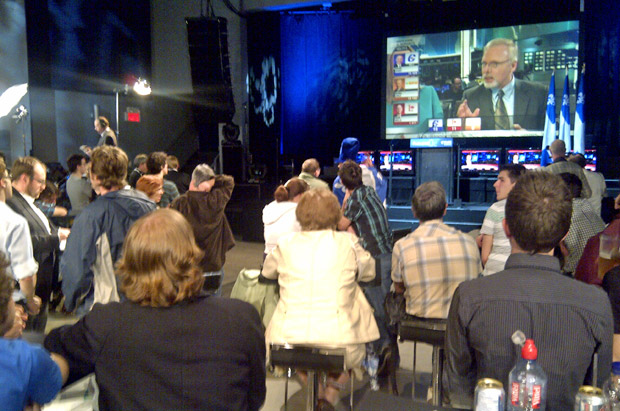
As election results for the province of Quebec are announced, Gilles Duceppe is staying away from his party’s headquarters at the Telus Theatre in downtown Montreal.
Officials say it may be as late as midnight before the longtime party leader appears.
As of 10:15 p.m. ET, the NDP had taken lead in the province with 54 seats, far ahead of the Bloc, which had only three.
This year’s federal election battle has seen more twists and turns than any other in recent history — and it doesn’t look good for the Quebecer.
No guarantees
Duceppe’s seat in Laurier-Ste-Marie is hotly contested for the first time this decade.
At the beginning of the campaign, Duceppe’s defeat would have seemed next to impossible.
In 2008, Duceppe, who’s been leader of the Bloc Quebecois since 1997, defeated Liberal Sebastian Caron by 15,283 votes. He also won the riding in 2006 by 18,000 votes, and in 2004, he took the seat with 20,000.
While the number of supporters has slightly dropped over those years, it’s safe to say few would have predicted the Bloc’s drastic decline in this election.
On March 26 when the campaign began, the Bloc set its sights on not only keeping its 49 Quebec seats, but perhaps adding a few more.
But those were early campaign goals – set before the unprecedented NDP surge, which took hold across the nation and specifically in Quebec.
Suddenly, the notion of adding new seats to the Bloc’s repertoire went to the wayside.
Instead, the focus became trying to ensure incumbent candidates – Duceppe included- could hang on. Duceppe called on Jacques Parizeau, a statesman of the sovereignty movement, to help with the campaign. The Bloc’s message shifted to pushing sovereignist message that only the Bloc can defend Quebec’s interests in Ottawa.
But the major slide in support for his party will be a significant marker of this election.
There are many factors contributing to the party’s drop in numbers.
Provincial power
For one, some sovereigntists are starting to think that if there is any hope of separating, the move will be one that comes from the provincial level and not the federal.
Secondly, some political analysts say Quebecers are looking for change – and as Journal de Montreal columnist Richard Martineau wrote on May 1, when a few buy into a new idea, it’s not long before they’re joined by the masses.
Thirdly, for some Quebecers, there’s a growing sense that the only major difference between the Bloc and the left-leaning NDP is separatism.
Jack Layton’s focus on health care, education and other social programs, connects with many of the values Quebecers share.
In this campaign, he also appealed to Quebec nationalism, even going so far as to suggest Bill 101 should be applied to federal government offices in Quebec.
Combined with the fact that last week, two former Bloc MPs came forward to encourage Quebecers to vote NDP, it’s made for a more challenging playing field than Duceppe likely could have predicted.
When asked by reporters this weekend to comment on his future, Duceppe replied only that he was focused on the task at hand.
Background
Duceppe is a graduate of the Universite de Montreal, and became president of a major Quebec student association at the age of 21.
He is the son of a well-known Quebec actor, Jean Duceppe.
He was also the first Bloc Quebecois candidate elected to the House of Commons, in the 1990 by-election. He was Leader of the Official Opposition in the Parliament of Canada from March 17, 1997 to June 1, 1997.
In February of this year, he won a party leadership review endorsement by 95.3 per cent.
He is considered to be the most popular separatist politician in the province with many observers saying he will some day lead the Parti Québécois.



Comments
Want to discuss? Please read our Commenting Policy first.