

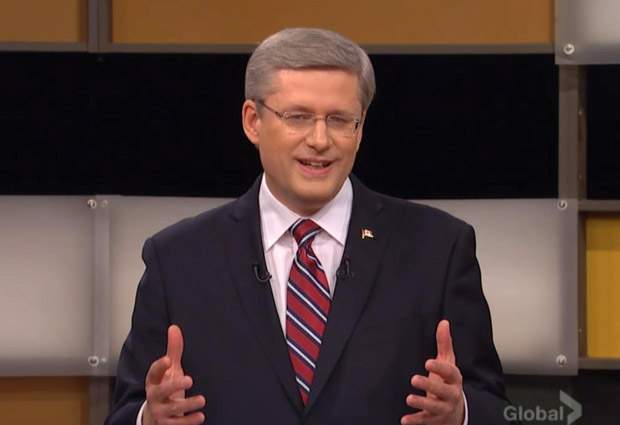
OTTAWA – Among all the issues in Tuesday’s election debate it was a bit of non-verbal communication that may have generated the most attention in the Twitterverse: Stephen Harper’s stare.
An analysis of user messages on Twitter suggests that the most popular topic of the evening was the prime minister’s habit of gazing past his opponents, towards the camera.
As of 9:30 p.m., about a half-hour after the debate’s conclusion, Harper’s stare had generated at least 1,474 messages – including original messages and retweets.
That compares with 1,132 messages about crime; 1,198 about NDP Leader Jack Layton’s quips using the modern buzzwords "bling" and "hashtag fail"; 910 about the economy and deficit; 656 about majority and minority governments; 410 about coalitions; and 688 about bickering.
The prime minister’s body language was carefully chosen, his aides said, to rise above the partisan cacophony and deliver a clear message to viewers at home: only a Conservative majority can end the bickering.
The direct eye contact had both supporters and detractors.
"Harper’s ‘speak directly to the voters’ dead gaze into the camera isn’t just rude, it’s Walking-Dead creepy," said one less-than-flattering message.
Another Twitter user, however, playfully suggested the tactic might be working: "What’s going on with Iggy? Is Harper’s death gaze getting to him?
"Maybe he’s feeling Harper’s psychic hand around his throat?"
A more neutral message playfully suggested an alternative name for the debate: "The Great Harper Camera Stare-Down."
The debate created considerable online traffic, with 39.3 million potential views of messages by users. There had been 38,000 debate-related tweets as of 11 p.m.
As of last August, an estimated 4.5 million Canadians were on Twitter.
At one point Tuesday, six of the top 10 trending topics in Canada were debate-related – the most popular being the hashtag used by users to identify the evening’s contest: #db8.
The terms #db8, "Gilles Duceppe" and "Iggy" even became worldwide trending topics Tuesday evening, alongside entries such as "Walmart," #PlaybookHaiku, and #uknowlifeishardwhen.
"The stare issue was one issue that kept coming up," said digital public affairs strategist Mark Blevis.
"It speaks to style. It’s an issue that’s easy to discuss in a limited character space. . . People understand interpersonal communication."
Blevis said policy discussions on complex topics like the economy and deficit reduction, health care and the environment are difficult to do in real time with 140 characters or less.
The Canadian Press analysis of social media during the campaign is being carried out daily; Blevis uses a mapping program called Sysomos to scan Twitter, blogs, online forums and other social media sites for election-related traffic.
The methodology is not scientific.
Searches are being tailored to try to capture material that is clearly linked to the campaign by using a set of 10 hashtags for Twitter and specific sets of keywords for other media or issues.
The Harper-stare tweets turned up, for instance, in searches that included "Harper," in combination with terms such as "looking," "facing" or "eyes."
While the social-networking site and its measurement mechanism might be relatively new innovations, the stare tactic literally dates back to the dawn of televised debates.
John F. Kennedy’s direct stare into the cameras during the 1960 U.S. presidential debate – the first of its kind – is considered one of the reasons he connected with viewers at home and eked out a razor-thin win over opponent Richard Nixon.



Comments
Want to discuss? Please read our Commenting Policy first.