

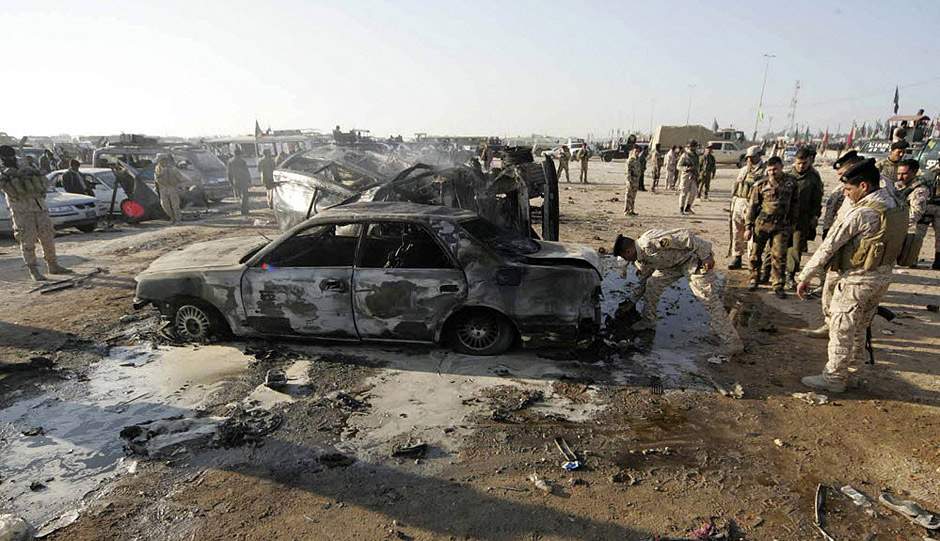
BAGHDAD – A massive car bomb ripped through a funeral ceremony in a Shiite district of Baghdad on Thursday, killing 37 people in the bloodiest day in the Iraqi capital in more than two months.
The blast was the deadliest in a series of bombings Thursday that claimed 42 lives across the city, and is the latest in a spate of violence in the past 10 days that has killed more people than violence throughout November or December.
The apparent surge in attacks, mostly targeting Iraq’s majority Shiite Muslims, comes little more than a month after Prime Minister Nuri al-Maliki formed a national unity government, ending nine months of deadlock following elections in March.
"A car bomb that exploded outside a tent where mourners were gathered for a funeral ceremony killed 37 people, and 78 were hurt," a defence ministry official said, speaking on condition of anonymity.
The toll was confirmed by an interior ministry official.
The car bomb in the predominantly Shiite neighbourhood of Shuala, north Baghdad, completely burned the tent where the funeral was taking place, leaving pools of blood and scattered pieces of clothing and shoes at the scene, an AFP journalist said.
Several cars were also completely destroyed, while the windows of nearby homes were shattered from the force of the blast. One nearby house was badly damaged and security forces closed off many of the main roads leading to the blast site.
Police who rushed to the scene were confronted by an angry mob that assaulted them with volleys of stones, officials said, adding that soldiers were deployed to restore order.
Maliki ordered the arrest of the area’s security chief, army Lieutenant Colonel Ahmed al-Obeidi, in the immediate aftermath of the attack.
In other blasts around the capital on Thursday, five people were killed and 21 wounded by roadside bomb attacks and a bomb placed inside a minibus.
The overall death toll of 42 killed was the highest for Baghdad since November 2, when 11 car bombs rocked the capital, killing 63 people and wounding nearly 300 in predominantly Shiite neighbourhoods.
The funeral attack was the latest targeting Shiites since a spate of car bombings last week killed 57 people outside the central shrine city of Karbala.
Those bombings came ahead of a Shiite mourning ritual when hundreds of thousands of pilgrims poured into the city to mark 40 days after the Ashura anniversary commemorating the slaying of Imam Hussein, the sect’s revered seventh century saint.
On January 20 on the outskirts of Karbala, three car bombs exploded among crowds of worshippers around 20 minutes apart, killing 45 people and wounding 150 others.
Another triple car bombing four days later killed 12 and wounded dozens.
Imam Hussein’s death at a battle near Karbala is at the heart of the historical division between Islam’s Sunni and Shiite sects, a split that has fuelled sectarian violence between Iraq’s Shiite majority and the Sunni Arab minority that dominated Saddam Hussein’s regime until its ouster in the U.S.-led invasion of 2003.
Also last week, al-Qaida’s front group in Iraq claimed responsibility for a series of suicide bombings north of Baghdad that cost more than 60 lives.
The Islamic State of Iraq (ISI) said its suicide bombers carried out attacks in Baquba and Tikrit, according to a U.S. group that monitors jihadist statements.
The attacks in the two cities had targeted Iraqi security forces and the provincial council of Diyala, of which Baquba is the capital. The ISI accused it of attempting "to spread the Shiite doctrine" in the central province.
Violence across Iraq since a suicide bomber blew himself up in the middle of a crowd of police recruits in Tikrit on January 18 has already killed more people – at least 181 – than in all of November or December, when 171 and 151 people died respectively.



Comments
Want to discuss? Please read our Commenting Policy first.