

MONTREAL, Que. – Few people have probably thought about the rich history of Montreal’s Ste. Catherine Street as they darted in and out of its restaurants and shops.
It’s unlikely they dwelled much on it either as they walked past its homes on the way to some outdoor concert at the Montreal International Jazz Festival or took in an event from some other festival.
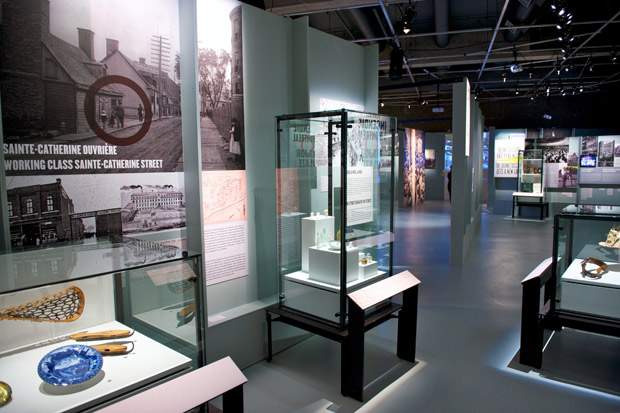
A new exhibit entitled Sainte Catherine Street Makes the Headlines, at Pointe-a-Calliere, the Montreal Museum of Archeology and History, aims to change that.
"For the museum, the idea of presenting an exhibit on the history of Ste. Catherine Street was quite important," says Anne-Elisabeth Thibault, the project manager for the exhibit which runs until April 24.
"It’s one of the most popular streets – if not THE most popular street – in Montreal."
Francine Lelievre, the museum’s executive director, says that besides being a vital artery, Ste. Catherine Street is "a valuable witness to Montreal life, as well as one of its most faithful reflections.
"This is a wonderful opportunity to salute the 250-year history of such a symbolic thoroughfare, in the first exhibition on the subject, based on original research."
The museum team were aware that the show had to be accessible not only to locals but also out-of-towners who figured their burg had its own iconic street.
"When we thought about our exhibit, we really wanted to put it up not only for Montrealers but for people who would not know the street, who would be able to discover it through this exhibit," Thibault says.
The street’s story is told through several themed sections using 230 artifacts, 300 pictures and 31 film clips in the large room of the Old Montreal museum.
"A little bit of the Forum is in this exhibit," notes Thibault as she perches on one of the seats from the Old Forum, as the building is referred to by locals.
The Forum, which is one of Ste. Catherine Street’s most famous venues, was replaced as the Montreal Canadiens’ home in 1996 by the Molson Centre, which was later renamed the Bell Centre.
Besides the seats, which are adorned with names of players such as Howie Morenz and Henri Richard, there are other Canadiens items including sticks, rings, cups, jerseys, masks, trading cards and even bobble-head dolls.
Ste. Catherine Street’s 11 kilometres has seen a lot of history in its 250 years and the intersection of Peel and Ste. Catherine is often touted as one of Canada’s important crossroads, right up there with Winnipeg’s Portage and Main.
The bustling thoroughfare that tourists are so familiar with now started out as a bunch of fields and then a rural road that ran along the city’s fortifications. It was first laid out by land owners until a more systematic approach was applied.
It’s name is a source of mystery – some tales say it came from an apparently illegitimate daughter of Louis XV who lived in the city. Others say it comes from the daughter of Jacques Viger, the inspector of roads in 1813.
Thibault says when the museum started planning the show, it found there wasn’t a lot of general information about the street itself but a lot of bits and pieces that had to be drawn together to give a cohesive portrait.
"The development of Ste. Catherine is kind of the mirror for the development of Montreal," Thibault says. "All the innovative things that Montreal has built up through time, you’ll find it on Ste. Catherine."
She says taking a chronological approach would have been repetitive so the exhibit is broken into several themes which bring not only the history but the route’s vitality to life.
Along with the residential aspects – homes and apartments still dot the street’s length at the east and west ends – the show hones in on its impact on culture, sports and business.
"It’s uniqueness is in the fact that you can find the street has various missions," Thibault says. "You can live on Ste-Catherine Street, you can shop on Ste-Catherine, you can go to bars, you can go to restaurants, you can go to a festival.
"It’s a street where you can live by day but also by night," she noted. "It’s alive 24 hours a day."
Besides bottles and figurines that were dug up by archeologists and traced to some of the elegant homes of Ste. Catherine Street’s early days, there are also pieces of ornate furniture and classic statues.
Vintage firefighter’s equipment harks back to a darker time, when a devastating blaze ripped along the street in 1852 and left 10,000 people homeless.
The street’s seamier side is also invoked in a small section that recalls its notorious reputation as a cornerstone of the Red Light District, a target of vice-busting crusader – and later mayor – Jean Drapeau.
However, besides hosting some of the country’s most eyebrow-raising burlesque, Montreal also boasted a nightlife that was the envy of many cities with thriving club and theatre scenes.
There is footage of demonstrations in the exhibit but they’re mainly peaceful and not the melee of the fabled hockey or political riots that left stores along the strip trashed. A circus parade photo from 1919 has Montrealers agog at exotic beasts.
Thibault pointed out that because of its geography, Ste-Catherine Street became a place "where people will go spontaneously."
Indeed, shopping seems to have been included in that impulse, stoked by the iconic department stores such as Eaton’s, Morgan’s and Simpsons, which thrived alongside Dupuis Freres until they were eclipsed by boutiques.
Dresses, toys and other items from the stores are on display as well as silverware from Eaton’s historic art-deco ninth floor restaurant which is now closed to the public.
Some items from the city’s transit history are in the show, such as a model streetcar and a conductor’s equipment. Ste. Catherine Street used to be plied by streetcars until those were replaced by buses in 1956.
While the exhibit touches the high points of the street’s history, a more in-depth look is available at the museum in the form of the book "Ste. Catherine Street: At the Heart of Montreal Life."
If you go:
Address: 950 Place Royale in Old Montreal
Hours: Tuesday to Friday: 10 a.m. to 5 p.m.; Saturday and Sunday: 11 a.m. to 5 p.m. Closed on Monday.
Rates: Adults: $15; children (0-5): free; youths (6-12): $6; students (13-30, with valid ID): $8; seniors (65 +, with ID): $10. Family rates: One adult and three children (17 and under): $30; two adults and two children: $30.



Comments
Want to discuss? Please read our Commenting Policy first.