

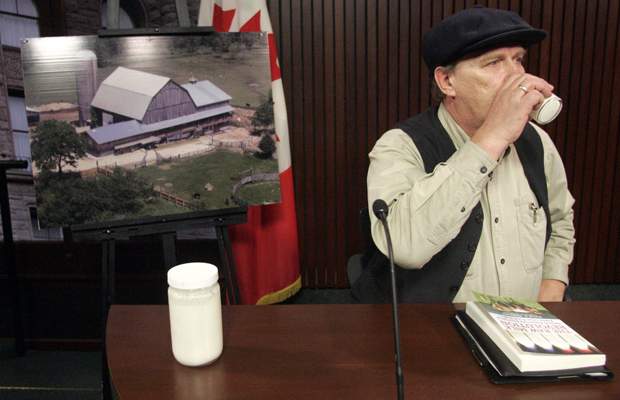
TORONTO – It’s been nearly a year since Ontario dairy farmer Michael Schmidt was acquitted in a landmark case involving the sale of raw milk, but the debate over the illicit liquid has yet to go sour.
In January, an Ontario justice threw out 19 charges laid against the Durham, Ont., farmer for providing raw milk and raw-milk products through his cow-share business. Schmidt had argued he wasn’t guilty of distributing to 150 customers because they were all entitled to the milk after each purchasing a $350 share in the cows he kept at Glencolton Farms, just north of Toronto.
The judge agreed, ending a 16-year-long legal battle.
The government is appealing the ruling in February.
"There’s still a push on the whole raw-milk issue," said Schmidt, 55, in an interview earlier this month. "We still need to force a discussion to resolve it. The consumer pressure isn’t going away."
In Canada, it is illegal to market, sell, distribute or deliver unpasteurized milk or cream. Yet, it is legal to drink or use the raw milk to make cheese.
Since the ruling, cow-share operations have quietly grown in numbers in British Columbia, Saskatchewan, Alberta, Prince Edward Island and Nova Scotia. Many of the businesses rely on word of mouth.
Schmidt’s own farm has grown to 40 cows, requiring him to make milk deliveries to Toronto for his cow-share owners every week.
The demand also prompted Schmidt to start Cow Share Canada, an organization that accredits raw-milk operations by providing production, testing and inspection guidelines to existing and emerging dairy farmers.
Last year, 15 farms signed up for a weekend course the organization held on how to produce safe raw milk. It was so successful the course will be offered across Canada beginning in the new year.
According to Health Canada, non-sterilized milk is unsafe to drink because it can contain bacteria that may lead to potentially debilitating illnesses such as salmonella, E. coli and Listeria. In the past five years, nearly 200 people in Ontario alone have become sick from consuming raw milk. Canadian dairy farmers have been required to pasteurize their milk since the 1930s.
Out of all the G8 countries, Canada is the only one to prohibit the sale of raw milk.
A growing number of organic food experts and consumers believe Canadian laws are outdated and do not reflect current technology which they claim has made unpasteurized milk not just safe, but healthy, to drink.
This debate is also being fuelled by a growing movement across Canada with consumers demanding a say on what they eat and where the food comes from.
"This debate is sort of an awakening on what we want to put in our mouths," said Schmidt. "That’s a dominant theme here, that people are increasingly having trouble digesting pasteurized milk and looking at raw milk as an alternative."
He said it was "discriminatory" for a blanket ban on raw milk, when so many other foods approved by Health Canada – from spinach to cheese – constantly undergo health recalls.
"Why don’t we kind of harmonize our old approach to raw milk?" asked Schmidt. "The focus right now is fighting it, with tooth and nail, like every province. We need a national debate."
Still, the Ontario government plans to fight the ruling on appeal.
"(Laws) regulating the sale and distribution of unpasteurized milk have not changed," said Sarah Petrevan, a spokeswoman with Ontario’s Agriculture, Food and Rural Affairs Minister Carol Mitchell. "Cow share programs are not an exception to the law."
B.C. has also taken a hard stance against the distribution of raw milk by recently declaring it a health hazard under the province’s public health act.
In September, Chilliwack, B.C. farmer Alice Jongerden faced a charge of contempt of court for not following a B.C. Supreme Court ruling in the spring that asked her to cease and desist her Home on the Range dairy. She was still continuing to milk and care for the 26 Jersey cows that belonged to about 450 shareholders. The milk was being placed in jars labelled with "Not For Human Consumption" but a health inspector said that was the purpose for the illicit liquid.
The farm has since been taken over by Schmidt.
Jongerden, who has been unemployed for the past three months, said small-time farmers like herself are the casualties in this food battle. "I am still sitting back and trying to figure out how all this happened," she said. "For me, this was a real wake up to the system that is out there. This was never about health for them."
The Dairy Farmers of Canada, which represents the nearly 13,000 farms across the country, have come out against farmers who have chosen to illegally provide raw milk to consumers.
"You look at any study and it shows there’s high levels of pathogenic bacteria (in raw milk). It really is dangerous to consume," said spokeswoman Elizabeth Cork in Ottawa. "We don’t, in any circumstances, advocate drinking raw milk."



Comments
Want to discuss? Please read our Commenting Policy first.