

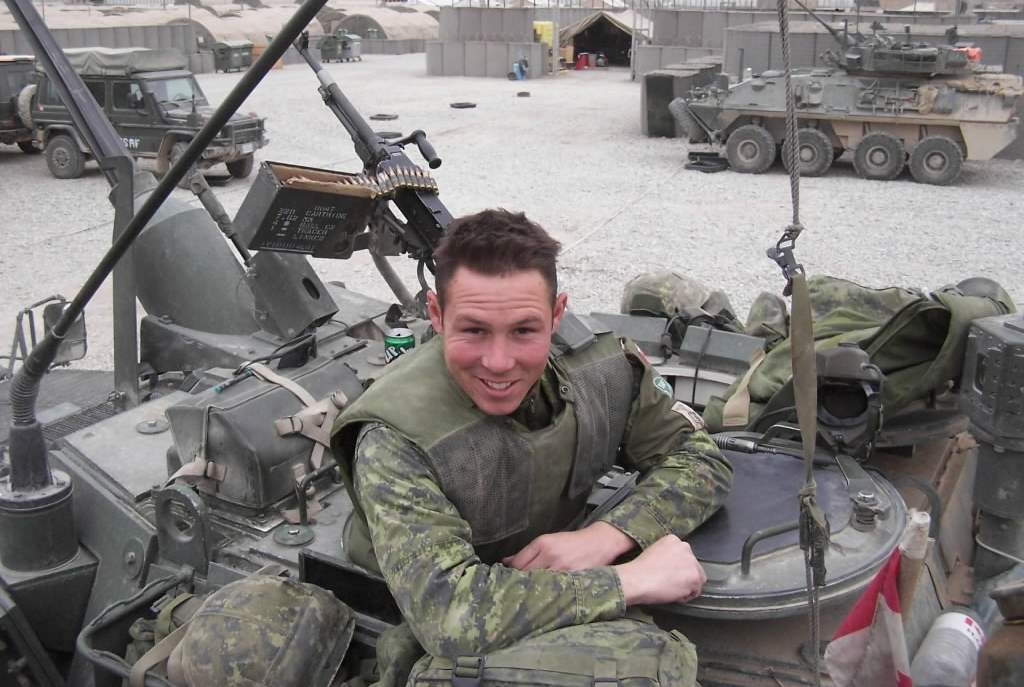
The Defence Department has told the mother of a dead soldier to stop phoning the Ottawa offices of the military’s pension branch as she attempts to sort out her son’s estate.
Sheila Fynes has been trying since March to get DND to return her son’s pension contributions to his estate.
She has made about 22 phone calls to the department, but has gotten few answers as she has been bounced from person to person, she said. At one point, the bureaucrat dealing with the file went on maternity leave and Fynes had to start over.
Fynes said that, since her son’s death, the family has been poorly treated by DND, but that the highly unusual Sept. 21 legal letter forbidding her to call government offices was insulting and offensive.
"Since when does the military decide in Canada who people can and cannot talk to?" asked Fynes. Her son, Cpl. Stuart Langridge, committed suicide at CFB Edmonton in 2008.
Langridge, a model soldier and a veteran of Bosnia and Afghanistan, was suffering from symptoms of post-traumatic stress disorder.
"This isn’t about money," said Fynes, adding that the pension contributions are likely a relatively small amount. "This is about the institution that Stuart served honourably having some respect for him."
The move is the latest roadblock facing Sheila and her husband, Shaun, as they try to sort out their son’s affairs and untangle the bureaucratic mess they say the Canadian Forces created.
Paperwork naming Shaun as the executor of the estate was eventually found behind a filing cabinet at CFB Edmonton but, before that, the military allowed another person to assume that role. Documents clearly naming Sheila and Shaun as primary and secondary next of kin were ignored by the Forces, who instead turned to his girlfriend of 14 months for that role. Mistakes were also made on the death certificate.
The Canadian Forces withheld Langridge’s suicide note from the Victoria, B.C. couple for almost 15 months. The soldier’s car, eventually returned to Fynes, was seriously damaged while in military storage.
So far, the Fyneses say it has cost them $12,000 in legal fees to correct DND’s mistakes.
Veterans Affairs has corrected its records regarding Langridge but the Defence Department has not, said Sheila Fynes, who is holding a press conference today to release more details about DND’s treatment of her family and her son.
The family maintains the Forces partially contributed to Langridge’s death after it failed to get him help. After Afghanistan, the soldier slid into mental illness, mixing medications and alcohol. He tried to kill himself six times.
Fynes said she contacted DND’s pension office in March and things appeared to be progressing. DND requested she send various documents, which she did. But after the public servant working on the file went on maternity leave, Fynes was referred to a number of different officials.
Most of her interaction with DND was leaving messages and bureaucrats leaving messages for her, although not providing any information. When she finally got hold of a senior official, that public servant would only answer her questions with: "I cannot speak to that."
"I said, ‘I’m starting to get the impression you’re not to speak to me and her answer to that was, ‘I cannot speak to that at this time’," said an exasperated Fynes, who said she was polite in her conversations with bureaucrats.
On Sept. 21, the DND/Canadian Forces legal advisor, Lt.-Cmdr. Gordon Thomson, sent a letter to a law firm the Fyneses sometimes used. It read: "I must request that you immediately inform Mrs. Fynes not to have any further direct contact with members of the Canadian Forces, Department of National Defence, or Department of Justice with respect to any matters relating to the claims she has demanded from the Crown."
Henceforth, all questions would have to be submitted by the Fyneses’ lawyer, according to the letter. DND, Department of Justice and Canadian Forces members in various offices had been informed not to talk to Sheila Fynes.
Fynes points out she never contacted the Justice Department and the family’s only claim for reimbursement is for the $12,000 in legal fees. She said she requested the pension be returned, but has not filed legal action on that.
DND spokesman Andrew McKelvey said the intent of the letter was to "follow general law principles to convey the next steps in the legal process for this very difficult, sensitive and complex issue.
"It’s a general principle of law societies that counsels are forbidden from communicating directly on the file with persons who are represented by counsel," said McKelvey.
"As the Fyneses are represented by legal counsel, correspondence from Department of Justice counsel on this matter must go through the Fyneses’ counsel."
Fynes said DND’s actions are typical. "They want everything to go through a lawyer so they can drive up our legal fees and hope we just go away," she said. "That’s not happening."
Last year, a military spokesman said an investigation had been launched into how Langridge’s records were handled. "There were things that clearly happened the way we would not want them to happen," acknowledged Maj. Dave Muralt.
An officer assigned to help the Fyneses work with the bureaucracy also acknowledged in an e-mail the family had been "deceived, misled, and intentionally marginalized (at) various points" by DND and the Canadian Forces.
Military police have also acknowledged they were wrong to keep the suicide note from the family for 15 months.
Asked whether DND was treating the Fyneses fairly, McKelvey responded: "We feel the legal process is fair."



Comments
Want to discuss? Please read our Commenting Policy first.