


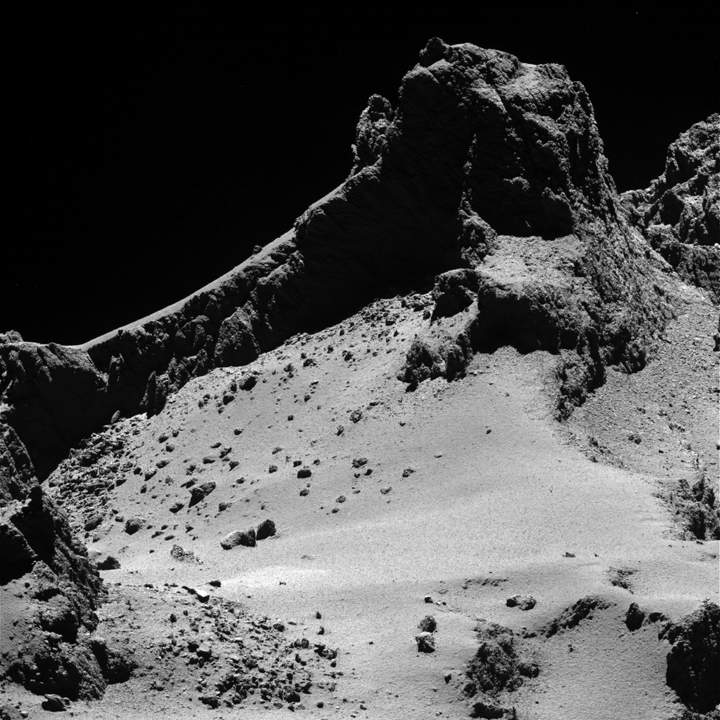
TORONTO – Extraterrestrial life: this is what astrobiologists dream about finding some day.

That’s likely why some media are excited by claims by two astrobiologists — Max Wallis and Chandra Wickramasinghe — who today reported that there was some chance that microbial life was likely to exist on Comet 67P/Churyumov-Gerasimenko. (The Guardian has since published a story refuting the claim.)
What set everyone atwitter was a study presented by the two scientists at a National Astronomy Meeting in Wales on Monday. They believe that the comet — which is currently being orbited by the Rosetta spacecraft and has the Philae lander on its surface — could be home to microbial life that helped create its distinctive features.
READ MORE: It’s the pits: Comet observed by spacecraft seems to have sinkholes
In a press release on the Royal Astronomical Society’s website, Wallis was quoted as saying, “Rosetta has already shown that the comet is not to be seen as a deep-frozen inactive body, but supports geological processes and could be more hospitable to micro-life than our Arctic and Antarctic regions.”
Essentially, the scientists believe that the black crust of the comet, that has underlying ice and smooth flat-bottomed craters, was created by a mixture of ice and organic material that unified under the sun’s warming.
But aside from that supposition, there is no other evidence presented.

Get breaking National news
This is not the first time Wickramasinghe has made a seemingly outrageous claim. In 2003, he, along with a few other scientists, suggested that the SARS virus came from outer space. In 2002, he claimed to have collected microorganisms from the stratosphere.
That’s not to say without a doubt that Comet 67P doesn’t have microbial life. Anything is possible. But so far there hasn’t been any evidence to support the scientists’ theory. What’s needed is solid evidence, as many scientists are calling for.
Comments