


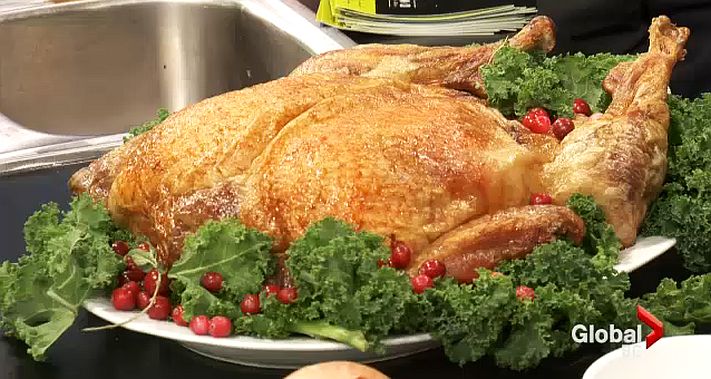
Turkey will be on the menu for many Canadians this holiday weekend, and it’s important to properly prepare what will be the centrepiece of the festive meal to avoid food-related illness.

Turkey poses particular food safety challenges because it can be contaminated with bacteria such as salmonella, which can cause diarrhea, vomiting and stomach cramps.
Adopting standard safe cooking and safe handling practices (clean, separate, cook and chill) reduces the risk of getting sick from undercooked turkey and stuffing and from cross-contamination during preparation.
Read more: Thanksgiving
Health Canada offers the following steps for home cooks to help ensure their turkey feast is a safe one:
– Store your turkey in the refrigerator or freezer in a leak-proof bag immediately after you buy it.
– Health Canada discourages thawing your turkey at room temperature. It’s better to thaw turkey in the refrigerator or in cold water.

Get weekly health news
– If you thaw your turkey in cold water, keep the turkey in its original wrapping and change the water regularly to ensure the water remains cold.
Read more: Save a turkey, feed Toronto’s homeless with a tweet
– Don’t rinse raw turkey. This can spread bacteria everywhere the water splashes, creating a safety hazard.
– Clean and disinfect surfaces and kitchen utensils touched by raw turkey or drippings from thawing turkey.
– Wash hands carefully with soap and warm water for at least 20 seconds before and after handling raw poultry and clean and disinfect surfaces and kitchen utensils touched by raw or thawing turkey and its juices.
– Use a digital food thermometer and cook turkey until the temperature of the thickest part of the breast or thigh is at least 85 C (185 F).
– Cook stuffing separately in its own oven dish or on the stovetop. If you stuff your turkey, place loosely in the cavity just prior to roasting, and remove all stuffing immediately after cooking. Cook stuffing to a minimum internal temperature of 74 C (165 F).
– Refrigerate leftovers within two hours of cooking. Use leftover turkey meat, stuffing, gravy and other cooked dishes within two to three days or freeze immediately for later use.
– Foods such as fully cooked turkey and potatoes can be eaten cold. Gravy should be reheated to reach a full rolling boil and other leftovers should be reheated to at least 74 C (165 F).




Comments
Want to discuss? Please read our Commenting Policy first.