

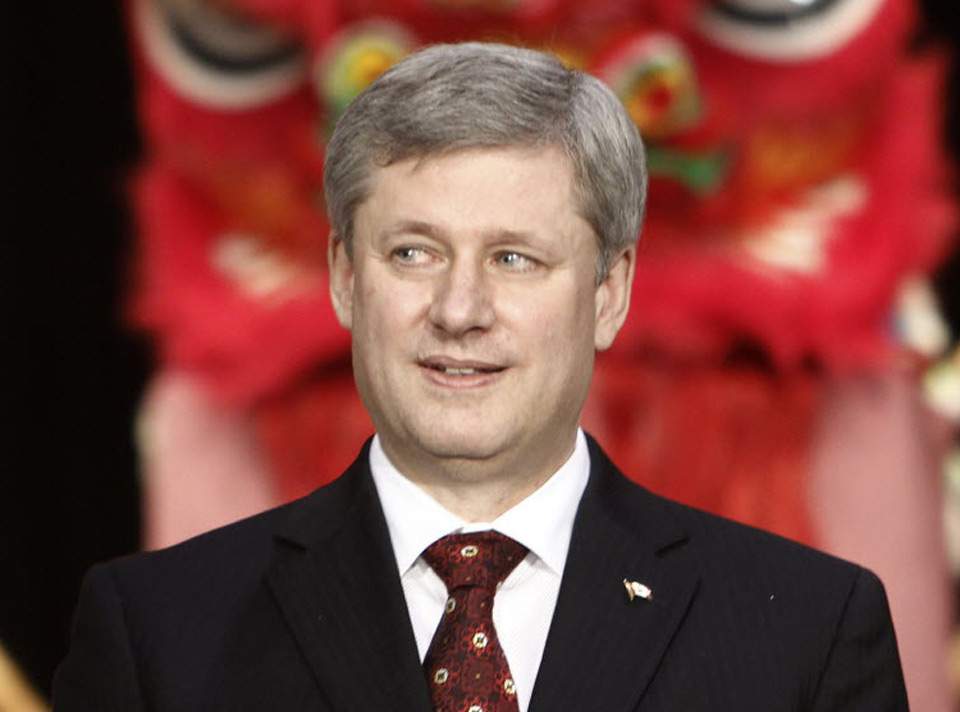
OTTAWA – Prime Minister Stephen Harper called for a co-ordinated international effort Thursday to halt "the grave danger" Iran is posing by developing nuclear capability and accused the regime in Tehran of committing "terrible rights abuses" on its people.
His strong comments came amid reports that Iran summoned Canada’s charge d’affaires in Tehran to demand a clear explanation from the Canadian government about recent revelations that former Canadian ambassador Ken Taylor was a "de facto" station chief for the Central Intelligence Agency during the Islamic revolution three decades ago.
An Iranian Foreign Ministry statement quoted on Iranian news sites said Taylor’s actions were "in violation of the Vienna Convention concerning diplomatic relations and, therefore, the Canadian government has to provide a clear explanation on the issue."
Foreign Affairs spokesmen in Ottawa declined to comment on grounds they do not speak about security and intelligence matters.
Iran celebrated the 31st anniversary of its revolution Thursday with massive pro-government rallies and a declaration the country is now a "nuclear state."
Iranian President Mahmoud Ahmadinejad made the claim before a huge Tehran crowd as he bragged Iran’s atomic scientists had this week enriched uranium to levels that put the country within reach of producing weapons-grade fuel.
He spoke as reports emerged that Ahmadinejad had, in a telephone call with Syrian President Bashar Assad, said any attempt by Israel to launch a military strike against Iran’s nuclear program should be met with Israel’s destruction.
Israel, which Ahmadinejad has infamously said should be "wiped off the map," has continued to say that all options remain open as the risk of Iran acquiring a nuclear bomb increases.
"If the Zionist regime … initiates a military operation, then it must be resisted with full force to put an end to it once and for all," Ahmadinejad told Assad on Wednesday evening, according to a report Thursday by IRIB, Iran’s state broadcaster.
Harper spoke in Vancouver after calling Russian President Vladimir Putin, who also condemned Iran. Harper took pains to distinguish between the government and the people of Iran.
"While we are concerned about the regime in Tehran, our solidarity, for Canadians, is with the great Iranian people who continue to suffer terrible rights abuses, and our solidarity is with them going forward," Harper said.
Earlier, Foreign Affairs Minister Lawrence Cannon pledged in Ottawa that the government would use its role as president of the G8 countries to seek methods, including possible further sanctions, to press Iran to halt its uranium enrichment program and to comply with monitoring and other oversight by the International Atomic Energy Agency.
"Canada and the international community will not accept the regime’s latest moves, which bring Iran considerably closer to possessing weapons-grade material," Cannon said. "Iran must suspend its enrichment activity and take immediate steps toward transparency and compliance."
He also called on China, which has powers of persuasion on Iran, to "step up to the plate and do something here."
Citing Iran’s nuclear development activity and the Iranian government’s treatment of protesters, Cannon accused Iran of "threatening global security and stifling democracy, blatant disregard of human rights and … threatening and irresponsible behaviour to regional and global stability."
The United Nations Security Council has imposed three rounds of sanctions on Iran since 2006, such as a ban of exports of nuclear-related goods and a travel ban on persons involved in Iran’s nuclear program.
Cannon predicted the matter would be on the agenda at a G8 foreign ministers meeting in Gatineau, Que., in late March. His news conference was with Finnish Foreign Minister Alexander Stubb who said the European Union will impose sanctions soon if Iran does not pull back. The difficulty was to find sanctions which hit the government but not the people.
Iran said it had begun enriching uranium to the 20 per cent level to provide material for a Tehran medical facility. Nuclear experts say that a nation with such a capability could move relatively quickly to producing uranium with the 90 per cent purity optimally sought for nuclear bomb manufacture.
In Washington on Thursday, White House spokesman Robert Gibbs said U.S. allies were "more united than they’ve ever been" behind efforts to make Iran rein in its nuclear program through the imposition of new UN Security Council sanctions.
This year’s celebration of the 1979 overthrow of the shah had taken on huge significance amid the reformist backlash that followed June’s flawed presidential election, which saw the Islamic regime declare Ahmadinejad returned to power.
But the massive security clampdown appeared to have blunted opposition hopes of embarrassing the regime on a day Iranian Supreme leader Ayatollah Ali Khamenei had pledged to deliver a "punch" that would leave protesters and the West "stunned."
Arrests, many during early morning raids, have been underway for weeks as part of an overall anti-dissident strategy that some analysts believe has been borrowed from the Chinese – whose Communist government is equally intolerant of dissent.
Still, the full picture of the level of dissent in the streets may not be known for days because Iranian authorities banned foreign journalists from covering any protests.



Comments
Want to discuss? Please read our Commenting Policy first.