

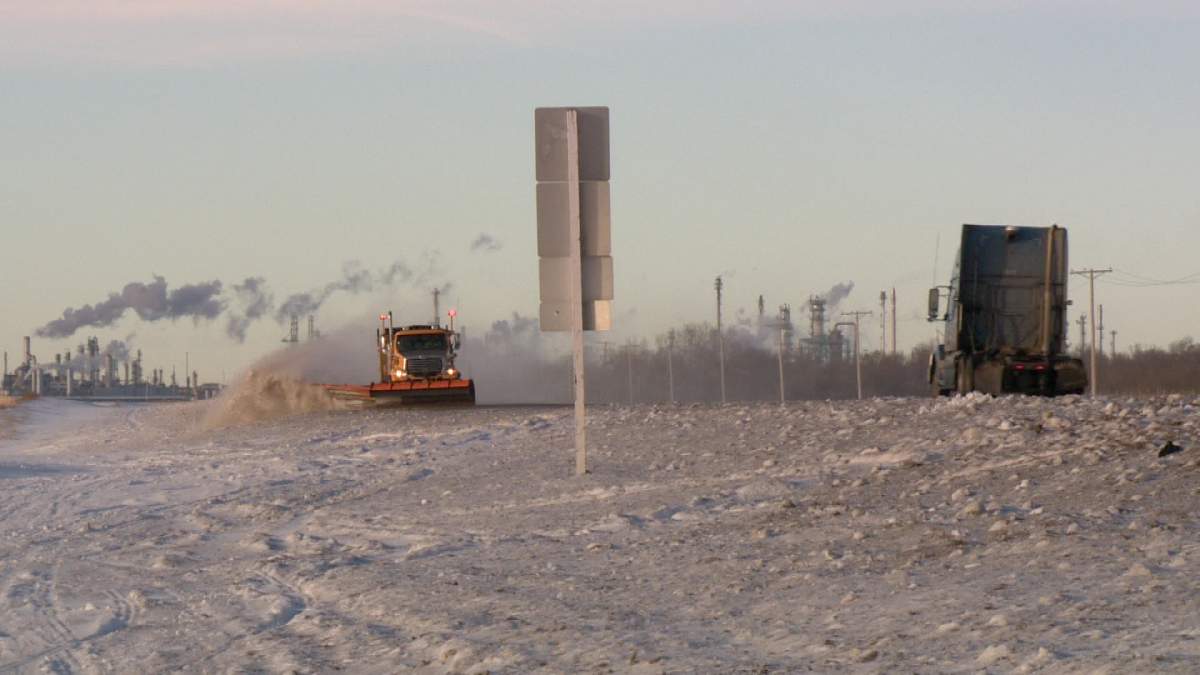
SASKATOON – The Saskatchewan Ministry of Highways and Infrastructure hopes the provinces’ motorists will respect their fleet of 300 snow plow trucks’ essential presence on the road.

Snow plows can create a whiteout condition in their wake, obscuring the vehicle from sight on the highway.
Motorists who approach a sudden whiteout should be aware it is likely a snow plow up ahead and to slow down and stay back.
Snow plows pull over every 10 kilometres or so to allow following vehicles the opportunity to pass.
“Every year we see motorists collide with snow plows – in fact 58 collisions since 1998 – and in the majority of cases it’s because the driver didn’t see the snow plow until it was too late,” said Don McMorris Minister of Highways and Infrastructure.
“We’re hoping to spread the message to ‘stay back and stay safe’ this winter so our operators can do their work to keep the roads clear so everyone can get home safe.”
Legislation passed in 2009, requires drivers to slow to 60 km/hr when passing a snow plow with warning lights flashing.
Winter maintenance is prioritized based on highway classification and traffic volumes (Annual Average Daily Traffic):
Level 1 – Inter-provincial routes and highways with greater than 1,500 AADT
- The highest priority is given to major routes such as Highways 1, 7, 10, 11, 16 and 39.
- Snow removal is initiated after 3 cm of snow has accumulated on the driving lanes.
- Snow is plowed from the driving lanes within six hours of the end of the storm.
- Ice treatment or assessment is initiated as soon as practical and within six hours after the storm.

Get daily National news
Level 2 – Highways with an AADT between 300 and 1,500
- Snow is plowed from the driving lanes within 12 hours after a storm ends.
- Ice treatment or assessment is initiated within 12 hours of the end of the storm.
- Snow removal commences when resources do not jeopardize Level 1 highways.
Level 3 – Highways with an AADT less than 300
- Snow removal commences when resources do not jeopardize Level 1 or Level 2 highways and should be plowed within 24 hours after the storm.
- Ice is treated or assessed within 24 hours of the end of the storm.
In very severe storms, equipment is pulled off the road for the operator’s safety and any motorists that may be on the highway.
Highway maintenance will not begin work if visibility is less than 200 meters. Equipment already in service may be removed when visibility is reduced to 100 metres.
Snow plow safety facts:
- Blading snow off the road creates a “mini blizzard” or snow zone next to and behind the plow.
- It is up to motorists to be cautious and drive safely in the Snow Zone.
- Watch for the black and yellow checkerboard patterns and flashing amber and red lights on the rear of the plow.
- Slow down and use caution when in the vicinity of snow plows on the highway.
- Plows must travel slower than regular traffic when pushing snow and spreading sand/salt.
- Maintain a safe distance and give the snow plow operator room to do thier job.
- Plows stop at all railway crossings.
The ministry is in the process of updating all plows with new technology and practices to make winter travel safer and ensuring snow and ice are removed quickly and efficiently.
Over 60 per cent of the Ministry’s snow plow fleet is equipped with state-of-the-art equipment.
Snow plow technological features:
- High-tech spreader control systems automatically adjust the amount of salt spread, which ensures a consistent and efficient application of material on the highway.
- An infrared pavement temperature sensor displays road temperatures, which helps operators determine how much salt and sand to apply.
- Highways are treated with a salt and corn or molasses based solution to help sand/salt stick to the road so that it’s less likely to blow off.
- Conveyor chains were replaced by an auger to moves the material in the box. This helps prevent corrosion of the vehicle, which means fewer repairs for corroded parts.
At temperatures below -6 degrees Celsius road salt loses its effectiveness.
Motorists can check the Highway Hotline website or call 1-888-335-7623 for provincial road conditions.
For the latest weather conditions, download the Skytracker app.


Comments
Want to discuss? Please read our Commenting Policy first.