


Watch the video above: Flash floods and landslides triggered by Tropical Storm Jangmi left at least 31 people dead and seven missing in the Philippines, including in areas still recovering from last year’s Typhoon Haiyan.

TORONTO – A tropical storm in the Philippines has left at least 29 people dead with another 10 declared as missing.
Jangmi — called Seniang locally — dumped heavy rains Monday on southern Mindanao Island, where floods destroyed bridges and highways, sending thousands of residents to evacuation centres. The storm then pushed its way through the eastern and central Philippine islands, where most of the deaths occurred Tuesday.
READ MORE: AirAsia jet overshoots runway in Philippines

Get breaking National news
Mayor Stephanie Uy-Tan said 12 people died when a landslide buried two vans and six houses near a mountainside highway in eastern Catbalogan City. She said voices could still be heard from one of the vans and rescue efforts are ongoing.
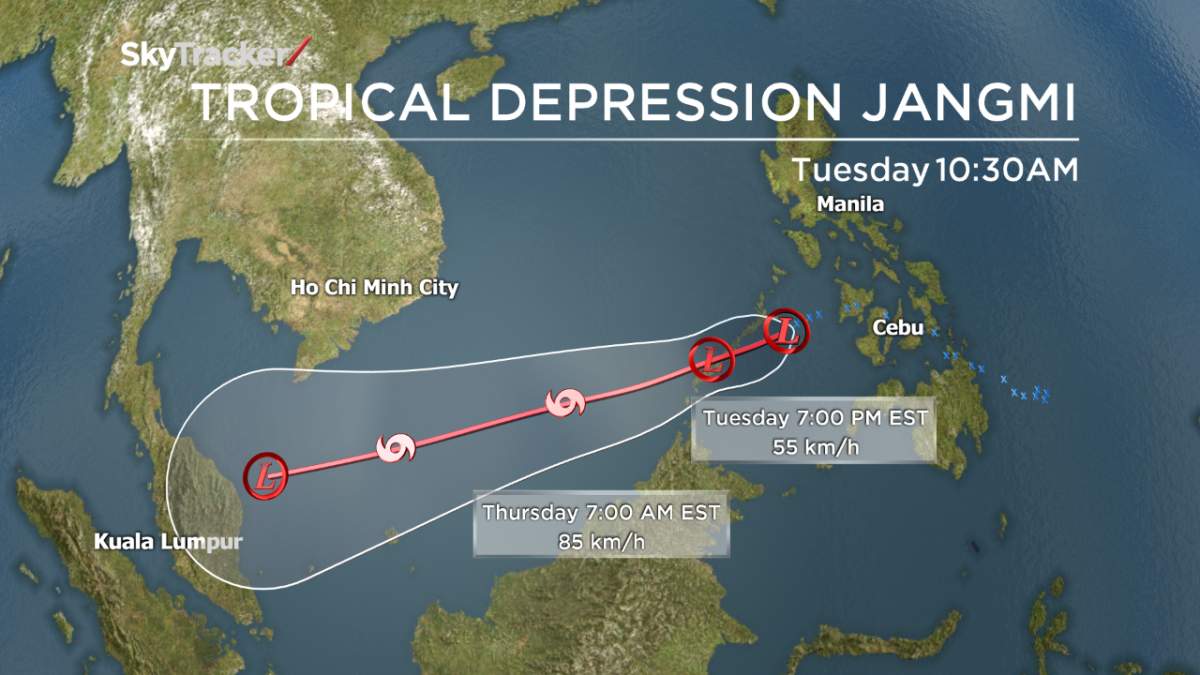
According to the Philippine Atmospheric, Geophysical and Astronomical Services Administration (PAGASA), there were storm warnings in effect for Luzon, Visayas and Mindanao on Tuesday as Jangmi, now a tropical depression, continued to move westward at 19 km/h.
READ MORE: Bodies recovered in Indonesian waters where AirAsia plane disappeared
On Tuesday, the storm, which had moved toward Puerto Princesa, was producing winds of 80 km/h and rainfall of about 7.5 to 15 mm per hour. PAGASA also warned residents that waves of up to five metres were possible and that residents in low-lying and mountainous areas could see flash floods and landslides.
–with files from The Associated Press




Comments
Want to discuss? Please read our Commenting Policy first.