

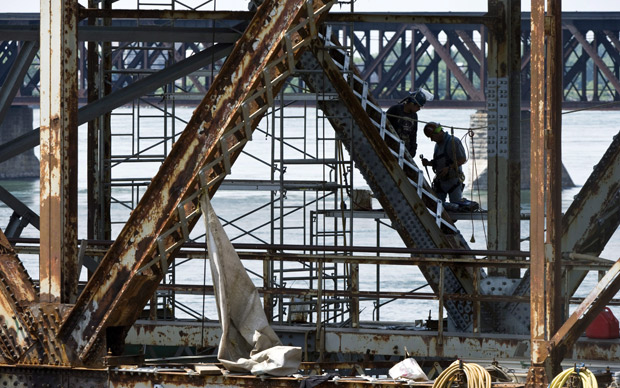
MONTREAL – The Mercier Bridge’s deterioration between 2008 and 2011 was monitored but officials did not notice the disrepair of the parts that required an emergency closing of the bridge this summer until late in that period, Transport Quebec officials acknowledged Monday.

They made the comments as they released long-awaited inspection reports for the span, half of which was built in 1930 and half of which was constructed in 1960.
The Transport Department’s website is to include, by the end of October, a section with inspection reports for the most important of Quebec’s 5,200 bridges, tunnels and overpasses. The information would also include height and load restrictions so truckers can plan their routes better, Transport Quebec officials said Monday.

Get breaking National news
Moreau said he, too, was “surprised” when he saw the extent of the rapid deterioration of the Mercier Bridge between 2008 and 2011.
But he said he has been reassured of the bridge’s safety by engineers in his department since he took over as transport minister less than two weeks ago.
“You have to see behind the rust,” Moreau said. “That’s the job of engineers.”
Moreau, who is not an engineer, added he has full confidence that he is being given sound advice.
He said a damning report leaked last week alleging corruption in Quebec’s construction industry and at Transport Quebec does not compromise the work of the department overall “because of some bad apples.”
Answering a reporter’s question about Mohawk workers’ involvement in painting the Mercier Bridge, Moreau said contract requirements for Mohawk workers who deal with the Mercier are just as stringent as for any other employees. Transport Quebec is planning to repaint the bridge.
A letter from the Dessau engineering firm dated Sept. 5 says: “The paint system (on the bridge) no longer offers adequate protection (and) the structure is deteriorating rapidly.”
Dessau engineer Christian Lemay recommends the bridge be repainted by December 2012.


Comments
Want to discuss? Please read our Commenting Policy first.