

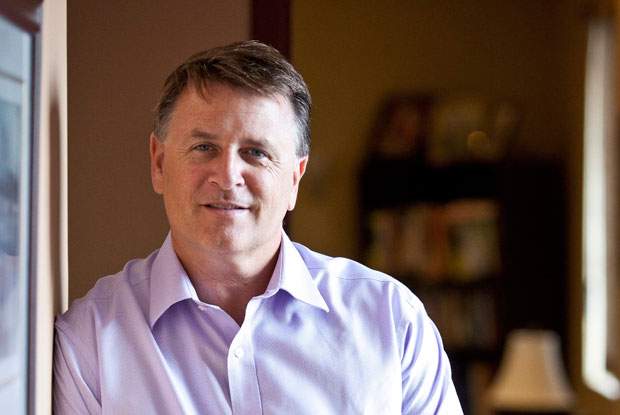
Financial planner David Chilton’s book, The Wealthy Barber, was released in 1989 and sold more than two million copies.
With the sequel, The Wealthy Barber Returns, now hitting bookshelves, he sat down with Globalnews.ca to discuss his book, the global economy and his spending habits.

Here is an edited transcript of the interview:
What prompted to you to write another Wealthy Barber book?
Four years ago, before the credit crisis, I got back involved in personal finance a lot more, both in speaking and looking at people’s personal finances. I know this sounds a bit corny but I got frustrated. I couldn’t believe how low savings were, even among my friends, and how much debt they had taken on and in what bad position their balance sheets were. I thought, “Okay let’s try it again.” It took me a while to come up with the right format.
When did you make the decision to do the book again?
I started writing it in 2009 but I aborted the first effort. I didn’t think it was the right angle. I didn’t think it was inviting enough to bring people in. Then, later that year I decided to write like I speak, and use my stage voice.
It took a tremendous amount of testing. I would write each chapter and literally test it with 30, 40 or 50 people until I got the feedback I was looking for – both in terms of positive reaction and also in terms of understanding. Then I would go on from there. It was a long process
The original book sold more than two million copies. What is your goal for this one?
I don’t even think that way. I mean, I had a goal of 10,000 for The Wealthy Barber (TWB). I have never thought of a number with this book. I just wanted to make the book the best it could be and just get it out there and see what happens.
What is your target audience for this book? Is there a certain demographic?
No. The first book was aimed at 20 to 45 years old. Fortunately for me, it was read by people of all ages. In fact, our biggest buying audience was 55, 65 and 70 year olds buying the book for their adult children.
This book has a wider target. It’s intended for everybody. There is a lot of humour in the book and it has a very different writing style. It was also fast-paced. One of my goals was to make it a book you could read in four hours. I clocked it to make sure that was possible.
I hope the book has a mass appeal. That is the challenge writing about finance. You have readers who are 17 and you have readers who are 72. You have people who are very knowledgeable about finance and people who are neophytes. You have people who are wealthy and people who are poor. Trying to appeal to all those demographics with common themes and messages is a tough task, which is why the testing of the manuscript is such an important part of the process.
You discuss the psychology behind spending in this book.
I wanted to tackle the spending angle much more aggressively than most financial planning books. They go out there and advise people to save 10 per cent – I was guilty of that too – instead of looking more deeply at why people spend so much. In this book, I try to tackle the question, “Why do we love spending so much?” from every angle — psychological, physiological and even societal pressures. A lot of research went into that. I tried to make it palatable and fun for people to read.
If a reader was to take one lesson from the book, what would it be?

Get daily National news
It’s always tough to break a book down into one lesson like that. You journalists love that kind thing, but it’s hard to do. Maybe the fundamental message is that living within your means is not the sacrifice it seems to be.
People think giving up today’s consumption to save for the future is a trade off. My argument is that people who plan for the future are happier in the present. They’re soothed by the fact that they have their future taken care of – and they’re not caught up in the race to consume.
I think all the consumption out there, the race to keep up, is causing stress for people instead of joy. I don’t think there is a strong link between what we’re consuming and our happiness. I try to make those points, but not in a new-age Oprah kind of way.
I’m a journalist and my neighbour is an investment banker. How do I stop myself from trying to keep up with him by buying a shiny new BMW and going into massive debt?
Well, that is something I talk about in the book – about how friends and the group you spend time with influences your spending tremendously. Keeping up the Joneses is no longer a problem, it’s an epidemic. It’s gone way beyond a conventional small problem.
One of the things I preach in the book is that you have to learn to say, “I can’t afford it.” It was the only chapter in the book that I wrote quickly. I knew exactly what I wanted to say. It’s the chapter that is going over the best. It’s a very simple principle.
You have to look worldwide, and look through history, and realize that all of us are living better lives than people did in the 1930s and 1940s and certainly in the 1800s. Look at our lives compared to people in Africa and other parts of the world. If you keep that perspective, you are less inclined to spend.
Do you really think that buying the Beamer is going to make you happy two months after you buy it? Look at habituation. You’ll get accustomed to what you own quickly; the buzz you get when you first buy an item doesn’t sustain itself very long.
Like your golf clubs…
Yes, like my golf clubs and most things I buy. I’m guilty of some of the problems I talk about in the book – but less so than most people. I live in an extremely humble home. I don’t need 3,000 square feet because 1,300 square feet will do. I even have a room that I never go in.
Does self-confidence play a role in spending habits?
Yes. A survey in the U.S. indicates that people who live in homes that are less than they can afford tend to be happier. I think you might be on to something; perhaps because these people were confident to begin with, they don’t feel they need to have a bigger home to show off, to keep up.
So, they don’t need the validation from others.
Yes, exactly. What we call conspicuous consumption is actually competitive consumption. So yes, I think that people who are confident probably tend to be better spenders.
Do you keep your credit cards in the freezer as a way to prevent yourself form over-spending as does one of the women you mention in your book?
No, but I seldom use my credit card. I have never been to an ATM in my entire life. I go to the bank and I get cash. I have done that my whole adult life. I find it’s a better way to control your spending. I have a finite amount of money in my wallet and when I spend it it’s gone. Because of that, I know exactly how much I am spending. I am pretty good at practicing what I preach. In general I am not a big spender and that comes easily because I get very little joy out of it.
It’s crazy how much Canadians are spending. It all ties back to lines of credit. It’s a constantly available source and is thought of as a second income. I’m amazed at how much debt so many Canadians are carrying. It’s at an all time high statistically. I’m worried that statistics don’t even paint an accurate picture of how bad it really is.
If we ever have a high-interest environment – which is unlikely at the moment because of the economic slowdown – we are really going to be pinched, no doubt about it.
What do you foresee happening in the future?
I think we’re going to get more knowledge. I used to get no questions about mutual funds, for example, and now I am besieged by these kinds of questions. You can see people are finally thinking they should take more control.
The next few years are going to be challenging on the investment front. This is not complex macro-economics. This is Grade 3 arithmetic. There is just too much debt in the world. When you look at the developed world in particular, and add up government debt and private debt relative to GDP and relative to income you go, “Holy smokes!” We’re at the end of a 30 year super-cycle of debt. We have all lived beyond our means publicly and privately — and we’re going to pay a price with muted growth.
It’s a fairly challenging time right now, which makes it more important to live within your means. Pay down your debt and start saving money because it is a tough investing arena.
Remember, I haven’t gone nuts here. I haven’t told people they should never have fun. In fact, I say in the book that if there are certain areas you are passionate about, it’s okay to over-spend there — but you have to make sacrifices elsewhere. You are still dealing with a finite resource – money and income.
This is not as big a sacrifice as you think. It’s going to make you happier.
Some people claim that to run a government debt is necessary.
There is no doubt. For a government, running a debt makes sense at certain times — during times of war, for example, or when we are in a down cycle. The government has to step in and do some spending.
British economist John Maynard Keynes advocated that. But he also advocated running surpluses during good times – and that is something that, in a democracy, is very challenging to achieve; governments are always focused on getting re-elected. The more they can spend, the more trouble we get in.
I don’t have any trouble with governments borrowing on occasion but I don’t think anyone can look at the situation and say we haven’t gone too far in the developed world. When you look at the levels of debt in countries like Italy, Greece, the U.S. and Japan, it’s crazy – even in Canada, where we think we’re in such good shape. If you take our federal debt and add in our provincial debt it’s very, very high.
We don’t have the same unfunded liability problem that the U.S. does, but we’re not in tremendous shape ourselves.


Comments
Want to discuss? Please read our Commenting Policy first.