

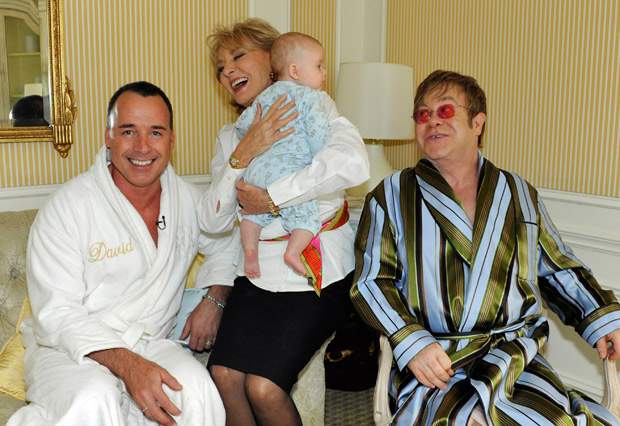
TORONTO – They may belt out their big hits on stage, but when entertaining their littlest fans at home it’s more likely that lullabies are on the set lists for both Bryan Adams and Elton John.
The Canadian rocker and British pop-rock legend are among the recent additions to the ranks of a distinct group of dads: men making their foray into fatherhood at a later age.
The 51-year-old Adams assumed the dad mantle with the birth of daughter Mirabella Bunny on April 22. Her mother is Alicia Grimaldi, co-founder of the Bryan Adams Foundation and personal assistant to the Vancouver native.
John, 64, and his Toronto-raised partner David Furnish, 48, welcomed their son Zachary Jackson Levon, who was delivered on Christmas Day via surrogate in California.
The new dads follow fellow celebrities like talk show host David Letterman and actor Chris Noth of "Sex and the City" fame who each fathered sons in their 50s. But seeing men become first-time dads at a later age is hardly a phenomenon exclusive to the A-list crowd.
Bill Templeman admits becoming a father wasn’t always front-of-mind. Among the close friendships developed with a number of guys about 10 to 15 years his junior, he recalled only one of them saying he really wanted to become a father.
"It was just so remote as a part of my life plan that I wanted to become a dad," he said in a phone interview from Peterborough, Ont. "It just didn’t occur to me that it was something that would be a big part of my life or that I wanted to do."
It was a different story after Templeman tied the knot. He said his wife knew at age 12 that one of the things on her bucket list was to become a mother. After marrying at 49, he became a first-time dad two years later. Now 67, he has two daughters, aged 15 and 12.
In a piece published in Maclean’s, he described parsing the "Deadly Arithmetic," calculating the ages he and his wife, Trudi, who is 15 years his junior, would be when their youngest child turned 21.
While admittedly afraid of dying too soon, Templeman said any concerns or self-consciousness about being an older first-time father didn’t occur to him.
"When I was out with them when they were really small, like when my oldest was five and the youngest was 1 1/2 or two… it did happen a few times that people would assume I was their grandfather. That was sort of funny."
Templeman said the hands-on work of raising kids and all the other responsibilities that come with parenting and maintaining a household can be both challenging and frustrating. But when it comes to his role as a father, he can’t imagine not doing it.
"I mind with helping of homework late at night when I want to sleep, but for the most part I don’t mind," he said. "It’s fine. In fact, it’s wonderful."
"I know these kids are going to pass out of my life in a few years and it’ll be just like I was with my parents: visit a couple of times a year and they’re off living their lives. And I want to savour it."
In Canada, the average age of men at the entry into fatherhood increased from 27.8 years in 1995 to 29.1 years in 2006, according to Statistics Canada. The increase follows the upward trend of women at the time of the birth of their first child.
The overall average age of Canadian fathers has also been on the rise, up to 41.6 years old in 2006 compared to 39.8 years in 1995.
Changes in the age of marriage and pursuit of higher education and careers could be among the factors shaping why men are becoming fathers at a later age, said Kerry Daly, dean of the college of social and applied human sciences at the University of Guelph.
"I think there’s just a longer period of extended adolescence that a lot of kids go through in terms of exploration and a variety of activities before they decide to settle into marriage and kids, and I think part of it is getting more established in jobs and economic conditions," said Daly, co-chair of the Father Involvement Research Alliance.
Daly said parenting is one of the main manifestations of generativity – a lifespan development theory describing the stage where individuals become adults and it becomes important for them to think of giving back to the next generation.
"It’s that opportunity or that stage in your life where you’re willing to sacrifice, give of your time and energy to be available to do things for your children as a fulfilling part of the next chapter of your development," he said.
"We often think about generativity as being the function of the transition to adulthood," he added. "But for men who are in their 30s or 40s … the fruit’s been on the vine for a while, so you could argue that there’s an even greater readiness on that front in terms of the willingness to provide that care to the next generation."
When Sean Sharp became a father at 43 to son Jonah, he had plenty of support from friends and family members who were in a similar position.
A good friend from Virginia had his first child at 40, and his second at 45. Sharp’s cousin had his first biological child at 48. His own father became a dad again to Sharp’s half-sister at 48.
"I think the general attitude I got was that so much of life had already sort of happened, that they’d done things already that being a parent was the focal point at that point when you’re older and you have a kid, this is the adventure," he said in a phone interview from Eugene, Ore.
"I’m not saying that’s not true for younger parents – I don’t want to imply that. But I think it’s maybe perhaps more focused as an older parent, at least for me. I’m very aware of the fact that I’ve done stuff now being with my family and having these kids is what I really really want to be doing."
He recorded an audio journal for his son during his 48-kilometre drive to work sharing his thoughts on life. For his daughter, Nora, now 1 1/2, he started writing her letters when she was born.
"It would have been very interesting to learn about what my parents were experiencing when I was a baby, I think, so that was sort of my motivation for that."
In the meantime, he’s focused on being a central presence in their lives. Part of that includes maintaining his physical fitness with the goal of being able to keep up with Jonah and Nora as they grow up.
"I feel strongly about trying to keep myself in good physical shape because as the kids get older and want to play and do stuff I want to be able to do that," said Sharp, who recently ran a 10K trail race.
"I like to hike and backpack, and I hope to be able to do some of that stuff with the kids as they get older as well."



Comments
Want to discuss? Please read our Commenting Policy first.