

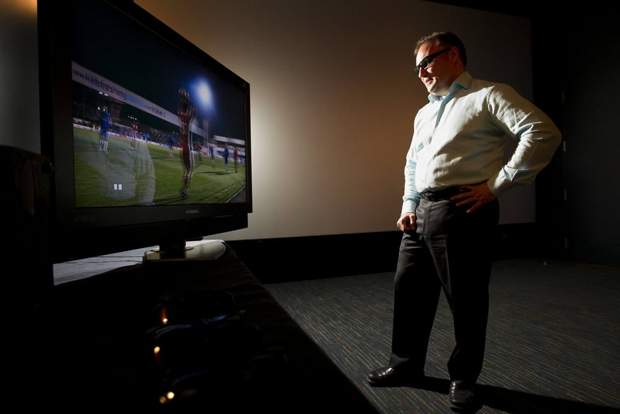
MONTREAL – When the World Cup of Soccer kicks off in June, thousands around the world will be able to watch it live in 3-D at local movie theatres, thanks to a Montreal company.
For Sensio Technologies Inc., founded in 1999, landing soccer’s World Cup is a huge boost for the company, because it’s the world’s most-watched sporting event.
The event will be broadcast live in 3-D in more than 1,000 theatres in at least 26 countries, possibly several in Montreal.
Louis Rousseau, the company’s vice-president of marketing and communications would not reveal how lucrative the World Cup contract is to the company, but said the most important effect of the deal will be to boost Sensio’s profile.
The company is pushing for its technology to replace open-source technology in future 3-D television screens. It has already convinced giant screen-maker Vizio to use its technology, and is in discussion with Sony and Samsung to also adopt its technology.
The technology is already used in Ubisoft’s video game based on the motion picture Avatar, while theatre chains, including Canada’s Empire Theatres, have broadcast live events such as the NBA All-Star Game skills competition.
In September, ESPN ran a series of tests of Sensio’s technology by broadcasting an NCAA football game between USC and Ohio State. ESPN telecast the event to fans at the Galen Center on the USC campus and to several movie theatres at which Sensio’s decoding technology allowed fans and ESPN executives to watch the game on the big screen and on flat-screen televisions.
Rousseau said Sensio technology’s advantage is the patented way that it breaks up an image and then reconstructs it. It allows broadcasters to combine the left eye and right eye images necessary for 3-D programming into a single signal, then encode it in such a way that it can be transmitted through the current broadcast infrastructure for 2D television, then decoded and formatted for different types of displays using Sensio’s technology once it reaches the consumer.
With the 3-D transition on the horizon and a handful of 3-D television channels launching in the United States this year, much of the attention has been focused on TV manufacturers such as Sony Corp. and Panasonic Corp., and content producers, including Toronto’s Imax Corp.
But Sensio and other companies that provide key pieces of technology that make living room 3-D a reality appear poised for growth.
Sensio isn’t involved in building special 3-D televisions or 3-D cameras; rather the company licenses its software and computer code to broadcasters, cinema chains, video game
companies and consumer electronics makers, which are then able to transmit 3-D signals along 2D channels without losing resolution.
While Sensio’s stock price is down significantly from its peak of $3.99 in December, shares of the company are still trading at $2.29 as of Friday, which afford the company a market cap of $118 million despite revenues in the most recent quarter that totalled all of $24,018.
Major electronics retailers in Canada such as Future Shop and Best Buy have begun selling 3-D TVs, while major Hollywood blockbusters such as James Cameron’s Avatar and Tim Burton’s Alice in Wonderland are helping to spur greater demand for 3-D content from consumers.
Imax reported result Thursday that far outpaced analyst expectations as Avatar and Alice and Wonderland played to big crowds.
While company co-founder Nicholas Routhier said he expects 3-D to grow in popularity throughout 2010, he expects mass adoption of the technology is still a few years out.
"Technologically, these things have been ready for quite a while," Routhier said. "The difference here is that the content providers are saying they are actually going to provide content. . . . If I go with the more conservative view, and I think it’s important to do it, gradually within the next five years it will be everywhere."
Montreal Gazette and Financial Post



Comments
Want to discuss? Please read our Commenting Policy first.