


While the organizers of two global sporting events wait for clarity on if or how Russia will enforce its anti-gay propaganda law on outspoken Olympic competitors, the International Olympic Committee (IOC) and FIFA may have just gotten a taste of how athletes might address the issue on an international stage.

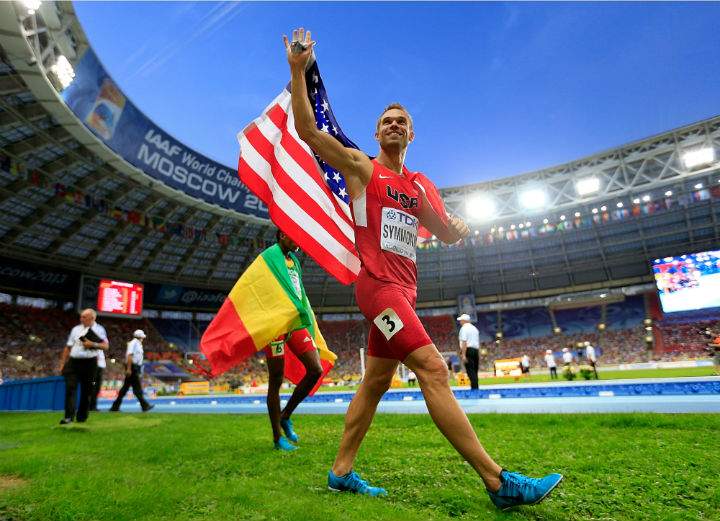
After taking the silver medal at the International Association of Athletics Federations (IAAF) World Championships, underway in Moscow at the moment, runner Nick Symmonds addressed the issue of gay rights in an interview after his 800-metre race.
“Whether you’re gay, straight, black, white, we all deserve the same rights. If there’s anything I can do to champion the cause and further it, I will, shy of getting arrested,” Symmonds said at Luzhniki stadium, according to Russia’s Ria Novosti.
The Russian law allows police to slap fines on people and organizations who promote “non-traditional relationships.” Violators of the law, passed in the Duma in June, could also face imprisonment.
Read more: Gay men who fled Russia seeking refuge in Vancouver
The law applies to foreign citizens as well, with punishment including fines up to 100,000 rubles ($3,126 CAD), up to 15 days in prison, deportation and denial of re-entry into Russia.
Read more: It’s okay to be gay at the Olympics as long as you don’t talk about it: Russia
The 29-year-old athlete had previously said he wouldn’t say anything about his disapproval of the anti-gay law while competing in Russia.
But in dedicating the medal to lesbian, gay, bisexual and transgender friends, Symmonds reportedly said “all humans deserve equality as however God made them.”
“It’s just such a slap in the face I couldn’t sit back and watch it happen to some of my friends,” Symmonds said in the interview.

Get breaking National news
The runner has been a proponent of LGBT rights and appeared in an ad for the NOH8 campaign.
Ahead of the event, IAAF President Lamine Diack said the anti-gay law is “no problem whatsoever.”
“Russia has their laws. Each athlete can have their own private life, so we won’t call upon people about this and that,” Diack – also a member of the IOC – told reporters last week.
But, the organization’s Deputy General Secretary Nick Davies said he would like to see Russia “reconsider their views instead of just living in an isolated society.”


The anti-gay propaganda law has drawn international condemnation, particularly after Russian Sports Minister Vitaly Murtko said it would be enforced during the 2014 Olympic Winter Games, to be held in Sochi from Feb. 7 to Feb. 23.
There have been calls for a boycott of the games, as well as an online petition lobbying to move the games to 2010 host city Vancouver.
The IOC has said moving the games would not be possible.
WATCH: Olympic gold medalist Jon Montgomery discusses the ongoing anti-gay controversy in Russia and its impact on the Sochi games and if he would support an Olympic boycott.
The IOC as well as FIFA, which will hold the 2018 World Cup in Russia, have asked the government for clarifications on the law.
Russia’s Interior Ministry addressed the issue on Monday, saying the law is not anti-gay and that the government does not have an issue with same-sex relationships.
With files from The Associated Press


Comments
Want to discuss? Please read our Commenting Policy first.