


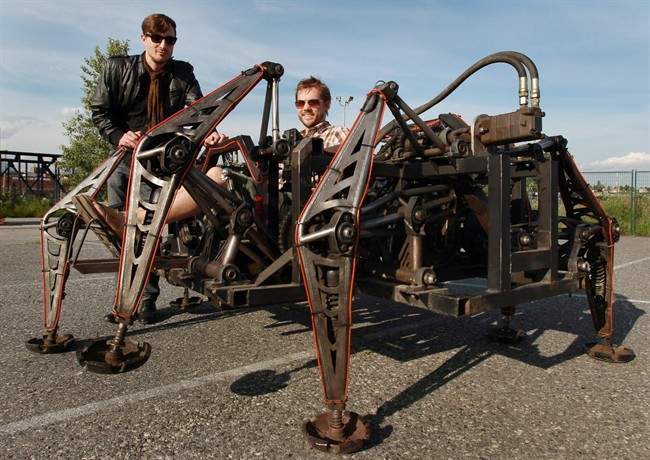
VANCOUVER – A growing community of people is living by the philosophy that if it can be dreamt, it can most certainly be built.

Ideas that might be deemed whimsical, inane or impossible by less ambitious folk are being nurtured, shared and created by this fast-growing movement.
Makers and do-it-yourselfers are people who bring their ideas to life. And with the power and connectivity of the Internet, everything – from charging an iPod with an onion to building digital TV coat hanger antennas – really does seem possible.
“It’s about the ethos of challenging yourself to do things that you otherwise wouldn’t,” said Dallas Luther, a Vancouver-based props builder and member of the maker movement.
“These skills are really accessible and they’ve never been more accessible, with the Internet. We’re encouraging people to engage with their innate creative abilities.”
Maker projects can range from common hobbies, like crocheting or mosaics, to the more niche, like kinetic sculptures or “c and c” – computer and numerical controlled machines that are pre-programmed to cut or build specific projects. Makers are also known to modify or customize already manufactured devices, like remote controls or espresso machines.

Get breaking National news
The moniker “maker” stems from Maker Magazine, a publication devoted to the art of making things. Founded in 2005, it quickly garnered a strong following across North America. From knitted crafts to homemade robots, Maker walks its readers through each project in a straightforward and accessible manner.
In 2006, the magazine launched Maker Faire, in San Mateo, Calif., a large-scale event meant to bring its readership and their ideas together. It’s since expanded to Detroit and New York.
On June 25-26, Vancouver will host Mini Makerfaire, a place for the city’s makers to swap, marvel and, of course, make.
Co-organized by Luther, the two-day event is a science fair on steroids, a rallying point of panels, exhibits, workshops and displays all devoted to the art of doing-it-yourself.
The range of activities and demonstrations reflects the wide spectrum of interests throughout the maker communities. Some will come to teach or learn a new skill, like making bacon from scratch or building a model airplane, while others will attend to showcase their (often head-scratching) creations. The Playa Time Project, for example, is a six-metre clock tower run by a giant hamster wheel.
“All you need is curiosity and will,” said Jonathan Tippett, who will exhibit his art project Prosthesis, a wearable walking machine, at Mini Makerfaire. “If you have even the vaguest inkling or interest or curiosity for making anything, there’s an entry point, which is facilitated uniquely by where the maker community has gotten to now.”
Organizers are hoping to bring together people from different disciplines, who are looking to collaborate on even more imaginative projects.
Kim Werker, who’s written several books on crocheting and runs a craft workshop called Mighty Ugly, said she’ll be exhibiting at Mini Makerfaire as a way to reach out to people with a different skill set. Her ultimate goal is to bring her crocheted dolls to life.
“I’d love to team up with someone from the electronics side of things and be able to make those dolls move, or react to their environment,” she said. “I could learn that stuff on my own, but I could learn it better and have more fun by learning it from someone who knows.”
For those coming to the Mini Makerfaire with no obvious skill set, talent or ambition, Werker promises it will be far from boring.
“It will be a spectacle like none you’ve ever seen before,” she said. “The kind of spectacle that happens when creative people come together. The variety of things you’ll see there will … delight you for at least an afternoon.”


Comments
Want to discuss? Please read our Commenting Policy first.