

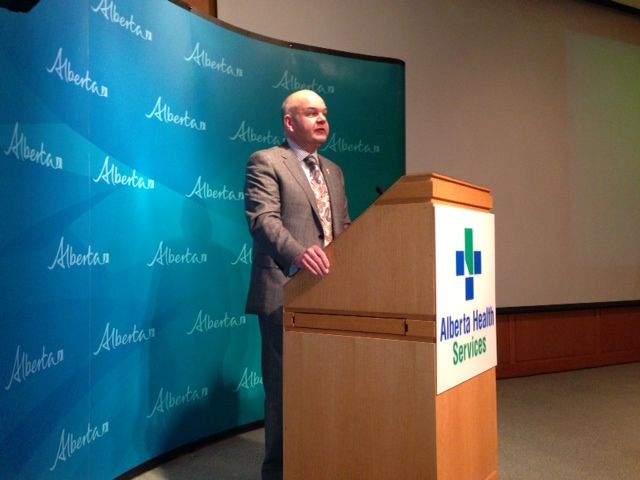
EDMONTON – The Alberta government is claiming success in its campaign to lower generic drug costs, even though just a small percentage of the medications have so far met the province’s new pricing standard.

Health Minister Fred Horne said Wednesday his ministry will continue to push to get prices down further but the government is still on track to see about $80 million in savings this year.
“I’m really pleased with what we have achieved, but we are by no means stopping here,” Horne said. “We need to keep pursuing greater savings.”
The province announced in its March 7 budget that it would demand the lowest prices in Canada for generic drugs at 18 per cent of brand name rates — down from 35 per cent — and set a deadline of May 1 for suppliers to meet that standard. Negotiations then commenced over several weeks, as generic drug manufacturers determined whether they would agree to sell at the demanded rate or offer different prices.
The new Alberta drug price list released Wednesday shows a large number of medications have come down in price, though at a variety of rates. Most did not fall as much as the government wanted.
For example, while anti-psychotic medication Olanzapine decreased to $1.78 per tablet from $2.70, blood-pressure drug Ramipril fell only slightly to 26 cents per tablet from 29 cents.
“This is a good move in the right direction but there is ground left to be covered,” said Michael Law, a pharmaceutical policy researcher at the University of British Columbia. “I think Alberta and other Canadian provinces should be looking at ways at getting these prices more appropriate than they are.”
The Alberta government covers almost 4,600 different drugs, of which 2,800 are considered “interchangeable” generic medications that are available from more than one supplier.
Among these generics, about 2,150 came down in price, about 535 stayed the same and 115 increased in price, the province said.
However, only about 80 drugs dropped to around the 18-per-cent rate the government was seeking. Far more came in at around 25 per cent of brand name rates — the price standard that is applied in Ontario. The trend indicates drug companies are willing to bring Alberta prices on par with Ontario, but are so far resistant to going lower.
One example is the drug Citalopram, the generic version of the popular anti-depressant drug Celexa. The Alberta price has been lowered from 46 cents per tablet to 33 cents, the same rate Ontario pays.
Horne said that of the many generics that did not come down to the 18-per-cent rate, the vast majority were granted a four-month “conditional exception.” This means Alberta will pay the higher price until Aug. 30, but in the meantime will push the companies to prove why they can’t lower costs further.

Get weekly health news
“What’s disappointing is the very small number that were actually quoted at 18 per cent, but that’s not unexpected,” Horne said. “Companies are going to request exceptions to prices from our government, but in this case there were so many that requested exceptions, we’re going to be asking for more information.
“It does appear there are some things we need to look into further. Our goal is still to get to the 18 per cent. It’s not unrealistic.”
Most of the drugs the province covers are made by multiple generic suppliers, in some cases by up to 12 different companies.
Horne said that when the latest rates came in, the province noticed a concerning pattern. For several of the drugs, multiple companies quoted the exactly the same price, raising questions of potential collusion among suppliers that are supposed to be competing.
“I don’t want to speculate, but I can tell you there are actually many, many of those where they came in at exactly the same price — in some cases for six manufacturers and in some cases there are as many as 12,” Horne said. “It is cause for concern because this is supposed to be a competitive environment.”
Jim Keon, president of the Canadian Pharmaceutical Association, said he is confident no collusion is occurring. He said manufacturers may be submitting the same price for some drugs because they are using the regulated rate from Ontario.
Keon said his organization and Alberta Health officials are expected to get together later this spring and summer to talk about pricing and whether there are other ways to lower costs. However, he said it’s unclear how much more room generic manufacturers have to further lower prices, which are under pressure all over Canada.
“Alberta has already achieved massive savings over what they had before.”
However, Law said drug manufacturers still have a long way to go to match prices offered in other countries such as the United States and New Zealand.
“If you compare what we pay in Canada for generics, even if it was at 18 per cent, our prices are dramatically higher than what you see in other countries,” he said. “The difference in other countries is they actually use competition. If all the provinces were to work together and say we’re going get firms to compete against one another to supply different regions of Canada, that would carry a level of clout.”
Horne said that is exactly what he hopes will happen. He said lower prices result in a cost savings for government-sponsored drug programs, but the prices also apply to employer-covered plans and patients who pay for prescriptions out of pocket.
There has been some opposition in Alberta to the government’s move.
The Wildrose has argued the government’s push for lower prices has disrupted the market to the point that some drug manufacturers are pushing back by raising the rates of medications for which they are the lone supplier. This could result in some patients paying more for prescriptions, they say.
Horne acknowledged the province has little choice but to pay the higher rates in such cases because patients still need the medications; however, he said this is happening for a relatively small number of drugs.
Pharmacists have also targeted the lower pricing mandate for threatening a source of their income.
That’s because many pharmacists have arranged special volume deals with drug suppliers, who pay back a rebate worth about 40 to 50 per cent of the drug costs. In basic terms, if a pharmacy buys enough of a certain kind of drug that costs $1 per tablet, the supplier gives them back up to 50 cents.
But if drug suppliers have to sell product at just 18 per cent of brand name rates, they can’t afford to offer the same kind of rebates, pharmacists say.
————
The story of one pill’s cost
Drug: Citalopram, a commonly used anti-depressant. It is the generic version of the brand-name drug Celexa.
Step 1: The province negotiates with suppliers on a price for Citalopram, which currently stands at 33.2 cents for a 20 mg tablet. That’s down from last month’s rate of 46 cents.
Step 2: Pharmacies arrange to buy the drug from suppliers at that price. For example, a pharmacy might by 1,000 tablets, which would cost $332.
Step 3: A patient gets the prescription filled at the pharmacy, usually paying a portion of the cost. How much they pay depends on the type of drug plan they have. Seniors, for example, pay 30 per cent of the cost of a prescription up to a maximum of $25. If a senior was prescribed 100 tablets of Citalopram, they would pay $9.96 of the $33.20 cost.
Step 4: The pharmacist bills the provincially funded Alberta Blue Cross for the remainder of the cost, and also bills $10.93 as a dispensing fee.
As an additional stream of revenue, many pharmacists have also arranged special volume deals with drug suppliers, who pay back an “allowance” worth about 40 to 50 per cent of the drug costs. If a pharmacy buys enough of a certain kind of drug that costs $1 per tablet, the supplier gives them back up to 50 cents. Pharmacists say this income is being squeezed, because if suppliers are forced to adhere to the province’s new lower prices, they won’t have any room to provide allowances.




Comments
Want to discuss? Please read our Commenting Policy first.