

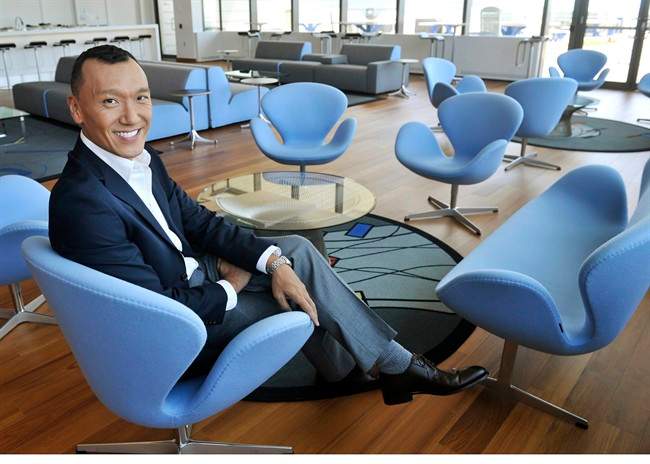
TORONTO – With appearances on everything from morning shows to “Gossip Girl,” Joe Zee is among the rare top figures in fashion media with a familiar face and presence well beyond style circles.

The affable homegrown style guru who serves as creative director of Elle Magazine said it’s not uncommon for people to approach him on the subway or even gym locker rooms asking for advice.
While Zee finds it “surreal” that people know his name, he relishes the chance meetings and interactions with those outside the fashion realm.
“I don’t mind,” he said in a recent interview.
“I think if I actually inspire people to want to ask questions and feel like they could grow from it, I don’t mind at all. I think that’s all part of what I do.”
The Toronto-raised Zee was a self-described “fashion-obsessed crazy kid” from the beginning. He recalled time spent between periods at his North York high school sitting with a stack of fashion magazines he’d pore through from cover to cover.
“I loved that fashion could change forms so much and fashion could be an idea,” he said. “It was a painting, it was an expression, it was a mood, it was so many different things.”
Zee started his career at Allure Magazine and served as fashion editor at W Magazine. He has also been a sought-after stylist, from print and TV campaigns to photo shoots with A-listers like Jennifer Lopez, and been featured on reality shows “Stylista” and “The City.”
He is bringing his no-nonsense approach and style savvy as a fashion godfather to struggling designers in the series “All on the Line,” which premieres Tuesday at 8 p.m. ET on Sundance Channel.

Get breaking National news
Zee works with designers who have encountered bumps in their journey to stay afloat financially and remain creatively relevant. In addition to dispensing advice, he brings in industry heavy-hitters, including designers and buyers, all aimed at helping get their labels back on track.
The debut episode features Liquica, a designer, and Andrei, her husband and financial partner. What started as an initial $3,000 seed investment into the line, Radenroro, has ballooned to more than $300,000 – and little to show for it. After several seasons, the couple decides to make a final attempt to keep the line alive.
It doesn’t take long for Zee to deduce one of their key problems: the failure of the line to leave an impression and produce clothes that are memorable.
“This industry is unforgiving. It’s very hard,” he said. “Every season you have to reinvent yourself. Every season you have to re-prove yourself to the world, to the retailers, to the business that you can do it.”
“A lot of people that you think have a successful business in actuality don’t because it’s just a rat wheel of trying to get this business going.”
Zee said a problem among some designers featured on the series is a feeling they have to tailor their creations toward what stores or customers want.
“You have to be true to yourself in order to sort of get through the glut of what’s going on out there. You have to be genuine. And without that level of authenticity in the work that you do, no one will care,” he said.
“If you just design for what you think the store will want, they won’t want it. But if you design for what you believe in, maybe they might want it.”
Zee said a key thing he advises designers to do is to have a strong voice, vision and point of view, something that has been the trademarks of other industry successes like American fashion heavyweights Marc Jacobs, Michael Kors, Donna Karan, Ralph Lauren and Tom Ford.
“No matter how crowded the market is … no matter how hard something is, if you’re good you’ll rise to the top – but you’ve got to be true to what you do,” Zee said.
For any designer looking to expand, Zee said it’s critical to have a firm grasp of the business side of the industry.
“It’s not an industry anymore today where you can just sit and say, ‘I’m going to be creative. I’m a really good sewer. I’m a really good sketcher.’ That doesn’t cut it anymore,” he said bluntly. “Today, you’ve got to understand expansion, you’ve got to understand business.”
“It’s great that you want to grow, but can you manufacture? Can you ship overseas? Can you actually do it? What needs are you serving outside of your immediate circle? And they’ve got to understand all those things.”
At the end of each episode, there is an update posted on how the designers have progressed. Zee said he would love the chance to do a recap after a year to see where people are with their businesses.
He continues to keep in touch with the designers long after the cameras have stopped rolling, and still offers help where time permits.
As for his future personal pursuits and endeavours, he admits he has a “huge bucket list.” But for now, he is content to seize on opportunities as they present themselves.
“I stop setting paths for myself because I think it’s more interesting to sort of see where life takes you.”


Comments
Want to discuss? Please read our Commenting Policy first.